The 3-Step Method
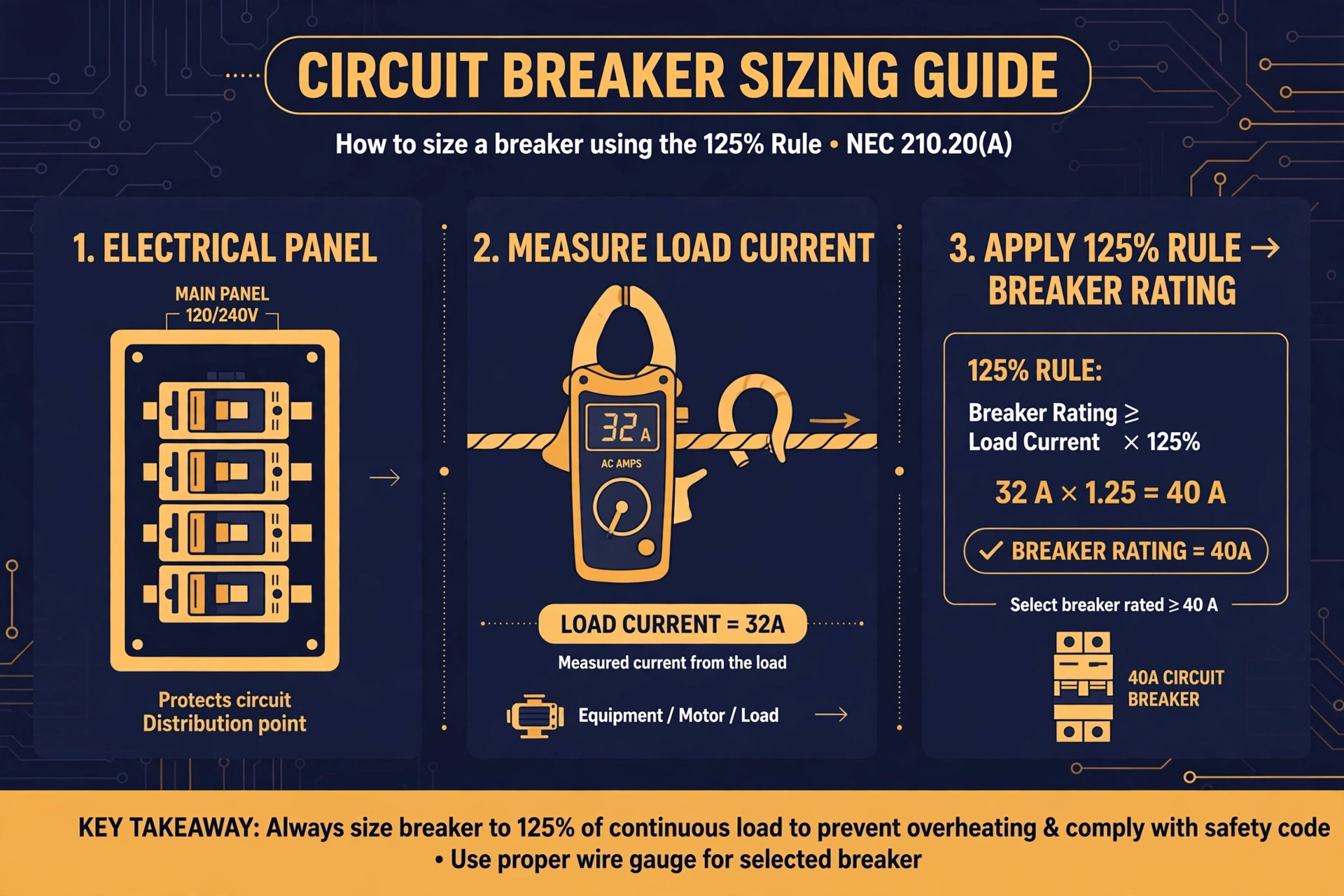
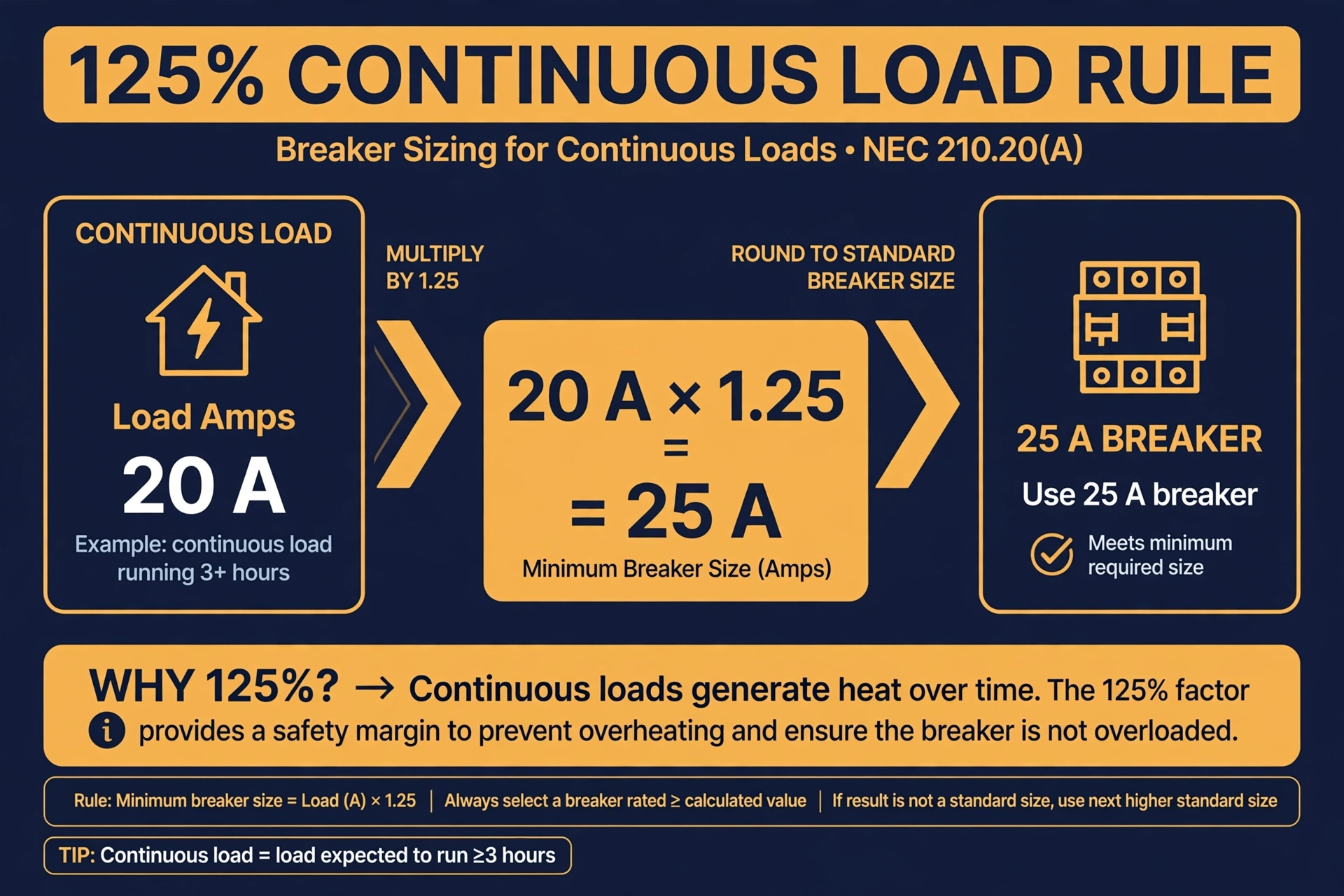
1) Convert kW to amps: single-phase I = kW×1000 ÷ (V×PF); three-phase I = kW×1000 ÷ (1.732×V×PF). 2) Multiply by 1.25 for continuous loads. 3) Round up to the next standard breaker size.
Quick Reference (230 V Single-Phase, PF 1)
| Load | Amps | ×1.25 | Breaker |
|---|---|---|---|
| 2 kW | 8.7 A | 10.9 A | 16 A |
| 3 kW | 13.0 A | 16.3 A | 20 A |
| 5 kW | 21.7 A | 27.2 A | 32 A |
| 7 kW | 30.4 A | 38.0 A | 40 A |
| 9 kW | 39.1 A | 48.9 A | 50 A |
Quick Reference (400 V Three-Phase, PF 0.85)
| Load | Amps | ×1.25 | Breaker |
|---|---|---|---|
| 5 kW | 8.5 A | 10.6 A | 16 A |
| 10 kW | 17.0 A | 21.2 A | 25 A |
| 20 kW | 34.0 A | 42.5 A | 50 A |
| 30 kW | 51.0 A | 63.7 A | 80 A |
Remember
The breaker protects the wire — always confirm the cable is rated for the breaker size you select.
Continuous vs Non-Continuous Loads
Electrical codes treat loads differently based on duration. A continuous load runs for 3 hours or more — water heaters, lighting circuits, EV chargers. A non-continuous load is everything else: a kettle, a power drill, a microwave. The distinction matters because heat builds up in breakers and wires over time.
For continuous loads, size the breaker at 125% of the load current (equivalently, load the breaker to only 80%). A 5.5 kW water heater at 230 V draws 23.9 A; × 1.25 = 29.9 A, so you need a 32 A breaker. For a non-continuous load of the same current, the next standard size above 23.9 A — a 25 A breaker — is acceptable, though many electricians still apply the 125% rule for margin.
When in doubt, treat the load as continuous. The cost difference between a 25 A and 32 A breaker is trivial; the safety margin is not.
Standard Breaker Sizes You’ll Actually Find
Breakers come in standard ratings, and you always round up — never down. Common IEC sizes: 6, 10, 16, 20, 25, 32, 40, 50, 63, 80, 100, and 125 A. (North American panels use 15, 20, 30, 40, 50, 60 A, among others.) If your calculation says 27.2 A, the answer is a 32 A breaker — there is no 28 A breaker, and a 25 A would nuisance-trip.
Match the breaker to the wire, not just the load: the breaker’s job is protecting the cable. A 32 A breaker on cable rated for only 20 A is a fire hazard, no matter what the load calculation says. Always verify the cable’s current rating meets or exceeds the breaker rating.
Three-Phase Worked Example
An 18 kW three-phase load at 400 V, power factor 0.85: first convert to amps — I = 18,000 ÷ (1.732 × 400 × 0.85) = 30.6 A. For a continuous industrial load, apply the 125% rule: 30.6 × 1.25 = 38.2 A. The next standard size up is a 40 A three-pole breaker.
Note the “three-pole” part: three-phase loads need a breaker that disconnects all three phases together. A 40 A single-pole breaker is a completely different device — always specify three-pole (3P) for three-phase circuits.