Sizing a cable for a motor feels intimidating the first time, but it is really three steps: find the current, add margin, pick the cable. Here is the whole process.
Step 1: Find the full-load current
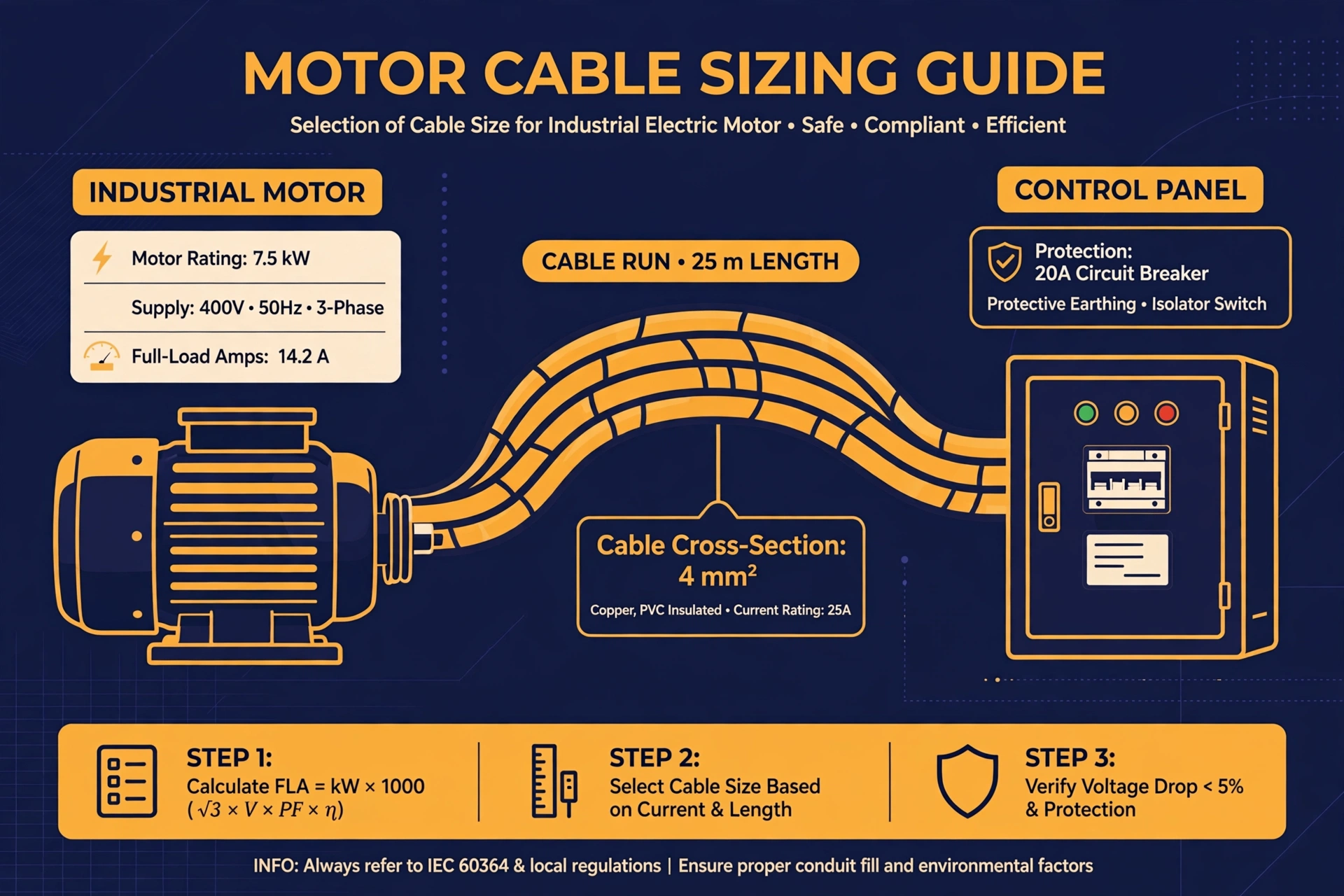
Read the motor nameplate — it lists rated power (kW), voltage, and often the full-load amps directly. No nameplate? Calculate it: for a three-phase motor, amps = (kW × 1000) ÷ (1.732 × volts × power factor × efficiency). A typical 7.5 kW, 400 V motor at PF 0.85 and 90% efficiency draws about 14.2 A. Our motor calculator does this in one step.
Step 2: Add the safety margin
Size the cable for at least 125% of the full-load current — this is standard practice in most electrical codes and covers motor starting currents and warm environments. Our 14.2 A motor needs cable rated for at least 17.75 A.
Step 3: Pick the cable and check the run
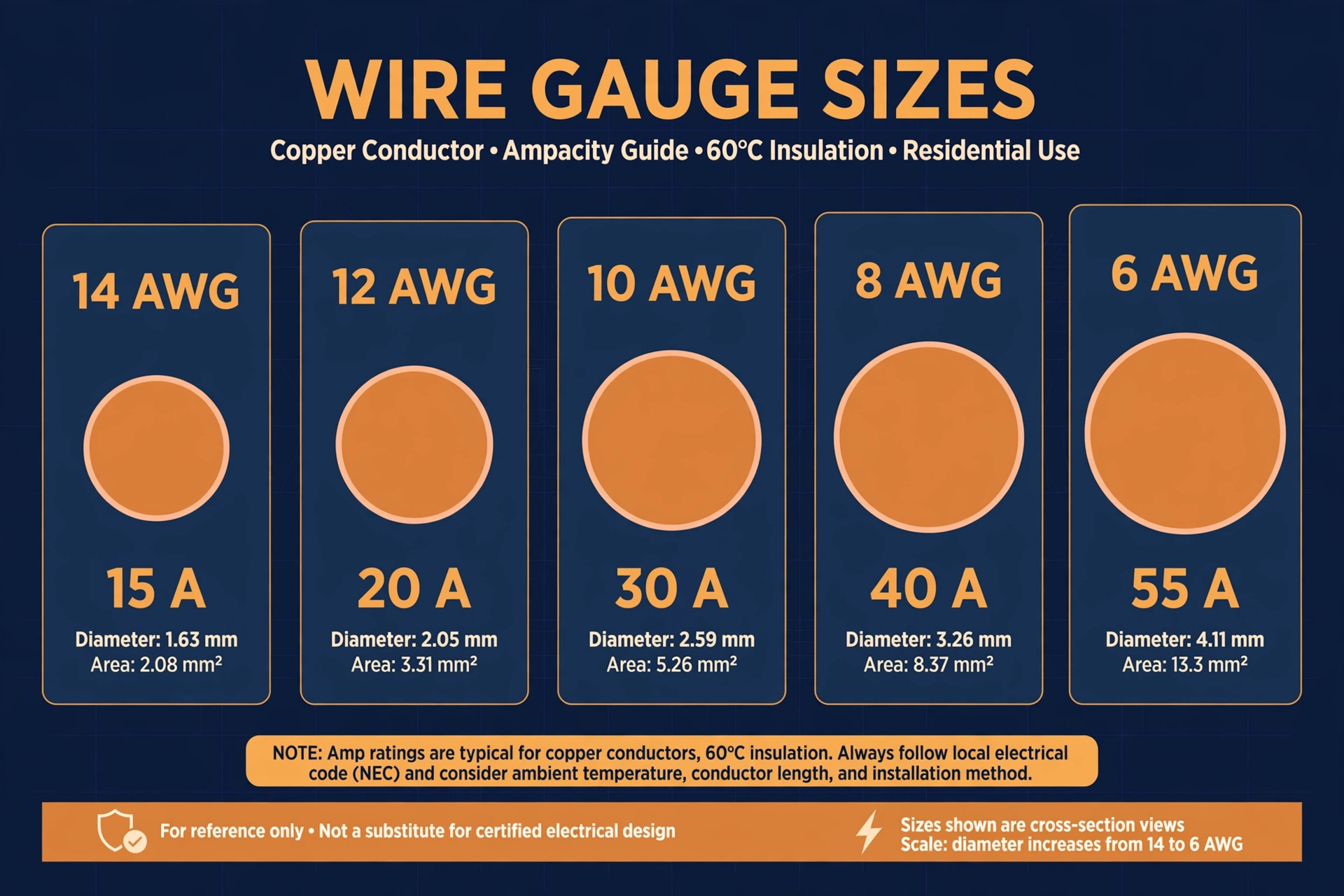
Look up the current rating in your cable manufacturer’s table (ratings vary by insulation and installation method — conduit, tray, or buried). Then check voltage drop: for long runs, you may need to go one size up even if the current rating is fine. As a rough guide, keep voltage drop under 5% from supply to motor.
When to call a professional
This covers straightforward cases. Star-delta starters, variable-frequency drives, explosive atmospheres, and anything above 1000 V deserve a licensed engineer. The math gets you oriented; it does not replace one.
Reading a Motor Nameplate Like a Pro
The nameplate is a small metal plate riveted to the motor frame, and it contains everything you need. Key fields: rated power in kW, rated voltage (V), full-load current in amps (often marked “FLA” or “In”), power factor (cos φ), and efficiency (η, or an IE efficiency class like IE3). If the plate lists full-load amps directly, use that number — it already accounts for power factor and efficiency.
Two more fields matter for cable sizing: duty type (S1 means continuous running — the common case) and insulation class (which sets how hot the motor is allowed to run). For hazardous or outdoor locations, also note the IP rating (dust/water protection). When the nameplate is missing or unreadable, measure the actual running current with a clamp meter under normal load and add 25% margin.
Voltage Drop: The Silent Cable Killer
A cable can be perfectly rated for current yet still be wrong for the job if the run is long. Voltage drop — the voltage lost along the cable — makes motors run hot, start poorly, and draw extra current to compensate. Most codes limit drop to 5% from supply to load (3% for lighting).
Worked example: a 2.2 kW single-phase motor at 230 V, PF 0.8 draws about 12 A. Over a 40 m run in 2.5 mm² copper (0.007 Ω/m), the drop is 2 × 40 × 12 × 0.007 = 6.7 V, or 2.9% — acceptable. Stretch that run to 80 m and the drop doubles to 5.8%: now you must step up to 4 mm² even though 2.5 mm² was “big enough” for current. Always check long runs.
Single-Phase vs Three-Phase Motor Wiring
Single-phase motors (up to about 3 kW) wire with two conductors plus earth, and their higher current for the same power means thicker cable: a 2.2 kW single-phase motor at 230 V draws roughly 12 A, while a 2.2 kW three-phase motor at 400 V draws only about 4.3 A. This is a major reason industry prefers three-phase.
Three-phase motors need three phase conductors plus earth (and sometimes neutral for control circuits). Watch for dual-voltage motors marked “Δ/Y 400/690 V” — they can be wired delta for 400 V or star for 690 V, and the full-load current differs between the two. Always wire to match your actual supply voltage, and confirm the starter type: star-delta starters cut starting current to about one-third of direct-on-line, which affects upstream breaker sizing too.