Imagine two workshops, each running 50 kW of machinery. One pays noticeably more for electricity than the other, even though their machines do the same work. The culprit is invisible: power factor.
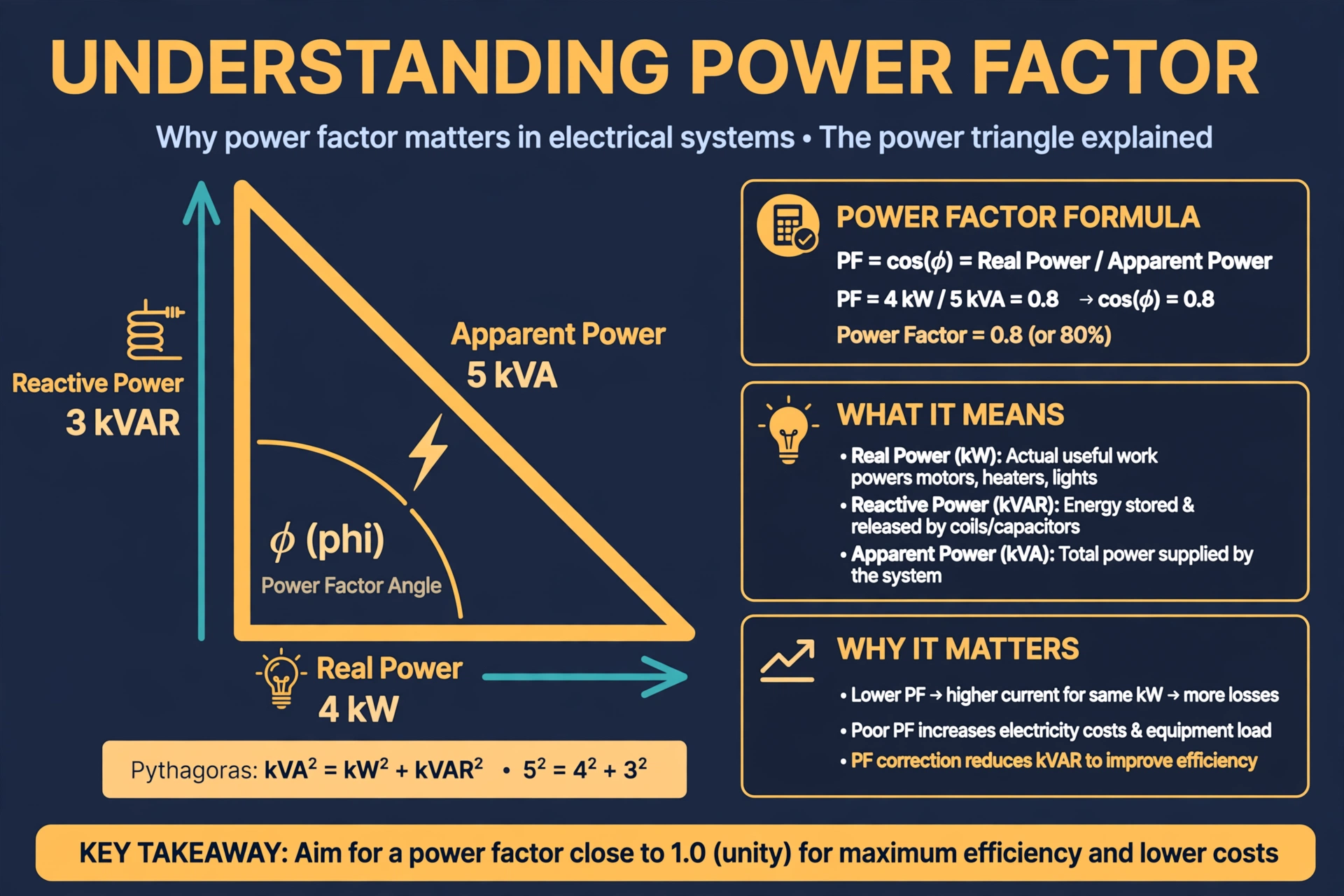
What power factor actually is
On AC circuits, current and voltage do not always peak at the same moment. The power factor (a number between 0 and 1) measures how aligned they are. A factor of 1.0 means every amp is doing useful work; 0.8 means you are drawing 25% more current than the useful power requires — and the wires, transformers, and breakers all have to be sized for that extra current.
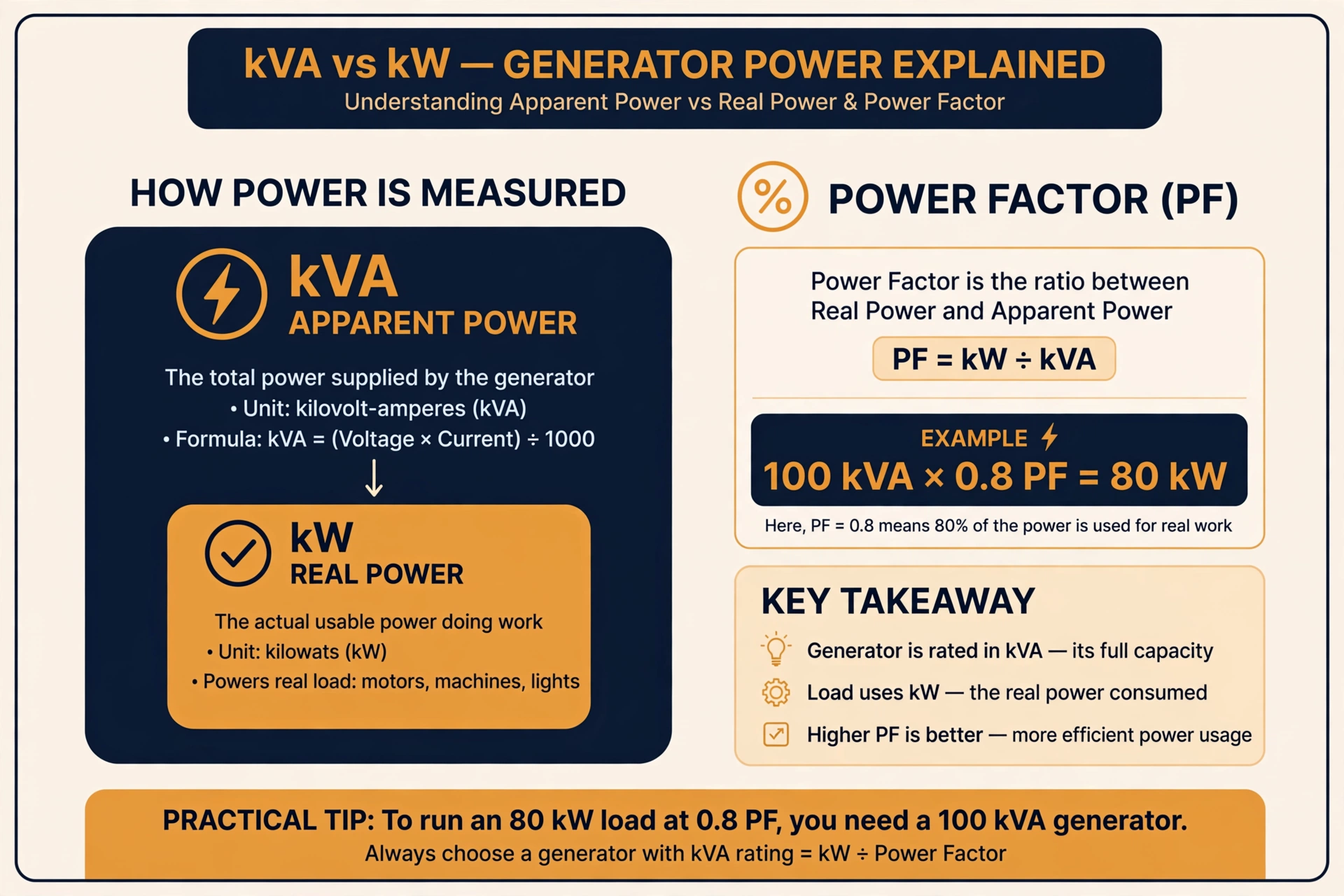
Who gets penalized
Homes rarely see power-factor charges, but commercial and industrial customers often do. Utilities commonly penalize power factors below 0.9 or 0.95, because low power factor forces them to deliver more current (and build bigger infrastructure) for the same billed kilowatts. The fix is power-factor correction: capacitor banks installed near inductive loads like motors.
What it means for your calculations
This is exactly why our AC calculators ask for power factor. A 10 kW motor at 400 V three-phase draws 14.43 A at PF 1.0 but 18.04 A at PF 0.8 — same work, 25% more current, thicker cable, bigger breaker. Try it yourself on the power factor calculator.
The Power Triangle: kW, kVAR, kVA
Engineers visualize AC power as a right triangle. The horizontal side is real power (kW) — the useful work. The vertical side is reactive power (kVAR) — the “borrowed” power that magnetizes motor coils and then returns to the grid each cycle. The hypotenuse is apparent power (kVA) — what the supply must actually deliver. Power factor is simply kW ÷ kVA: the fraction of delivered power doing useful work.
This triangle explains the bill shock. A factory running 50 kW of machinery at 0.7 power factor demands 71.4 kVA from the utility — 43% more infrastructure than the kilowatt number suggests. Improve the factor to 0.95 and the same factory needs only 52.6 kVA. The machines never changed; only the alignment of current and voltage did.
How Utilities Actually Bill You
Residential bills are simple: you pay per kWh consumed, and power factor is the utility’s problem. Commercial and industrial tariffs are different — many include a demand charge based on peak kVA, a power-factor penalty below 0.9 or 0.95, or both. A penalty clause might add 1–2% to the bill for every 0.01 the factor drops below the threshold, which adds up fast on a large account.
Utilities do this because low power factor costs them real money: thicker distribution cables, larger transformers, and extra generation capacity to carry current that does no billable work. The penalty is their way of pushing that cost back to whoever causes it — and of incentivizing correction equipment.
Power Factor Correction in Practice
Correction means installing capacitor banks near inductive loads to supply reactive power locally, so it never travels back to the grid. Sizing is straightforward: capacitor kVAR = kW × (tan(arccos(existing PF)) − tan(arccos(target PF))). For our 50 kW factory at 0.7 PF targeting 0.95: 50 × (1.020 − 0.329) = 34.6 kVAR — a standard 35 kVAR bank does the job.
Two cautions from experience: never correct past 1.0 into a leading power factor (over-correction causes its own voltage problems), and use detuned reactors with the capacitors if the site has significant harmonic distortion from drives or welders — plain capacitors and harmonics are a destructive combination. For most small workshops, a single automatic correction panel at the main incomer pays for itself within a year or two.