Here is a conversation that happens in homes every winter: “But it’s only a 2 kW heater — why did the 10-amp breaker trip?” The answer is that kilowatts and amps are not the same thing, and the breaker only understands one of them.
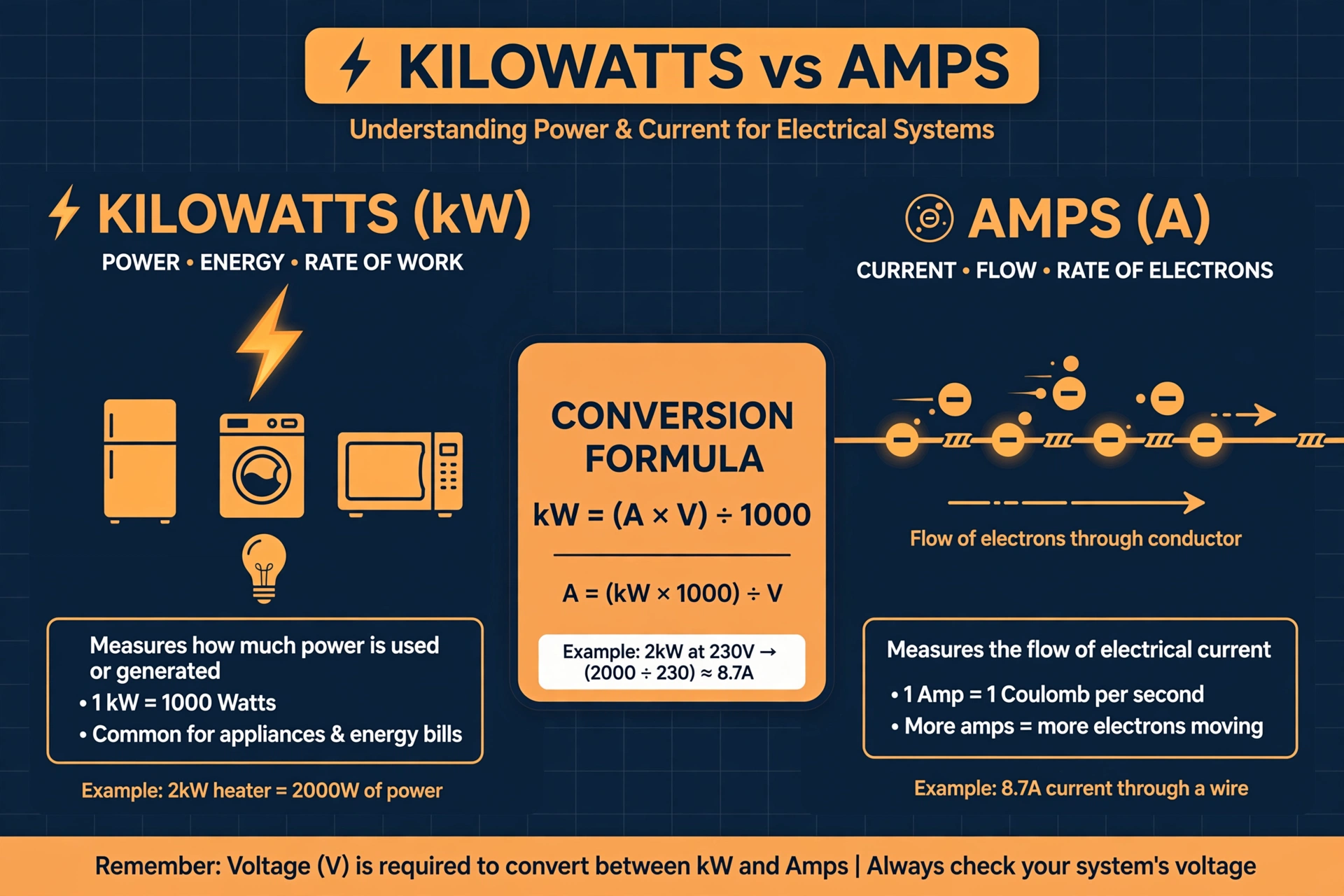
The breaker speaks amps, not kilowatts
A circuit breaker does not know or care how many kilowatts your appliance is rated for. It watches current — amps — flowing through the wire, and it trips when that current stays too high for too long. The kilowatt rating on the box tells you energy consumption; the breaker cares about wire heating, which is driven by current.
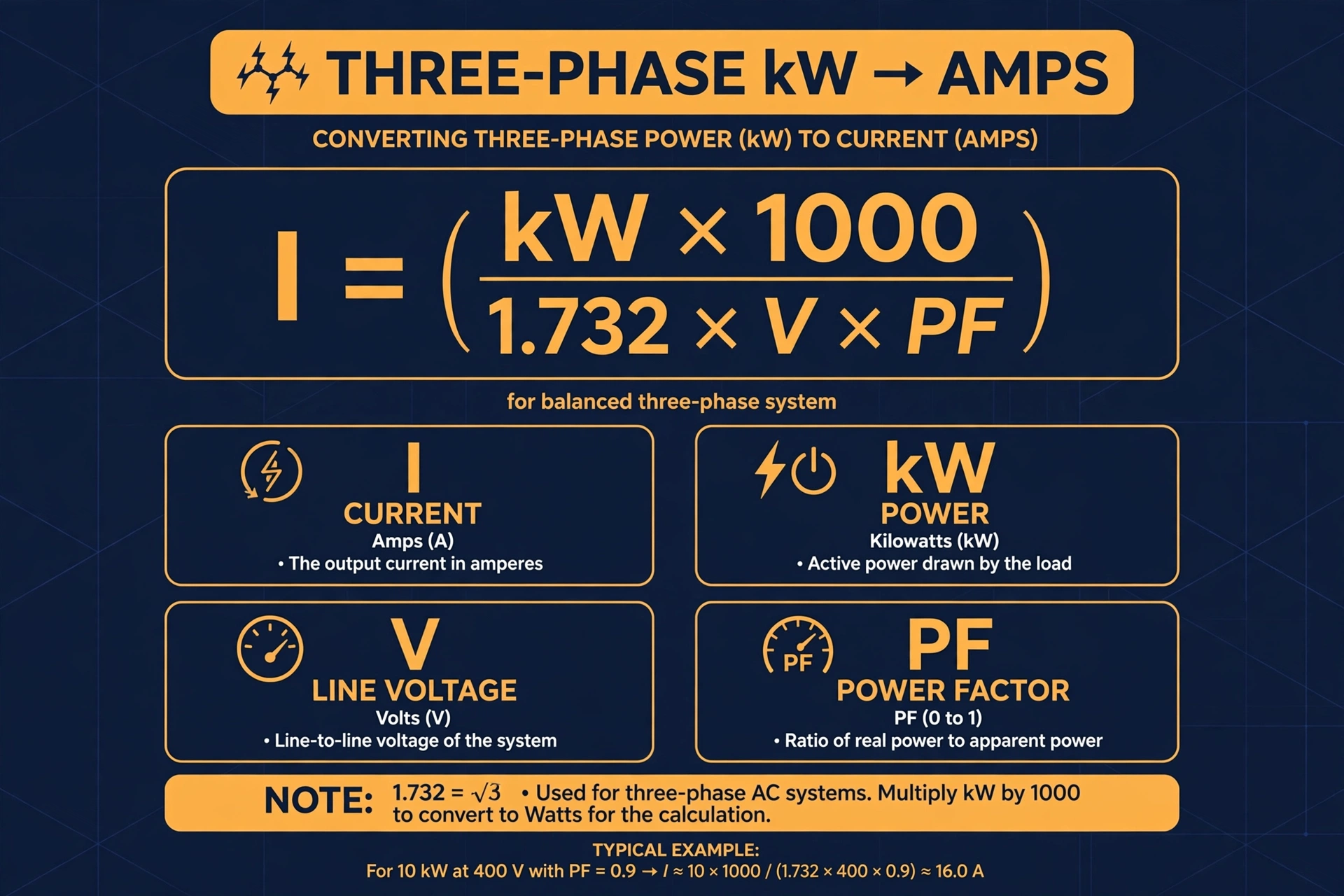
Do the translation yourself
Take that 2 kW heater on a 220 V outlet: 2000 ÷ 220 = 9.09 A. That is uncomfortably close to a 10 A breaker, and breakers are designed to trip before things get dangerous — nuisance tripping at 90% load is the breaker doing its job. On a 120 V system the same heater draws 16.67 A, which needs a 20 A circuit, not a 15 A one.
The rule of thumb
Electricians generally load a breaker to only 80% of its rating for continuous loads. So a 10 A breaker comfortably handles about 8 A continuous — roughly 1.76 kW at 220 V. When in doubt, convert first with our kW to amps calculator, then size the breaker.
kW, kVA, and Amps: The Three Numbers That Matter
Kilowatts (kW) measure useful power — the work your appliance actually does. Amps (A) measure current — the flow of electricity through the wire. Kilovolt-amps (kVA) measure apparent power — what the supply must deliver, including the wasted portion. They are linked by simple math, but they answer different questions: kW tells you the energy bill, amps tell you the wire and breaker size, kVA tells you the generator or transformer size.
The confusion starts because appliance labels show kW while breakers show amps. A “2 kW heater” label is telling you about consumption; your 10 A breaker is guarding against wire overheating. To translate between them you always need the voltage: amps = (kW × 1000) ÷ volts for DC and resistive AC loads.
Why Voltage Changes Everything
The same 3 kW load draws wildly different currents depending on voltage: at 120 V it pulls 25 A (needing a 30 A circuit), at 230 V it pulls 13 A (a 16–20 A circuit), and at 400 V three-phase just 5.1 A. This is why high-voltage distribution exists — higher voltage means lower current for the same power, which means thinner wires and smaller breakers.
It also explains why travelers’ appliances behave strangely abroad. A 1.5 kW kettle draws 6.5 A at 230 V but 12.5 A at 120 V. Plug a 230 V-designed device into 120 V through a simple adapter and it will underperform; the reverse mistake — a 120 V device into 230 V — destroys it instantly. Voltage always comes first in the conversion.
When Tripping Means Something Is Wrong
Occasional tripping at high load is normal protection behavior. But a breaker that trips with no obvious overload is telling you something: it could be a failing appliance drawing excess current, a loose terminal heating up, a breaker weakened by years of tripping, or — most seriously — damaged insulation leaking current to earth.
The diagnostic order is simple: unplug everything on the circuit and reset. If it holds, plug devices back one at a time until the culprit trips it. If it trips with nothing connected, stop and call an electrician — that points to wiring damage, which is a genuine fire and shock hazard, not a sizing problem.