Step 1 — Daily Energy (kWh)
List loads with hours per day: e.g., fridge 0.15 kW × 8 h = 1.2 kWh; lights 0.1 kW × 5 h = 0.5 kWh; laptop 0.06 × 6 = 0.36 kWh. Total ≈ 2.06 kWh/day. Add 20% system losses → 2.5 kWh/day to generate.
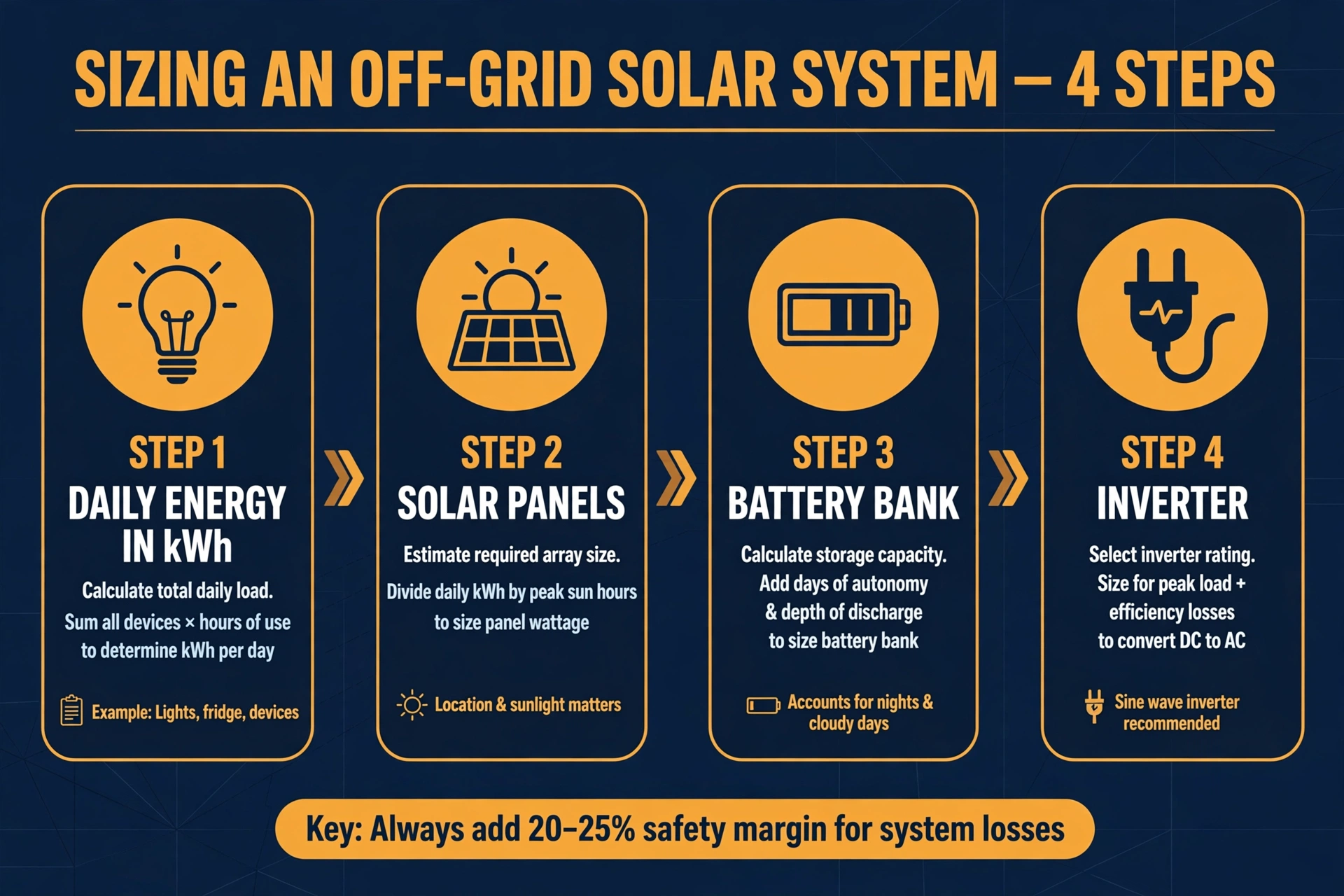
Step 2 — Panels
Divide by peak sun hours (4–6 in most regions; use 4 conservatively): 2500 Wh ÷ 4 h = 625 W of panels → two 400 W panels (800 W) gives comfortable margin.
Step 3 — Batteries
For 2 days autonomy at 48 V with 50% max discharge (lead-acid): 2500 × 2 ÷ 0.5 ÷ 48 = 208 Ah at 48 V. With LiFePO4 (80% usable): 2500 × 2 ÷ 0.8 ÷ 48 = 130 Ah.
Step 4 — Inverter and Wiring
Inverter ≥ peak simultaneous kW × 1.25. Battery cables sized from amps at battery voltage: 2.5 kW ÷ 48 V = 52 A → 16 mm² copper minimum with a 63 A fuse.
Why 48 V Beats 12 V for Bigger Systems
System voltage is the most underrated sizing decision. The same 3,000 W of load draws 250 A at 12 V but only 62.5 A at 48 V (amps = watts ÷ volts). At 250 A you need enormous, expensive cables and every connection becomes a fire risk if slightly loose; at 62.5 A, standard 16–25 mm² cable handles it comfortably.
As a rule of thumb: stay at 12 V for systems under 1 kW (a cabin, a camper van), move to 24 V between 1 and 3 kW, and use 48 V for anything above 3 kW. Higher voltage also means smaller, cheaper charge controllers for the same panel wattage.
Planning for Cloudy Days and Winter
Sizing for average sunshine is the classic beginner error. Panels produce their rated output only under ideal test conditions; real output drops with heat, dust, panel age and — most importantly — season. If your location gets 5 peak sun hours in summer but only 2.5 in winter, size the array for winter: our 2.5 kWh/day example needs 2,500 ÷ 2.5 = 1,000 W of panels for December, not 625 W.
Battery autonomy deserves the same pessimism. Two days of autonomy covers a normal cloudy spell; three to four days is safer if the system powers anything critical like a medical device or a water pump. Remember that lead-acid batteries also lose effective capacity in cold weather — another reason lithium (LiFePO4) has taken over off-grid builds despite the higher upfront cost.
Charge Controllers: PWM vs MPPT
The charge controller sits between panels and batteries, and the type matters enormously. PWM (pulse-width modulation) controllers are cheap and fine for small 12 V systems where panel voltage roughly matches battery voltage. MPPT (maximum power point tracking) controllers actively convert excess panel voltage into extra charging current, harvesting 20–30% more energy from the same panels — essential for 24 V and 48 V systems.
Size the controller from the panel array’s short-circuit current (Isc): add up the Isc of all parallel strings and multiply by 1.25 for safety margin. Four 400 W panels with Isc of 13 A each in parallel need a controller rated for at least 65 A — a standard 80 A MPPT unit fits perfectly.