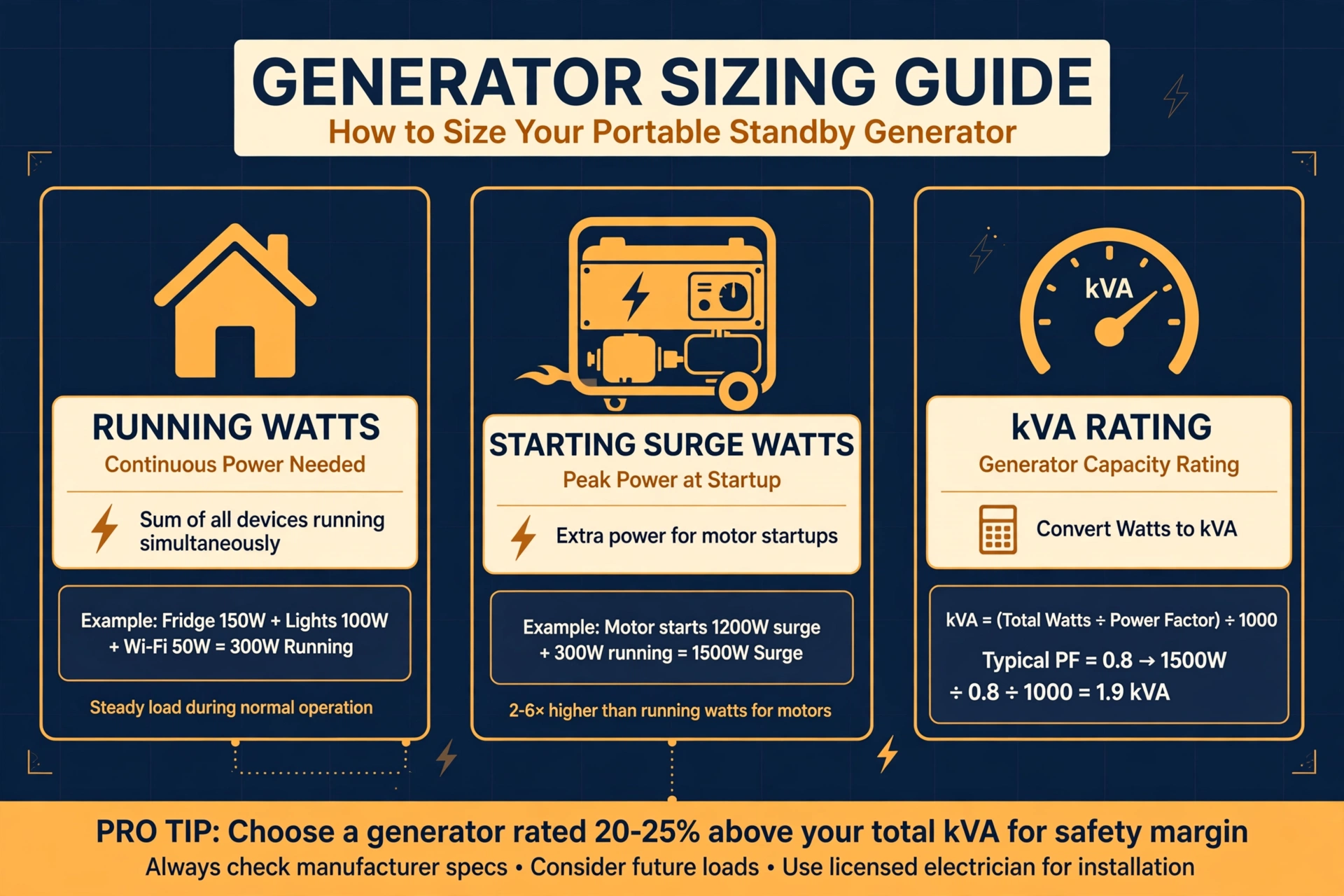
Start With Your Loads
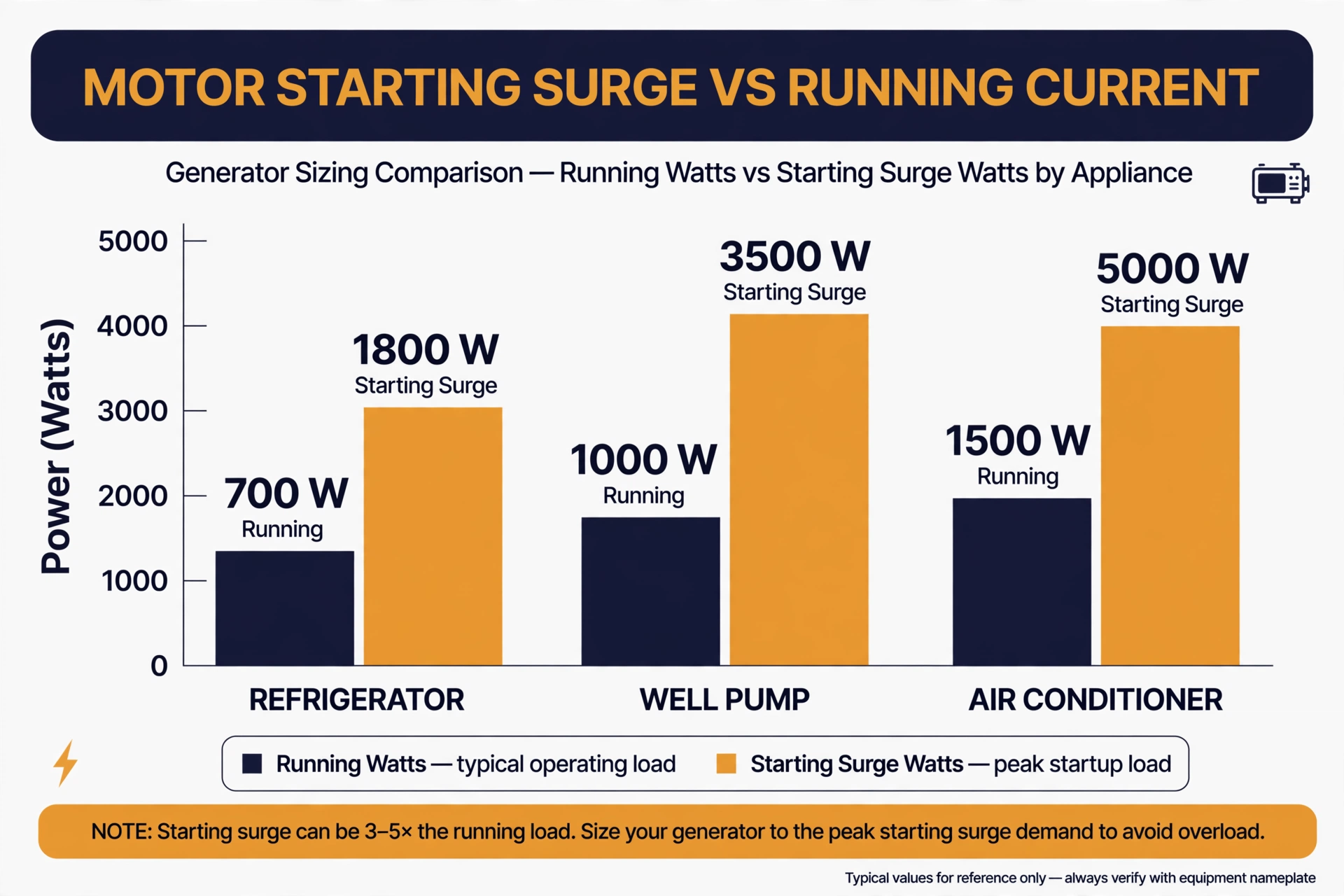
List every appliance the generator must power, with its running watts and starting watts. Motors (fridge compressors, well pumps, AC units) draw 3–7× their running current for a few seconds at startup — this surge, not the running load, usually determines generator size.
Convert kW to kVA
Generators are rated in kVA. Divide total kW by your expected power factor (0.8 is standard): a 8 kW load needs at least 10 kVA. Then add the largest motor’s starting surge on top.
Worked Example
Home backup: fridge (0.2 kW run / 1.2 kW start), lights (0.5 kW), well pump (1.1 kW run / 3.5 kW start), AC (3.5 kW run / 9 kW start). Running total: 5.3 kW → 6.6 kVA at 0.8 PF. Worst surge step: AC starting while everything else runs: 5.3 − 3.5 + 9 = 10.8 kW → 13.5 kVA. A 15 kVA generator covers it with margin.
Common Mistakes
- Ignoring surge: the #1 cause of generator overload trips.
- Oversizing wildly: a diesel generator running under 30% load glazes its cylinders (wet stacking).
- Forgetting derating: subtract ~3.5% capacity per 300 m altitude and ~1% per 5°C above 25°C.
Running Watts vs Starting Watts: Know Both Numbers
Every appliance has two wattage numbers, and confusing them is the most common sizing mistake. Running watts (sometimes called “rated watts”) is what the device draws while operating normally. Starting watts (also called “surge watts”) is the brief spike when motors kick on — typically 3 to 7 times the running watts for a few seconds.
Resistive loads like heaters, kettles, and incandescent lights have no surge: a 2 kW heater draws 2 kW from the first second. Inductive loads — anything with a motor or compressor — surge hard. A refrigerator that runs at 150 W can demand 1,200 W the instant its compressor starts. Your generator must handle the single largest surge event, not just the steady running total.
The practical method: add up all running watts, then add only the largest starting surge on top (appliances rarely all start in the same second). If your running total is 4,000 W and your biggest motor surges an extra 2,500 W above its running draw, size for 6,500 W of running-equivalent load before converting to kVA.
Portable vs Standby: Sizing Works Differently
Portable generators are sized for essentials — you choose which circuits matter during an outage and feed them through a transfer switch or interlock. Because you control the load list, a 7–10 kVA portable often covers a home’s critical loads: fridge, lights, well pump, internet, and a few outlets.
Standby generators, wired into the house with an automatic transfer switch, are usually sized for the whole house or a large managed portion of it. That means calculating the full connected load, which often lands in the 15–25 kVA range for a typical family home. Standby units also run on natural gas or propane, so fuel storage is less of a concern than with a portable’s petrol tank.
Either way, the math is identical: running kW total, worst-case surge, divide by power factor. The only difference is how much of the house you include in “total.”
Fuel, Runtime, and the Oversizing Trap
A generator’s fuel consumption is roughly proportional to the load it carries. As a rule of thumb, a diesel generator burns about 0.27 litres per kWh produced — so an 8 kW load running 10 hours needs roughly 22 litres of diesel. Petrol portables are thirstier, around 0.35–0.4 litres per kWh. Size your fuel storage from the runtime you actually need, not the tank that came in the box.
Resist the urge to massively oversize “just in case.” A diesel generator loafing along at under 30% load suffers wet stacking — unburned fuel glazing the cylinders — which shortens engine life. Aim to run your generator at 50–80% of its rated capacity during an outage: efficient, clean-burning, with headroom left for surges.