Quick Answer
The best synonyms for relax include unwind, de-stress, loosen up, chill out, rest, and take it easy. For formal writing, choose repose or rejuvenate. For casual conversations, chill or kick back work well. When you need a stronger word, unbend or let loose fit better. For a milder tone, settle down or ease up are excellent options.
Relax is a common word used to describe taking a break, becoming less tense, or enjoying a peaceful state of mind. Depending on the situation, you may want a synonym that sounds more casual, formal, descriptive, or expressive. Words such as unwind, rest, chill, decompress, rest, settle down, and rejuvenate can all convey the idea of relaxing, but each has a slightly different meaning and tone.
Choosing the right synonym for relax can make your writing more natural and precise. For example, you might unwind after a busy day, decompress after a stressful experience, rest when you need to recover your energy, or chill when speaking casually with friends. In this guide, you’ll discover useful synonyms for relax, their meanings, example sentences, and tips for choosing the best alternative based on context.
What Does Relax Mean?
The word relax means to become less tense, anxious, or rigid. It describes a state of physical or mental ease, often after a period of stress or activity.
Part of speech: Verb
Common usage: People use relax to describe letting go of physical tension, calming the mind, or taking a break from work or worry.
Example sentences:
- After a long week, she needed to relax on the couch with a good book.
- The music helps him relax before his big presentation.
Core Meaning of Relax
At its heart, relax refers to releasing tightness whether in muscles, emotions, or daily routines. It implies a shift from effort to ease, from tension to comfort. When you relax, you allow yourself to pause, breathe, and step away from pressure.
This word also suggests a deliberate choice. You choose to stop worrying. You choose to rest your body. You choose to create space for calm. The concept appears in everything from healthcare advice to lifestyle blogs, making it one of the most common verbs in everyday English.
Grammar and Usage Notes
Part of speech: Verb (transitive and intransitive)
Common patterns:
- Relax + (no object): “I need to relax.”
- Relax + object: “The warm bath relaxed her muscles.”
- Relax + preposition (with, into): “He relaxed into the chair.”
Common collocations:
- Relax your mind
- Relax your shoulders
- Relax and enjoy
- Learn to relax
- Take time to relax
When relax sounds natural: Use it in everyday situations, health advice, travel writing, or personal reflections. It works well in both spoken and written English.
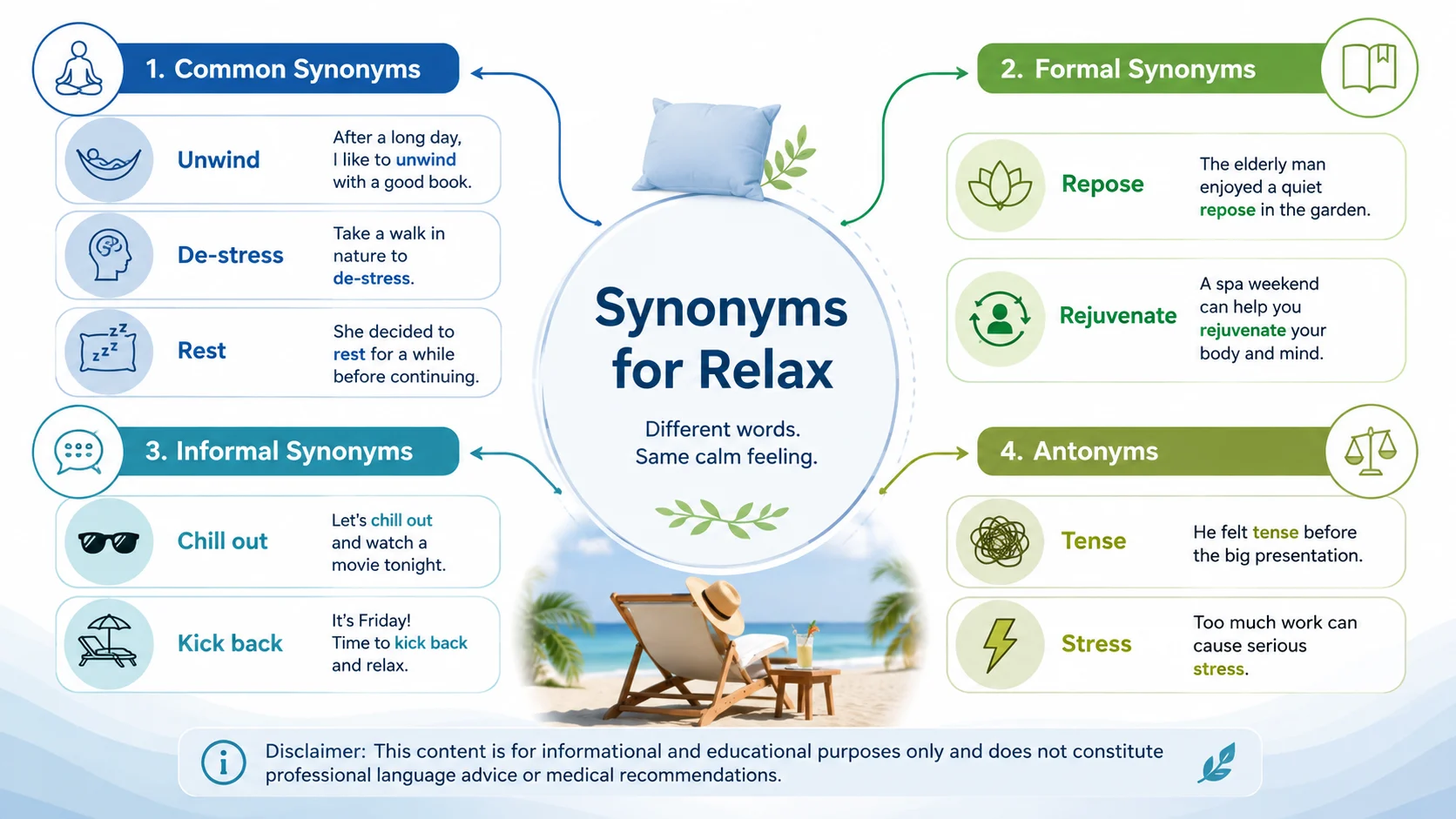
When a synonym works better: Use unwind when talking about mental release after work. Choose repose for formal or literary contexts. Pick chill out for casual conversations with friends. Select de-stress when the focus is on reducing anxiety.
Best Synonyms for Relax
| Synonym | Meaning | Tone | Best Use Case | Example Sentence |
| Unwind | Release mental or emotional tension | Neutral to informal | After work, social settings | She likes to unwind with a glass of wine. |
| De-stress | Reduce anxiety and stress | Modern, practical | Health and wellness topics | Yoga helps him de-stress after deadlines. |
| Loosen up | Become less rigid or formal | Informal | Social gatherings, performance settings | He needs to loosen up before his speech. |
| Chill out | Calm down and stop worrying | Very informal | Friends, casual conversation | Just chill out—everything will be fine. |
| Rest | Stop activity to regain energy | Neutral | Physical recovery, sleep | You should rest after that long hike. |
| Take it easy | Avoid strain or worry | Informal | Advice, friendly warnings | Take it easy this weekend—you deserve a break. |
| Repose | Rest in a peaceful, dignified way | Formal, literary | Poetry, formal writing | The painting shows a figure in quiet repose. |
| Rejuvenate | Restore energy and vitality | Positive, uplifting | Self-care, travel, health | A vacation helps rejuvenate the spirit. |
| Unbend | Become less strict or tense | Slightly formal | Business, personal growth | He finally unbent during the team retreat. |
| Let loose | Release inhibitions and enjoy freely | Informal | Celebrations, parties | They let loose at the wedding reception. |
Common Synonyms for Relax
These everyday words appear frequently in conversation and general writing.
Unwind
Unwind means to release mental or emotional tension after stress. It often refers to the transition from work to leisure.
Best context: Evening routines, weekends, or holidays.
Example: “After a long commute, she unwinds by listening to podcasts.”
De-stress
De-stress focuses on reducing anxiety and pressure. This word became popular in health and wellness conversations.
Best context: Self-care articles, workplace advice, or lifestyle blogs.
Example: “He de-stresses by going for a run after work.”
Rest
Rest emphasizes stopping activity to regain physical or mental energy. Unlike relax, rest often implies sleep or stillness.
Best context: Health advice, medical discussions, or travel plans.
Example: “You should rest your eyes after staring at the screen.”
Loosen up
Loosen up suggests releasing physical or social rigidity. It often describes becoming more flexible or carefree.
Best context: Social situations, creative work, or performance anxiety.
Example: “The warm-up exercises helped the team loosen up before the game.”
Take it easy
Take it easy advises someone to avoid stress or exertion. It can also mean slowing down.
Best context: Friendly advice, casual conversations, or get-well messages.
Example: “Take it easy—you’ve been working too hard.”
Formal Synonyms for Relax
Formal alternatives work well in academic essays, business reports, professional emails, and literary writing.
Repose
Repose means to rest in a calm, dignified manner. It carries a refined tone suitable for formal descriptions.
Best context: Poetry, art criticism, medical or legal documents.
Example: “The older man enjoyed his afternoon repose in the garden.”
Rejuvenate
Rejuvenate means to restore youthful energy or vitality. It appears often in wellness and luxury contexts.
Best context: Spa descriptions, self-care guides, or corporate retreat programs.
Example: “The leadership seminar aims to rejuvenate senior executives.”
Recuperate
Recuperate means to recover health or strength after illness, exertion, or stress. It implies a necessary healing process.
Best context: Medical writing, insurance forms, or sick leave policies.
Example: “She needs several weeks to recuperate after the surgery.”
Unbend
Unbend describes the act of becoming less formal, strict, or tense. It works well in professional psychology or leadership writing.
Best context: Business communication, personal development articles.
Example: “The manager unbent during the off-site meeting, cracking jokes with the team.”
Collect oneself
Collect oneself means to regain composure after stress or excitement.
Best context: Formal speeches, crisis communication, or courtroom descriptions.
Example: “He paused to collect himself before answering the difficult question.”
Informal Synonyms for Relax
Casual words help you sound natural, friendly, and approachable.
Chill out
Chill out means to calm down and stop worrying. Younger speakers use this phrase in everyday conversation.
Best context: Text messages, social media, or casual advice to friends.
Example: “Chill outthe test isn’t until next week.”
Kick back
Kick back means to recline or rest comfortably, often while enjoying leisure time.
Best context: Weekend plans, vacation talk, or casual invitations.
Example: “Let’s kick back and watch a movie tonight.”
Hang loose
Hang loose means to stay calm, relaxed, and carefree. It originated in surf culture.
Best context: Casual social settings, beach trips, or friendly encouragement.
Example: “Just hang loose and go with the flow.”
Veg out
Veg out means to do nothing mentally or physically demanding, similar to a vegetable.
Best context: Lazy weekends, TV watching, or rest days.
Example: “I’m going to veg out on the couch all day.”
Unplug
Unplug means to disconnect from technology or daily responsibilities.
Best context: Digital detox tips, vacation plans, or wellness advice.
Example: “We unplugged for the entire weekend and it felt amazing.”
Strong Synonyms for Relax
Stronger synonyms carry more emotion, urgency, or intensity. Use them when you want to emphasize release or freedom.
Let loose
Let loose means to release inhibitions and enjoy yourself fully. It often describes celebration.
Best context: Parties, concerts, or reunions.
Example: “After finals, the students let loose at the beach party.”
Unwind completely
Adding completely emphasizes total release.
Best context: Deep relaxation, spa treatments, or extended vacations.
Example: “The mountain retreat helped him unwind completely.”
Surrender to relaxation
This phrase suggests letting go of all control.
Best context: Meditation, guided relaxation, or transformative experiences.
Example: “She surrendered to relaxation during the massage.”
Melt away tension
This expression vividly describes stress dissolving.
Best context: Wellness writing, yoga descriptions, or product marketing.
Example: “The hot bath melted away all her tension.”
Recharge
Recharge means to restore energy through rest.
Best context: Travel, technology metaphors, or productivity advice.
Example: “We went to the cabin to recharge for the new year.”
Mild Synonyms for Relax
Milder words describe gentle, subtle relaxation. These work well when you want to sound calm rather than dramatic.
Settle down
Settle down means to become calmer or quieter. It suggests a gradual shift.
Best context: Bedtime routines, classroom management, or quiet evenings.
Example: “The children settled down after the story ended.”
Ease up
Ease up means to reduce effort, pressure, or intensity.
Best context: Workplaces, sports advice, or parental guidance.
Example: “You should ease upyou’ve been pushing yourself too hard.”
Slow down
Slow down means to reduce speed or pace. It often implies a gentler lifestyle.
Best context: Travel advice, health warnings, or life transitions.
Example: “She slowed down after her doctor’s warning.”
Lighten up
Lighten up means to become less serious or more cheerful.
Best context: Social advice, humor, or team building.
Example: “He needs to lighten up and enjoy the joke.”
Simmer down
Simmer down means to become less excited or angry. It paints a gradual decrease.
Best context: Parenting, mediation, or calming others.
Example: “Let the crowd simmer down before you speak.”
Synonyms for Relax by Context
Everyday Conversation
In daily talk, you need simple, friendly words.
Best words: Chill out, kick back, take it easy, loosen up
People use these with friends, family, or colleagues. They feel natural and approachable.
Example: “I need to chill out after that meeting.”
Professional Writing
Business communication demands neutral or slightly formal synonyms.
Best words: Unwind, rejuvenate, recuperate, collect oneself
These words avoid slang while staying professional. They suit emails, memos, and company blogs.
Example: “Employees should take time to unwind during the holidays.”
Academic Writing
Scholarly content requires precise, formal vocabulary.
Best words: Repose, recuperate, relaxation response, restoration
Academics often study relaxation in psychology, medicine, or sociology. They need technical clarity.
Example: “The study measured physiological markers during periods of repose.”
Creative Writing
Writers often need vivid, descriptive synonyms.
Best words: Sink into, melt, breathe out, settle into, let go
These words create images and emotions. They help readers visualize scenes.
Example: “She sank into the old armchair and let the quiet surround her.”
Marketing Copy
Advertisers sell relaxation through travel, spa, or self-care products.
Best words: Rejuvenate, recharge, escape, indulge, pamper
These words evoke desire and positive feelings. They make products feel essential.
Example: “Rejuvenate your skin with our new organic serum.”
Emotional Expression
When describing personal feelings, choose words that resonate.
Best words: Breathe, release, soothe, center myself, find peace
These words connect to inner states and emotional health.
Example: “She took a deep breath to soothe her anxious thoughts.”
Medical and Health Writing
Healthcare contexts require clear, trustworthy language.
Best words: Rest, recuperate, reduce stress, promote relaxation
Accuracy matters more than creativity. Avoid vague or emotional words.
Example: “Patients should rest to promote healing.”
Personal Communication
When talking to yourself or loved ones, choose warm, gentle words.
Best words: Take a break, calm down, breathe, slow down
These phrases feel supportive and caring. They suit journaling, texting, or self-talk.
Example: “I reminded myself to breathe and slow down.”
Another Word for Relax in a Sentence
These sentences show how different synonyms fit naturally in real writing.
- After work, I unwind by walking in the park.
- Yoga helps her destress after long meetings.
- The party let them loosen up and have fun.
- He told his friend to chill out and stop worrying.
- The doctor recommended resting for two days.
- Take it easyyou’ve earned a break.
- The painting depicts a woman in peaceful repose.
- We need a vacation to rejuvenate our spirits.
- The team leader unbent at the company dinner.
- After final exams, students let loose at the celebration.
- The family kicked back with popcorn and movies.
- She settled down with a cup of tea and a novel.
- The manager advised everyone to ease up on deadlines.
- He decided to slow down and enjoy life more.
- The warm sun helped her sink into a state of calm.
Relax Synonyms Compared
Some synonyms share similar meanings but differ in tone, formality, or intensity. Here is how to distinguish the closest ones.
Unwind vs. De-stress
- Unwind: Focuses on releasing mental tension after activity. It feels gentle and natural.
- De-stress: Focuses on reducing stress and anxiety. It feels more intentional and health-focused.
Best use: Use unwind for evenings and leisure. Use de-stress for wellness routines and workplace advice.
Chill out vs. Loosen up
- Chill out: Means calm down, especially when upset or excited. It often responds to emotion.
- Loosen up: Means become less rigid or nervous. It often relates to confidence or social ease.
Best use: Say chill out when someone panics. Say loosen up when someone seems stiff or anxious.
Rest vs. Repose
- Rest: General word for stopping activity. Works everywhere.
- Repose: Formal, peaceful, or dignified rest. Best for literature or formal descriptions.
Best use: Use rest in everyday English. Use repose in poetry or refined writing.
Let loose vs. Unbend
- Let loose: Wild, free, celebratory. Suggests losing control in a fun way.
- Unbend: Polite, professional, quiet. Suggests becoming more approachable.
Best use: Use let loose at parties. Use unbend in business contexts.
Rejuvenate vs. Recuperate
- Rejuvenate: Restores energy and vitality. Positive and aspirational.
- Recuperate: Recovers from illness, injury, or exhaustion. Practical and medical.
Best use: Use rejuvenate for spa trips. Use recuperate for health recovery.
Words Similar to Relax
These related words belong to the same emotional or physical category but may not directly replace relax in every sentence.
| Word | Meaning | Difference from Relax | When to Use |
| Soothe | Calm or comfort someone | Focuses on external action | “She soothed the crying baby.” |
| Pacify | Bring peace to someone upset | Implies active calming | “He tried to pacify the angry customer.” |
| Meditate | Focus the mind for calmness | Involves mental practice | “She meditates every morning.” |
| Breathe | Take air in and out | Basic biological action | “He took a moment to breathe.” |
| Retreat | Withdraw to a quiet place | Involves physical escape | “They retreated to the countryside.” |
| Lounge | Spend time idly and comfortably | Describes physical posture | “They lounged by the pool all day.” |
When to use these: Choose soothe when you calm someone else. Use meditate when you describe a mindfulness practice. Pick retreat when the focus is on physical distance from stress.
Antonyms of Relax
Sometimes the best way to understand a word is to explore its opposite.
| Antonym | Meaning | Example Sentence |
| Tense | Feel stiff or anxious | “His shoulders became tense during the interview.” |
| Stress | Experience mental or emotional strain | “Work stress kept her awake at night.” |
| Strain | Exert physical or mental effort | “He strained to meet the deadline.” |
| Agitate | Make someone feel anxious or upset | “The news agitated the entire office.” |
| Tighten | Become stiff or restricted | “Her muscles tightened with fear.” |
| Worry | Feel anxious about problems | “He worries about everything.” |
| Overwork | Work too much | “They overworked themselves all year.” |
| Panic | Sudden uncontrollable fear | “She panicked when she lost her keys.” |
How to Choose the Right Synonym for Relax
Picking the best word comes down to a few simple rules.
Match the Context
Where will the word appear? Formal reports need formal words like repose. Text messages need casual words like chill. Know your audience.
Match the Tone
Are you serious? Humorous? Professional? Friendly? Choose a synonym that matches your emotional tone.
Check the Intensity
Do you need strong imagery or gentle language? Let loose sounds dramatic. Ease up sounds subtle. Pick the intensity that fits.
Think About the Reader
Will your reader understand the word? Avoid jargon if your audience is general. Use simpler words unless the situation demands sophistication.
Test the Replacement
Replace relax with your chosen synonym. Does the sentence sound natural? If not, try another. Read it aloud.
Keep It Simple
When clarity matters, choose the most familiar word. Rest works almost everywhere. Fancy words impress but may confuse.
Common Mistakes When Using Synonyms for Relax
Even experienced writers make these errors. Avoid them to sound more fluent.
Mistake 1: Choosing the Wrong Tone
Using repose in a text message sounds ridiculous. Using chill out in a medical report seems unprofessional. Match the tone to the situation.
Mistake 2: Using a Word That Is Too Strong
“I need to let loose” sounds intense. Use it only when you mean wild celebration. For quiet evenings, unwind works better.
Mistake 3: Using a Word That Is Too Mild
“He slowly simmered down” suggests gradual cooling. If you mean total relaxation, rejuvenate fits better.
Mistake 4: Forgetting the Grammar
Some synonyms need objects. “The music relaxed her” works. But “She loosened up” is intransitive. Check the pattern.
Mistake 5: Treating Related Words as Exact Synonyms
Soothe and relax are related, not identical. You soothe someone else; you relax yourself or something else.
Mistake 6: Overcomplicating Sentences
Long lists of fancy synonyms sound artificial. Use the simplest word that works.
Mistake 7: Ignoring Collocations
Some words pair naturally: “unwind after work.” Other combinations sound wrong: “repose after work” sounds awkward. Learn common phrases.
Quick Synonym List for Relax
Common Synonyms
- Unwind
- De-stress
- Rest
- Loosen up
- Take it easy
Formal Synonyms
- Repose
- Rejuvenate
- Recuperate
- Unbend
- Collect oneself
Informal Synonyms
- Chill out
- Kick back
- Hang loose
- Veg out
- Unplug
Strong Synonyms
- Let loose
- Unwind completely
- Surrender to relaxation
- Melt away tension
- Recharge
Mild Synonyms
- Settle down
- Ease up
- Slow down
- Lighten up
- Simmer down
Related Words
- Soothe
- Meditate
- Breathe
- Lounge
- Retreat
FAQs
What is the best synonym for relax?
The best synonym depends on context. For most situations, unwind works well. For formal writing, choose repose. For casual talk, use chill out.
What is another word for relax?
Common alternatives include unwind, de-stress, rest, loosen up, and take it easy. Each has a slightly different nuance.
What is a formal synonym for relax?
Formal synonyms include repose, rejuvenate, recuperate, and unbend. These suit academic, business, or literary contexts.
What is an informal synonym for relax?
Informal options include chill out, kick back, hang loose, and veg out. Use them with friends or in casual writing.
What is a stronger word for relax?
Stronger synonyms include let loose, melt away tension, and unwind completely. Use them when you want to emphasize release or freedom.
What is a milder word for relax?
Milder synonyms include settle down, ease up, slow down, and lighten up. These work well when you want subtle or gentle language.
What words are similar to relax?
Related words include soothe, meditate, breathe, lounge, and retreat. They belong to the same semantic field but are not exact synonyms.
What is the opposite of relax?
Antonyms include tense, stress, strain, agitate, tighten, and worry. They describe anxiety, effort, or rigidity.
How do I choose the right synonym for relax?
Consider the context, tone, intensity, and your reader. Test the word in your sentence. Choose the simplest word that fits naturally.
Can I use “chill” in professional writing?
Avoid chill in formal work. It sounds too casual. Choose unwind or rest instead.
Conclusion
Finding the right synonym for relax gives you more flexibility as a writer and speaker. The perfect word depends on your audience, your tone, and the situation. Use unwind for everyday conversation. Pick repose for formal writing. Choose chill out for casual chats. Select let loose when emotions run high. And always test your word choice to see if it sounds natural.
Language matters, but clarity matters more. Keep your sentences simple, your tone appropriate, and your meaning clear. That way, your readers will relaxand appreciate your writing too.
Read More Articles