Finding the right word to express frequency or permanence can make your writing clearer and more engaging. While “always” is a common word, using it too often can make your writing feel repetitive or vague.
The best synonym for “always” depends on the context, tone, and exact meaning you want to express whether you’re describing something that happens every time, lasts forever, or feels constant.
This guide explains the most accurate synonyms for “always,” shows you how to use them naturally in sentences, and helps you choose the perfect word for any situation.
Quick Answer:
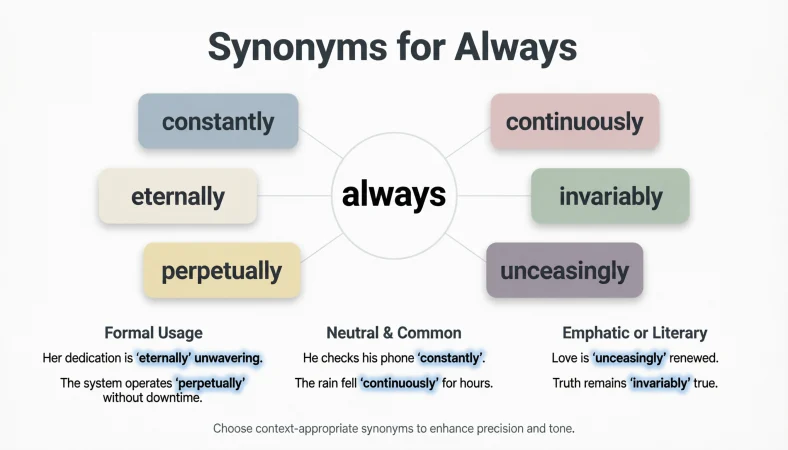
The best synonyms for always are constantly, continually, forever, perpetually, and invariably. For most everyday situations, constantly works well when something happens repeatedly, while forever fits when you want to emphasize permanence. For formal writing, invariably or perpetually are excellent choices. For casual conversation, all the time or every time sound natural and clear.
What Does Always Mean?
Always is an adverb that means at all times, on every occasion, or forever. It describes something that happens without exception or continues without stopping.
Core Meaning
- Every time – something happens on each occasion
- All the time – something is continuous or constant
- Forever – something lasts indefinitely or permanently
Part of Speech
Adverb
Simple Examples
- She always arrives at work before 8 AM.
- He always remembers my birthday.
- The sun always rises in the east.
Core Meaning of Always
The word “always” comes from the Old English phrase “ealne weg,” which literally meant “all the way” or “all along.” Over time, it evolved to describe things that happen consistently or last without interruption.
The concept behind “always” has three main shades of meaning:
- Repetition without exception – something that happens on every occasion
- Continuous duration – something that persists without stopping
- Permanence – something that will never end or change
Understanding these three layers helps you choose the most precise synonym. If you’re talking about repeated actions, words like “constantly” or “consistently” work well. If you’re describing permanence, “forever” or “eternally” are better fits.
Grammar and Usage Notes
Part of Speech
Adverb – modifies verbs, adjectives, or other adverbs.
Sentence Position
Usually comes between the subject and the main verb:
- She always tells the truth.
- They always eat dinner together.
With the verb “to be,” “always” comes after the verb:
- He is always late.
- The store is always busy.
Common Collocations
- Always + present tense (habitual actions)
- Always + past tense (past habits)
- Always + future tense (future intentions)
- Always + progressive tense (continuous actions)
When to Use Always vs. Other Words
- Always – general, neutral, and widely understood
- Constantly – implies frequency and perhaps intensity
- Forever – emphasizes permanence or duration
- Invariably – formal, implies predictability
- Every time – conversational, emphasizes each occurrence
- Relentlessly – implies persistence with a hint of pressure
Best Synonyms for Always
| Synonym | Meaning | Tone | Best Use Case | Example Sentence |
|---|---|---|---|---|
| Constantly | Happening frequently or without pause | Neutral to slightly emphatic | Describing ongoing or repeated actions | The baby constantly needs attention. |
| Continually | Happening repeatedly over time | Formal | Describing frequent repetition | She continually improves her skills through practice. |
| Forever | For all time; eternally | Strong and emotional | Emphasizing permanence or lasting impact | This memory will stay with me forever. |
| Perpetually | Continuing forever; never ending | Formal, literary | Describing permanent states or conditions | The ancient monument stands perpetually in the valley. |
| Invariably | Always; without variation | Formal, precise | Scientific or logical statements | The experiment invariably produces the same result. |
| Consistently | In a way that does not change | Neutral, professional | Describing reliable performance or behavior | She consistently delivers high-quality work. |
| Every time | On each occasion | Casual, conversational | Everyday speech and informal writing | Every time I see that movie, I cry. |
| All the time | Constantly; very often | Casual | Describing frequent habits or patterns | He talks about his travels all the time. |
| Relentlessly | Without stopping or giving up | Strong, slightly intense | Describing persistence or intensity | The team worked relentlessly to finish the project. |
| Unfailingly | Without fail; always dependable | Formal, positive | Describing reliability and trust | She is unfailingly kind to everyone she meets. |
Common Synonyms for Always
These everyday synonyms are useful in regular conversation and general writing. They’re natural, easy to understand, and appropriate for most situations.
Constantly
Meaning: Something that happens frequently or without interruption.
Best Context: Use this when you want to emphasize that an action happens over and over, sometimes with a sense that it’s persistent or even a bit excessive.
Example: He constantly checks his phone during meetings.
Every Time
Meaning: On each individual occasion; without exception.
Best Context: Ideal for casual speech when you’re talking about specific events or repeated actions. It’s more conversational than “invariably” and feels natural in everyday conversations.
Example: Every time I visit the beach, I feel relaxed.
All the Time
Meaning: Very often or continuously.
Best Context: Very informal—perfect for spoken English, personal messages, and casual blog posts. It can sound a bit generic in formal writing.
Example: She gets compliments on her cooking all the time.
Throughout
Meaning: During the whole period; from start to finish.
Best Context: Use this to describe something that exists across a period of time, not necessarily every single moment but consistently within that timeframe.
Example: The store remains open throughout the year.
Habitually
Meaning: Done as a habit; regularly.
Best Context: Useful when describing actions that have become automatic or routine.
Example: He habitually arrives at the office by 7 AM.
Formal Synonyms for Always
For academic writing, business reports, professional correspondence, and formal essays, these synonyms convey precision and sophistication.
Invariably
Meaning: In every case; always without exception.
Best Context: Scientific writing, logical arguments, and formal analyses. It emphasizes that something is predictable and unchanging.
Example: The results of this test are invariably accurate when performed correctly.
Perpetually
Meaning: Continuing forever or for an indefinite period.
Best Context: Philosophical writing, legal documents, literary works, and descriptions of permanent states.
Example: The city remains perpetually in a state of renewal and change.
Continually
Meaning: Repeatedly over a period of time; with regular occurrence.
Best Context: Formal writing that describes repeated actions without necessarily implying they happen every single moment.
Example: The committee continually reviews the budget to ensure fiscal responsibility.
Consistently
Meaning: In a way that does not change; reliably.
Best Context: Performance reviews, business analysis, academic assessment, and professional settings where reliability matters.
Example: Our team consistently meets its quarterly targets.
Unfailingly
Meaning: Without fail; always dependable.
Best Context: Positive, formal descriptions of character, reliability, or performance. Often used to praise someone’s consistency.
Example: The receptionist is unfailingly polite to every visitor.
Eternally
Meaning: Forever; for an endless period.
Best Context: Philosophical, religious, or poetic contexts. Also works in business writing when describing lasting values or principles.
Example: The company is committed to eternally improving customer service.
Informal Synonyms for Always
In conversation, text messages, social media, and casual writing, these alternatives feel natural and friendly.
All the Time
Meaning: Very often; continually.
Best Context: Everyday conversation. It’s the go-to alternative when “always” starts to feel too formal or repetitive.
Example: I get tired of this cold weather all the time.
Every Single Time
Meaning: Without any exception; on all occasions (emphatic).
Best Context: When you want to add emphasis or express mild frustration or surprise. The addition of “single” strengthens the meaning.
Example: Every single time I try to bake bread, it burns.
Always and Forever
Meaning: Permanently; for all time (emphatic).
Best Context: Romantic expressions, personal promises, and emotional declarations. It combines two words for extra emphasis.
Example: I’ll love you always and forever.
Nonstop
Meaning: Without stopping; continuously.
Best Context: Describing people, things, or actions that seem unending. It has a bit of energy and sometimes mild exasperation.
Example: The kids have been asking for snacks nonstop since we got home.
Night and Day
Meaning: All the time; constantly.
Best Context: Figurative speech to describe continuous activity or attention. It paints a vivid picture of something that never stops.
Example: He works night and day on his new business idea.
Around the Clock
Meaning: All day and all night; continuously.
Best Context: Describing services, effort, or activity that doesn’t pause. It’s common in both casual and professional informal contexts.
Example: Customer support is available around the clock.
Strong Synonyms for Always
These words carry more emotional weight or intensity. Use them when you want to convey strong emphasis, urgency, or deep feeling.
Relentlessly
Meaning: In an unyielding, persistent way; without stopping.
Tone: Intense, determined, sometimes aggressive. It implies pushing forward despite obstacles or pressure.
When to Use: Perfect for describing serious effort, personal determination, or aggressive pursuit of goals.
Example: The activist campaigned relentlessly for environmental justice.
Unceasingly
Meaning: Without stopping or pausing.
Tone: Persistent, often used in formal or literary writing. It suggests something that continues without any break.
When to Use: Describing natural phenomena, ongoing efforts, or conditions that never relent.
Example: The rain fell unceasingly for three days straight.
Endlessly
Meaning: Without end; infinitely.
Tone: Expansive, sometimes emotional, and often used figuratively. It conveys a sense of boundlessness.
When to Use: Describing love, patience, energy, or other qualities that seem infinite.
Example: She has endless patience for her students.
Incessantly
Meaning: Without interruption; constantly.
Tone: Often used to describe something annoying or overwhelming that doesn’t stop. It has a slightly negative connotation.
When to Use: Describing noise, complaints, demands, or actions that feel overwhelming because they never stop.
Example: The phone rang incessantly through the meeting.
Permanently
Meaning: In a way that lasts forever or for a very long time.
Tone: Definitive, final, and absolute. It conveys the sense that something has changed forever.
When to Use: Describing fixed states, irreversible changes, or decisions with lasting effects.
Example: The city’s skyline was permanently altered by the new skyscraper.
Mild Synonyms for Always
Sometimes, “always” sounds too absolute or emphatic. These milder alternatives soften the statement while still suggesting frequency or consistency.
Often
Meaning: Many times; frequently.
Tone: Neutral, softer than “always.” It suggests a high frequency without claiming perfection or absolute consistency.
When to Use: When you want to say something happens a lot but not necessarily every single time.
Example: I often walk to work instead of driving.
Frequently
Meaning: Regularly; happening many times.
Tone: Slightly formal but still neutral. Good for professional contexts where you want to be accurate without sounding exaggerated.
When to Use: Describing patterns in data, behavior, or scheduling.
Example: She frequently meets with clients in person.
Typically
Meaning: In most cases; usually.
Tone: Casual and conversational. It acknowledges exceptions without focusing on them.
When to Use: Describing common behavior, standard results, or general patterns.
Example: He typically works from home on Fridays.
Generally
Meaning: For the most part; mostly.
Tone: Balanced and non-committal. It suggests a broad pattern without guaranteeing every instance.
When to Use: General observations, rules of thumb, or broad statements.
Example: People generally enjoy sunny weather more than rainy days.
On the Whole
Meaning: In general; as a whole.
Tone: Reflective, thoughtful, often used in writing. It suggests a broad, considered judgment.
When to Use: Summarizing experiences, patterns, or overall impressions.
Example: On the whole, the project was a success despite a few setbacks.
Synonyms for Always by Context
Choosing the right synonym depends on the situation. Here’s how to match synonyms to different contexts.
Everyday Conversation
In daily speech, clarity and naturalness matter most. Use words that people use without thinking too hard.
Best Synonyms:
- All the time – general frequency
- Every time – specific repeated events
- Constantly – when you want slightly more emphasis
- Often – when “always” feels too absolute
Example: “I check my email all the time, so I’ll see your message quickly.”
Professional Writing
Business emails, workplace communication, and professional articles need words that sound polished without being stuffy.
Best Synonyms:
- Consistently – describes reliable performance
- Regularly – indicates scheduled or repeated actions
- Frequently – states frequency clearly
- Unfailingly – emphasizes dependability
Example: “Our department consistently exceeds its monthly targets.”
Academic Writing
Scholarly writing demands precision and often requires formal vocabulary.
Best Synonyms:
- Invariably – for logical or scientific certainty
- Perpetually – for permanent or ongoing conditions
- Continually – for repeated occurrences over time
- Consistently – for reliable data or behavior
Example: “The study’s results invariably support the original hypothesis.”
Creative Writing
Fiction, poetry, and narrative writing value variety and emotional resonance.
Best Synonyms:
- Forever – emotional permanence
- Endlessly – feels expansive and poetic
- Eternally – timeless and often romantic
- Relentlessly – intense and dramatic
Example: “He searched endlessly, never quite giving up hope.”
Marketing Copy
Advertising and promotional writing need words that attract attention and create positive associations.
Best Synonyms:
- Always (used sparingly for emphasis)
- Unfailingly – reliable, trustworthy
- Consistently – dependable quality
- Forever – lasting value
Example: “Our products are unfailingly crafted with care.”
Emotional Expression
When sharing feelings, the right word can make all the difference.
Best Synonyms:
- Forever – love, loyalty, devotion
- Endlessly – patience, gratitude
- Eternally – grateful, faithful
- Always – classic, sincere
Example: “I will forever remember the kindness you showed me.”
Another Word for Always in a Sentence
Here are natural examples using different synonyms for “always” in real sentences.
- She constantly checks her phone during meals.
- He forever talks about his childhood vacations.
- The computer consistently crashes when I try to edit video.
- I invariably forget where I put my keys.
- They visit that restaurant every time they’re in town.
- She’s endlessly patient with her little brother.
- The band perpetually tours new cities.
- He works nonstop on his startup.
- She unfailingly sends birthday cards to everyone.
- They argue incessantly about politics.
- I often think about moving to the coast.
- He regularly attends yoga classes.
- She frequently updates her blog.
- The library remains open throughout the summer.
- He habitually arranges his desk in the morning.
Always Synonyms Compared
Some synonyms seem similar but have subtle differences that affect meaning.
| Synonym | Meaning | Tone | Intensity | Best Use |
|---|---|---|---|---|
| Constantly | Frequent, repeated | Neutral | Medium | Ongoing actions |
| Continually | Repeated over time | Formal | Medium | Sequential events |
| Forever | Eternal | Emotional | High | Permanence, love |
| Perpetually | Never ending | Formal | High | Permanent states |
| Invariably | Without exception | Formal | High | Predictable results |
| Consistently | Reliably | Professional | Medium | Performance, quality |
| Every time | Each occasion | Casual | Medium | Specific repetitions |
| All the time | Very often | Casual | Low to Medium | General frequency |
| Relentlessly | Without stopping | Intense | High | Persistence, effort |
| Unfailingly | Dependably | Positive, formal | Medium | Reliability, character |
Close Comparison: Constantly vs. Continually
Many people use these two words interchangeably, but they have a subtle difference.
- Constantly suggests something happens all the time, often without pause. The baby constantly cries for attention – this suggests crying is nearly continuous.
- Continually suggests something happens repeatedly with breaks in between. The clock chimed continually throughout the day – this suggests it chimed many times but not without stopping.
Close Comparison: Forever vs. Perpetually
- Forever is emotional and personal. It emphasizes feeling and experience.
- Perpetually is more neutral and formal, often used for processes, states, or conditions that continue.
Words Similar to Always
These words belong to the same semantic field as “always” but are not direct synonyms. They can still be useful in the right context.
Usually
Meaning: In most situations; generally.
Why It’s Related: It describes frequency but allows for exceptions, whereas “always” implies no exceptions.
When It’s Useful: When you want to sound less absolute. It’s more accurate for describing most behaviors or outcomes.
Example: I usually have coffee in the morning.
Habitually
Meaning: Done as a habit; regularly.
Why It’s Related: It describes repeated behavior that has become automatic.
When It’s Useful: When you want to emphasize routine or ingrained behavior rather than conscious choice.
Example: He habitually checks his email first thing in the morning.
Repeatedly
Meaning: Over and over; many times.
Why It’s Related: It focuses on the repetition itself, not the frequency or permanence.
When It’s Useful: When you want to emphasize that something happened many times in sequence.
Example: She repeatedly asked for a second chance.
All Along
Meaning: From the beginning; throughout.
Why It’s Related: It suggests continuity over a specific period.
When It’s Useful: When you want to emphasize that something was true or present from the start.
Example: He knew the truth all along.
At All Times
Meaning: Always; on every occasion.
Why It’s Related: It’s a phrase that means exactly the same as “always.”
When It’s Useful: Formal settings that require clarity, or when you need extra words for rhythm.
Example: Security personnel are stationed at all times.
Day In and Day Out
Meaning: Every day; continuously.
Why It’s Related: It expresses the everyday nature of a repeated activity.
When It’s Useful: Informal, vivid descriptions of daily routines.
Example: She practices the piano day in and day out.
Antonyms of Always
Understanding the opposite words helps clarify the meaning of “always.” Here are the most common antonyms.
Never
Meaning: At no time; not ever.
Tone: Absolute and clear.
Example: I never eat breakfast before 8 AM. (contrasts with “I always eat breakfast before 8 AM.”)
Rarely
Meaning: Not often; on few occasions.
Tone: Milder than “never”; suggests something happens only sometimes.
Example: He rarely watches television. (contrasts with “He always watches television.”)
Seldom
Meaning: Not often; infrequently.
Tone: Formal, slightly old-fashioned.
Example: She seldom complains about anything. (contrasts with “She always complains.”)
Sometimes
Meaning: Occasionally; at certain times.
Tone: Neutral; suggests frequency but not consistently.
Example: I sometimes work from home. (contrasts with “I always work from home.”)
Occasionally
Meaning: Now and then; not regularly.
Tone: Neutral, slightly formal.
Example: They occasionally go out to dinner. (contrasts with “They always go out to dinner.”)
Sporadically
Meaning: At irregular intervals; not consistently.
Tone: Formal; suggests unreliability.
Example: She checks her email sporadically. (contrasts with “She always checks her email.”)
How to Choose the Right Synonym for Always
Picking the best word isn’t complicated if you think about these factors.
Match the Context
Think about where you’re writing. Academic papers call for “invariably” or “perpetually.” Casual emails work well with “all the time.” Business reports sound better with “consistently” or “regularly.”
Match the Tone
Consider the feeling you want to create. Forever sounds emotional and permanent. Constantly sounds factual and neutral. Relentlessly sounds intense and determined. Choose the word that fits your tone.
Check the Intensity
Ask yourself: Does this happen every single time without fail? Then “invariably” or “every time” work well. Does it happen often but maybe with exceptions? Then “often,” “frequently,” or “typically” are better.
Think About the Reader
Who’s reading? Friends appreciate casual language. Colleagues expect professionalism. Readers of academic journals need precision. Tailor your word choice to your audience.
Check for Exactness
Before replacing “always,” make sure the alternative means the same thing in context. “Often” is not the same as “always.” “Sometimes” is completely different. Read the sentence with the new word and ask whether it still means what you want.
Keep It Natural
If the synonym makes the sentence sound awkward, pick another word or stick with “always.” Natural writing always beats forced vocabulary.
Use Simple Words When Clarity Matters
Don’t choose a fancy synonym just to sound smart. If “always” is the clearest, simplest word, keep it. Complex vocabulary should add precision, not confusion.
Common Mistakes When Using Synonyms for Always
Here are pitfalls to avoid when swapping “always” with another word.
Choosing the Wrong Tone
Using “forever” in a business report feels out of place. Using “invariably” in a text message sounds stuffy. Match the tone to the medium.
Using a Synonym That’s Too Strong
If you say someone “relentlessly” works, you imply they push themselves constantly and perhaps with strain. If you mean they work regularly, “consistently” or “regularly” are better.
Using a Synonym That’s Too Mild
If you say someone “often” does something, you suggest there are exceptions. If you mean they do it every single time, “often” is inaccurate.
Using a Formal Word Casually
“I invariably grab coffee” sounds forced. “I always grab coffee” or “I grab coffee every time” sound natural.
Using a Casual Word Formally
“The results were all the time accurate” sounds unprofessional. “The results were consistently accurate” is much better.
Treating Related Words as Exact Synonyms
“Usually” is related to “always” but means something different. “Usually” leaves room for exceptions. “Always” does not. Make sure the word means exactly what you intend.
Making the Sentence Sound Unnatural
Forced vocabulary sticks out. If “always” was the most natural word in the sentence, keep it.
Quick Synonym List for Always
Common Synonyms
- Constantly
- Every time
- All the time
- Continuously
- Throughout
Formal Synonyms
- Invariably
- Perpetually
- Continually
- Consistently
- Unfailingly
Informal Synonyms
- All the time
- Every single time
- Nonstop
- Night and day
- Around the clock
Strong Synonyms
- Relentlessly
- Unceasingly
- Endlessly
- Incessantly
- Permanently
Mild Synonyms
- Often
- Frequently
- Typically
- Generally
- Regularly
Related Words
- Usually
- Habitually
- Repeatedly
- All along
- At all times
FAQs
What is the best synonym for always?
The best synonym depends on your context. In general writing, “constantly” and “forever” are common and clear. In professional settings, “consistently” works well. In formal or academic writing, “invariably” is precise and effective.
What is another word for always in everyday conversation?
In everyday conversation, “all the time” and “every time” are the most natural alternatives. They feel casual and familiar. “Constantly” also works but sounds slightly more emphatic.
What is a formal synonym for always?
Formal synonyms include invariably, perpetually, continually, and consistently. These words work well in academic papers, business reports, and professional communication where precision and sophistication matter.
What is a stronger word for always?
Stronger alternatives include relentlessly, unceasingly, endlessly, and incessantly. These words add intensity and often imply persistence without pause.
What is a mild alternative to always?
Mild alternatives include often, frequently, typically, and generally. These words suggest frequency without the absolute certainty that “always” carries.
What words are similar to always but not exact synonyms?
Words like usually, habitually, and repeatedly are related but not direct synonyms. “Usually” allows for exceptions, “habitually” emphasizes routine, and “repeatedly” focuses on repetition.
What is the opposite of always?
The direct opposite is never. Other opposites include rarely, seldom, sometimes, occasionally, and sporadically, depending on how much frequency you want to express.
How do I choose the right synonym for always?
Consider your context, tone, audience, and the specific meaning you want to convey. If you mean something happens every single time, choose a word like “invariably.” If you mean something happens often but not always, choose “often” or “frequently.” Always ask whether the word fits naturally in the sentence.
Conclusion
Finding the right synonym for “always” gives you more precision, improves your writing, and helps you avoid repetition. While “always” is a simple and useful word, alternatives like constantly, forever, invariably, and consistently each add a different shade of meaning. The best choice always depends on context, tone, and your audience.
In everyday conversation, stick with natural words like “all the time” or “every time.” In formal writing, “invariably” and “perpetually” bring clarity and sophistication. When you need strong emphasis, “relentlessly” and “endlessly” carry emotional weight. And when you want to soften the statement, “often” and “frequently” avoid absolutes.
The key is matching the word to the situation. When you take the time to choose carefully, your writing becomes clearer, more varied, and more effective.