Quick Answer: The best synonyms for “was” are existed, lived, remained, and occurred. Use existed to emphasize a state of being, lived for a period of life, remained for a state of continuity, and occurred for an event or action. The best choice for your sentence depends on the specific context, formality, and what you want to emphasize.
“Was” is one of the most common words in the English language, but it’s also one of the weakest. Relying on it too often can make your writing feel flat, repetitive, and lifeless. The best synonyms for was are existed, lived, remained, and occurred.
The right choice depends entirely on your sentence’s tone, context, and desired intensity. This guide will help you find the perfect alternative to elevate your writing.
What Does Was Mean?
At its core, “was” is the past tense of the verb “to be.” It serves as a linking verb, connecting the subject of a sentence to a subject complement that describes or identifies it. It indicates a state of being, an existence, or an action that happened in the past.
- Part of speech: Verb (past tense)
- Core idea: A state of being, existence, or an event in the past.
- Common usage: Used in simple past and past continuous tenses.
Example Sentences:
- The book was on the table.
- He was a doctor.
Core Meaning of Was
The word “was” is a grammatical workhorse. Its primary function is to place a person, object, or state in the past. It’s the backbone of countless sentences, used to tell stories, describe past events, and explain previous states of mind or being. While essential, its overuse can be a crutch for writers. By finding stronger, more descriptive verbs, you can paint a more vivid picture for your reader and transform your writing from passive and generic to active and engaging.
Grammar and Usage Notes
Understanding the grammatical role of “was” is key to replacing it correctly.
- Part of Speech: It’s a verb, specifically the first and third person singular past tense of “to be” (e.g., I was, he/she/it was).
- Common Sentence Patterns: It typically follows a subject and is followed by a noun, an adjective, or a present participle (the -ing form) to form the past continuous tense.
- Noun: She was the teacher.
- Adjective: The weather was cold.
- Past Continuous: He was running.
- Common Collocations: “Was” is found in many common phrases like “there was,” “as it was,” and “was it.”
- When “Was” Sounds Natural: It’s the only choice for basic statements of identity (“I was a child”) or to form the past continuous tense (“I was working”).
- When a Synonym May Work Better: If you are describing an action, a state that can be described with a more specific verb, or a simple existence, you likely have room to replace “was.” For example, instead of “He was sad,” you could write “He felt sad” or “He appeared sad.”
Best Synonyms for Was
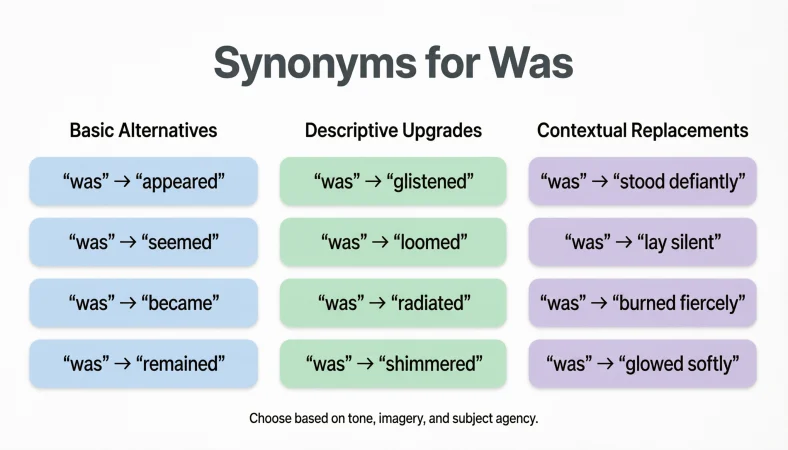
The following table provides a selection of the most versatile and powerful synonyms for “was.”
| Synonym | Meaning | Tone | Best Use Case | Example Sentence |
|---|---|---|---|---|
| Existed | Had a state of being or reality. | Neutral, factual | To emphasize that something was real or present. | The ancient civilization existed for over a thousand years. |
| Lived | Resided or experienced a particular life. | Narrative, emotional | For describing life, experiences, or periods of time. | She lived in Paris for a decade. |
| Remained | Stayed in the same state or place. | Formal, stable | To show continuity or that something did not change. | The building remained empty for years. |
| Occurred | Happened or took place. | Objective, reporting | For describing events, incidents, or situations. | The accident occurred at midnight. |
| Acted | Performed a specific function or role. | Active, professional | To describe a temporary role or a specific action. | He acted as a mediator between the two parties. |
| Served | Fulfilled a function or was useful. | Formal, professional | For roles, duties, or functional purposes. | The old warehouse served as a studio. |
| Felt | Experienced a physical or emotional sensation. | Personal, introspective | To describe an emotional or physical state. | She felt happy to see her friends. |
| Appeared | Seemed or gave the impression of being. | Descriptive, observational | For subjective observations or perceptions. | The project appeared to be on schedule. |
Common Synonyms for Was
These are everyday synonyms for “was” that can be used in general conversation, informal writing, and fiction to add variety.
Was
- Short meaning: A general past-tense linking verb.
- Best context: Basic statements of identity, location, or condition.
- Example: My car was in the shop.
Lived
- Short meaning: To have resided or experienced a specific kind of life.
- Best context: Describing a person’s life or experiences.
- Example: My grandfather lived a long and happy life.
Had the Role of
- Short meaning: To have been in a particular position or job.
- Best context: Describing someone’s job or temporary function.
- Example: In the play, she had the role of a queen.
Felt Like
- Short meaning: Gave the impression or sensation of.
- Best context: Describing a subjective emotional or physical state.
- Example: The party felt like a huge success.
Turned Out
- Short meaning: Ended up being or resulted in a certain way.
- Best context: Describing an unexpected outcome.
- Example: The experiment turned out to be a disaster.
Formal Synonyms for Was
For academic papers, business reports, or professional communication, these formal alternatives will elevate your writing.
Existed
- Best context: Academic and business writing to state a fact or reality.
- Explanation: This is a strong, factual word that avoids the passive feel of “was.
- Example: A clear pattern existed in the data collected.
Occurred
- Best context: Formal reports and academic papers to describe events.
- Explanation: It’s a precise and objective way to say something happened.
- Example: The incident occurred during the final quarter of the fiscal year.
Remained
- Best context: Professional analysis to show consistency or stability.
- Explanation: It’s a powerful, formal word for describing a state that didn’t change.
- Example: The core values of the company remained unchanged for fifty years.
Served As
- Best context: Business and formal writing to describe a purpose or function.
- Explanation: This is a dynamic phrase that adds clarity to a role or purpose.
- Example: The basement served as a storage room for decades.
Functioned As
- Best context: Technical writing to describe a specific purpose.
- Explanation: It emphasizes the practical or operational aspect of a state.
- Example: The spare room functioned as a home office.
Informal Synonyms for Was
Use these casual alternatives in friendly emails, personal messages, social media, and fiction dialogue.
Was Like
- Best context: Casual conversations, recounting stories.
- Explanation: A common filler in spoken English used to introduce a quote or paraphrase.
- Example: He was like, “I’ll meet you there at noon.”
Wound Up
- Best context: Describing an unexpected final state.
- Explanation: An informal way to say something ultimately became or ended up.
- Example: How did you wind up in Canada?
Ended Up
- Best context: Describing a final result or destination.
- Explanation: A relaxed way to describe how a situation concluded.
- Example: We ended up staying home and watching movies.
Felt
- Best context: Sharing personal feelings and emotions.
- Explanation: A simple and heartfelt way to describe an emotional state.
- Example: I felt so confused after the meeting.
Came Across As
- Best context: Describing a first impression in a casual way.
- Explanation: This phrase is a relaxed alternative to “appeared” or “seemed.”
- Example: Your idea came across as really innovative.
Strong Synonyms for Was
When you need to express a powerful idea or emphasize a point, these strong synonyms pack a punch.
Existed
- When to use: To strongly assert the reality of something.
- Explanation: This is a definitive and emphatic statement of being.
- Example: Love existed between them, even after all those years.
Lived
- When to use: To emphasize a vibrant or significant life.
- Explanation: It conveys a sense of life and energy beyond a simple existence.
- Example: For a brief moment, she lived as if she were free.
Occurred
- When to use: To highlight a significant or impactful event.
- Explanation: It gives weight to the event you’re describing.
- Example: A tragedy occurred that would change the world forever.
Prevailed
- When to use: To show dominance, success, or that something was the most common.
- Explanation: A very strong word indicating that something was triumphant or widespread.
- Example: Chaos prevailed in the aftermath of the storm.
Fluctuated
- When to use: To describe something that changed often.
- Explanation: This is stronger and more specific than “was changing,” implying constant motion.
- Example: The stock prices fluctuated wildly during the recession.
Mild Synonyms for Was
Sometimes, a softer touch is needed. These mild synonyms are useful when you want to be less assertive or more neutral.
Seemed
- When to use: For subjective impressions or when you want to avoid making a definitive statement.
- Explanation: It softens the claim and introduces an element of doubt.
- Example: The situation seemed under control.
Appeared
- When to use: Similar to “seemed,” but often based on visible evidence.
- Explanation: It suggests the impression is based on what can be seen.
- Example: The boss appeared to be in a good mood.
Felt
- When to use: To describe a personal, internal impression.
- Explanation: It’s soft and personal, drawing on internal sensation rather than fact.
- Example: The room felt strangely empty.
Came Across As
- When to use: To describe an impression in a low-stakes setting.
- Explanation: It’s a very mild and non-committal way to describe someone or something.
- Example: She came across as very confident, but I wasn’t sure if she really was.
Turned Out
- When to use: To describe an outcome without assigning blame or cause.
- Explanation: A neutral way to describe a result that may have been unexpected.
- Example: The plan turned out to be a great success.
Synonyms for Was by Context
Everyday Conversation
In casual chats, simple replacements like “felt,” “seemed,” or “turned out” are your best bets. They’re natural and easy to slip into a sentence. For example, instead of saying “The movie was good,” try “The movie turned out good.”
Professional Writing
In business reports or emails, use “remained,” “served as,” or “functioned as.” These words are precise and add a layer of professionalism to your writing. You might say “The budget remained unchanged” rather than “The budget was unchanged.”
Academic Writing
For essays and research papers, “existed,” “occurred,” and “prevailed” are excellent choices. They introduce a formal, analytical tone. For instance, “A pattern of behavior existed across all test groups” sounds more academic than “There was a pattern of behavior.”
Creative Writing
This is where you can get the most creative. Use “lived,” “felt,” “appeared,” and “seemed” to paint a vivid picture and show your reader the world you’re creating. Instead of saying “The house was quiet,” you could write “The house felt unnervingly quiet.”
Another Word for Was in a Sentence
Here are 12 example sentences using different synonyms for “was” to show how they work in practice.
- A strange stillness existed in the forest.
- She lived as a nomad for years before settling down.
- The rules remained in place, even after the new president was elected.
- A significant change occurred in his behavior after the incident.
- The old school served as a makeshift hospital during the war.
- He felt like a prisoner in his own home.
- The plan appeared flawless on paper.
- The knight acted as a defender of the realm.
- The results of the vote fluctuated as more ballots were counted.
- Her new novel came across as a deeply personal memoir.
- The project turned out to be much more difficult than anticipated.
- Justice prevailed in the end.
Was Synonyms Compared
Let’s compare some of the most commonly confused synonyms for “was.”
| Synonym | Meaning & Use | Best Context | Why Not Always Use It? |
|---|---|---|---|
| Existed | Stresses the simple fact of being or reality. | When you need to emphasize that something was real or present. | Can sound too formal or clinical in casual conversation. |
| Lived | Focuses on a period of life or a type of experience. | For describing a person’s life or a dynamic period. | It’s a bit too dramatic for simple, everyday states. |
| Remained | Emphasizes a state of continuity and that something didn’t change. | To show stability or lack of change. | Doesn’t work if you’re talking about something that did change or a one-time event. |
| Occurred | Points to an event, an incident, or something that took place. | Formal writing, reports, or narrating a specific event. | It’s not a direct replacement for “was” in simple identity statements. |
Words Similar to Was
These words are related to “was” but are not exact synonyms. They often describe a state of being but with a specific nuance.
- Became (Related): This implies a transition or a change of state. It means “began to be,” which is different from simply being. You wouldn’t say “He became a doctor” if he was already a doctor.
- Got (Related): An informal way to indicate a change of state (e.g., “He got tired”). It’s not a direct replacement for the simple past “was” but is a similar linking verb.
- Stood (Related): Often used to describe a building or object’s position. It’s more specific than “was.” For example, “The house stood on the hill” is a more vivid image than “The house was on the hill.”
Antonyms of Was
- Wasn’t: The negative form of “was.”
- Meaning: Was not.
- Example: He wasn’t the leader.
- Is: The present tense of “was.”
- Meaning: States a current condition.
- Example: He is the leader now.
- Became: Indicates a transition to a state.
- Meaning: Began to be.
- Example: He became the leader.
- Died: The end of a living state.
- Meaning: Stopped living.
- Example: The king died.
How to Choose the Right Synonym for Was
Choosing the right word can be done in seven simple steps:
- Analyze the Context: Is this an academic paper, a casual blog, or a novel? Your choice depends heavily on the setting.
- Identify the Tone: Are you trying to be formal, objective, subjective, or emotional?
- Check the Intensity: Are you making a strong statement or a gentle observation?
- Consider Your Reader: Write with your audience in mind. Are they executives or friends?
- Verify Exactness: Is the synonym an exact replacement for “was,” or does it imply a different meaning like change or action?
- Read It Aloud: Does the new sentence sound natural?
- Prioritize Clarity: Always choose the simpler, clearer word if you’re in doubt.
Common Mistakes When Using Synonyms for Was
- Using a Formal Word Casually: You might sound pretentious if you say “The party occurred at 8 PM” in a text message. “Was” or a simpler word is better.
- Using a Strong Word Out of Context: A sentence like “The sandwich existed on the table” is overly dramatic and unnatural.
- Using a Substitute That Changes the Meaning: For example, “became” is not a synonym for “was.” It means something different.
- Forcing a Replacement: Sometimes, “was” is the best and most natural word for the job. Don’t change it just for the sake of it if it sounds unnatural.
Quick Synonym List for Was
- Common Synonyms: existed, lived, remained, occurred, felt, seemed
- Formal Synonyms: existed, occurred, remained, served as, functioned as
- Informal Synonyms: was like, wound up, ended up, felt, came across as
- Strong Synonyms: existed, lived, occurred, prevailed, fluctuated
- Mild Synonyms: seemed, appeared, felt, came across as, turned out
- Related Words: became, got, stood, stayed, went
FAQs
What is the best synonym for was?
The best synonym for “was” depends on the context. Existed and lived are generally the most versatile and can replace “was” in many sentences to indicate a state of being or an experience.
What is another word for was in a formal context?
For formal writing, words like existed, occurred, remained, and served as are excellent formal synonyms for “was.” They are precise and elevate the tone of the text.
What is an informal synonym for was?
In casual writing or conversation, was like, wound up, and ended up are common informal synonyms for “was.” They fit naturally in everyday language.
What is a stronger word for was?
Stronger words like prevailed, existed, and lived add emphasis. For example, instead of “He was a hero,” try “He prevailed as a hero” to add power.
What is a milder word for was?
To soften your statement, use seemed, appeared, or felt. These are gentler and suggest a personal impression rather than a hard fact.
What words are similar to was?
Words that are related but not exact synonyms include became, got, and stood. They describe related states, such as a change of state or position.
What is the opposite of was?
The most direct opposite of “was” is wasn’t (was not). Other opposites that imply a change or end include became and died.
How do I choose the right synonym for was?
To choose the right synonym, always consider the context, tone, and intensity of your message. Think about the specific action or state you want to convey and select the word that best fits that purpose.
Conclusion
While “was” is a fundamental part of the English language, relying on it too much can make your writing dull. By understanding its core meaning and exploring the rich variety of synonyms available, you can greatly improve your writing.
Whether you choose the formal precision of “existed,” the casual tone of “ended up,” or the vividness of “lived,” the best word choice is the one that perfectly matches your context, tone, and intended meaning. Replace “was” thoughtfully, and your writing will be stronger, clearer, and more engaging.