Quick Ans: The best alternatives for I are myself, me, the writer, this author, this speaker, and the person speaking. The right choice depends on grammar, context, tone, and whether the writing is personal, professional, academic or creative.
In everyday English, “I” is usually the clearest and most natural choice. In formal writing, writers may sometimes avoid repeating “I” by changing the sentence structure instead of replacing the pronoun.
Finding synonyms for I can be confusing because “I” is not a normal vocabulary word. It is a first-person singular subject pronoun used to identify the person speaking or writing. Unlike many words, “I” does not have many direct synonyms that can replace it in every sentence.
The best alternatives depend on the sentence structure, writing style, and purpose. In some cases, words like myself, me, the writer, the speaker, this author, or this person may work. However, many alternatives change the meaning or make the sentence sound unnatural.
What Does I Mean?
“I” is a first-person singular pronoun used when a person talks about themselves as the subject of a sentence.
It shows that the speaker or writer is performing an action, having a feeling, or sharing an opinion.
Examples:
- I finished my project yesterday.
- I believe this idea can help others.
In grammar, “I” is called a subject pronoun because it usually appears before the verb and tells who performs the action.
Other first-person pronouns include:
- Me — used as an object
- My — shows ownership
- Mine — shows possession
- Myself — used for emphasis or reflexive actions
Core Meaning of I
The core meaning of “I” is the person who is speaking or writing. It represents personal identity, personal experience, opinions, actions, and thoughts.
The word creates a direct connection between the message and the person sharing it.
For example:
- I enjoyed the movie.
This sentence clearly shows that the speaker personally experienced enjoyment.
Replacing “I” with another expression may change the feeling:
- The writer enjoyed the movie.
This sounds more distant and formal because the speaker refers to themselves from another viewpoint.
Grammar and Usage Notes
Part of Speech
“I” is a first-person singular subject pronoun.
It is always written with a capital letter, even when it appears in the middle of a sentence.
Correct:
- My friend and I went shopping.
Incorrect:
- My friend and i went shopping.
Common Sentence Patterns
“I” commonly appears with action verbs:
- I work from home.
- I study English.
- I write articles.
It can also appear with linking verbs:
- I am happy.
- I am ready.
When I Sounds Natural
“I” is the most natural choice for:
- Personal stories
- Conversations
- Emails
- Opinions
- Reflections
- Creative writing
Example:
- I learned a valuable lesson from that experience.
When Another Expression May Work Better
Some formal writing avoids repeated use of “I.” Instead of replacing it with an awkward synonym, writers often restructure sentences.
Instead of:
- I conducted the research and I analyzed the results.
A more formal version:
- The research was conducted, and the results were analyzed.
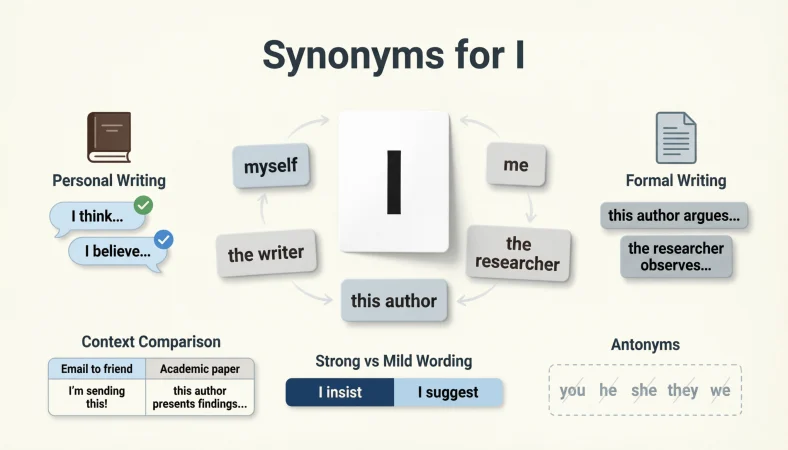
Best Synonyms for I
Because “I” is a grammatical pronoun, exact replacements are limited. The following alternatives work only in specific situations.
| Synonym | Meaning | Tone | Best Use Case | Example Sentence |
|---|---|---|---|---|
| Myself | Refers back to the speaker | Neutral | Emphasis or reflection | I completed the task myself. |
| Me | Refers to the speaker as an object | Neutral | After verbs or prepositions | She gave me advice. |
| This author | Refers to the writer | Formal | Articles and academic writing | This author believes further research is needed. |
| The writer | Refers to the person writing | Formal | Reports and analysis | The writer explains the main argument. |
| This speaker | Refers to the person talking | Formal | Speeches and discussions | This speaker supports the proposal. |
| The person speaking | Identifies the speaker | Neutral | Explanatory writing | The person speaking shares personal views. |
Common Synonyms for I
Myself
“Myself” is related to “I” but cannot replace it in every sentence. It is mainly used when the subject and object are the same person or when adding emphasis.
Example:
- I fixed the computer myself.
Best used for:
- Emphasis
- Personal responsibility
- Self-reference
Me
“Me” is another first-person pronoun, but it works as an object rather than a subject.
Example:
- She called me yesterday.
Do not replace “I” with “me” when “I” is the subject.
Incorrect:
- Me went to the store.
Correct:
- I went to the store.
The Writer
“The writer” is useful when discussing a piece of writing from a more objective viewpoint.
Example:
- The writer explains the importance of clear communication.
Best used in:
- Reviews
- Literary analysis
- Academic discussions
This Author
“This author” is a formal alternative often used by writers referring to their own work.
Example:
- This author suggests that language changes over time.
Best used in:
- Research papers
- Professional articles
- Formal essays
Formal Synonyms for I
In formal writing, replacing “I” is often less about finding a synonym and more about changing perspective.
Useful formal alternatives include:
This Author
This phrase creates a professional tone and clearly identifies the writer.
Example:
- This author examines the relationship between language and communication.
The Researcher
Useful when referring to someone conducting a study.
Example:
- The researcher collected information from multiple sources.
The Present Writer
A highly formal phrase sometimes used in academic writing.
Example:
- The present writer argues that the topic requires further discussion.
The Speaker
Useful when discussing speeches, interviews, or presentations.
Example:
- The speaker highlights the importance of teamwork.
Informal Synonyms for I
In casual communication, “I” usually remains the best choice. However, some expressions can replace it depending on context.
Me
Used naturally when talking about yourself as the object.
Example:
- They invited me to the event.
Myself
Used for emphasis.
Example:
- I made this decision myself.
Your Friend
Sometimes used playfully in messages.
Example:
- Your friend is ready for the weekend.
This is informal and depends on the relationship between speakers.
Strong Synonyms for I
There are no true stronger synonyms for “I” because the word only identifies the speaker. However, some alternatives create stronger emphasis.
Myself
Adds personal responsibility.
Example:
- I myself completed the entire project.
This Very Person
Creates dramatic emphasis in creative writing.
Example:
- This very person changed the course of history.
Use these carefully because they may sound unusual in everyday writing.
Mild Synonyms for I
“I” is already a neutral word. Softer alternatives usually come from changing sentence structure.
Examples:
Instead of:
- I think this solution works.
You can write:
- It appears that this solution works.
- The evidence suggests that this solution works.
These versions sound less personal and more objective.
Synonyms for I by Context
The best alternative for “I” depends heavily on where and how you are writing. Since “I” is a grammatical pronoun, many replacements are not direct synonyms. Instead, writers often choose different structures to create a more formal, objective, or creative tone.
Everyday Conversation
In daily conversations, “I” is almost always the most natural option. Replacing it too often can make speech sound strange or overly formal.
Common alternatives and related expressions include:
Me
“Me” is used when the speaker receives an action or appears after a preposition.
Examples:
- My friend told me about the event.
- She asked me a question.
Use “me” instead of “I” only when grammar requires an object pronoun.
Myself
“Myself” adds emphasis and shows personal involvement.
Examples:
- I prepared the meal myself.
- I completed the assignment myself.
It works best when you want to highlight personal effort.
My Own
“My own” shows personal ownership or responsibility.
Examples:
- I created my own design.
- I made my own choice.
It does not replace “I” directly but expresses personal connection.
Professional Writing
Professional writing often aims for clarity and objectivity. Instead of repeatedly using “I,” writers may refer to their role or change the sentence structure.
Useful alternatives include:
This Author
Best for articles, essays, and formal discussions.
Example:
- This author believes that clear communication improves teamwork.
The Writer
Useful when analyzing written work.
Example:
- The writer presents several solutions to the problem.
The Researcher
Appropriate for studies and reports.
Example:
- The researcher collected data from different sources.
The Consultant
Useful when describing professional advice.
Example:
- The consultant recommends improving the current strategy.
Academic Writing
Academic writing often limits personal language, especially in research papers. However, some fields allow first-person writing when explaining methods or arguments.
Alternatives include:
The Study
Used when referring to research findings.
Example:
- The study examines the effects of online learning.
The Research Team
Useful when multiple people conducted research.
Example:
- The research team analyzed the collected information.
This Analysis
Helps create an objective academic tone.
Example:
- This analysis explores the relationship between language and meaning.
Creative Writing
Creative writing usually benefits from using “I” because it creates a personal voice. However, writers sometimes use other viewpoints for style.
Possible alternatives include:
The Narrator
Used when discussing a storytelling voice.
Example:
- The narrator describes the journey through personal memories.
The Character
Used when discussing fictional experiences.
Example:
- The character reveals hidden emotions through the story.
This Soul
A poetic expression used for emotional writing.
Example:
- This soul searched for answers among the stars.
Marketing Copy
Marketing writing usually focuses on the reader rather than the writer. Instead of repeating “I,” brands often use a company voice.
Examples:
Our Team
Example:
- Our team creates solutions designed for customers.
Our Experts
Example:
- Our experts provide professional guidance.
The Brand
Example:
- The brand focuses on quality and trust.
Emotional Expression
When expressing feelings, “I” creates a direct and personal connection.
Related expressions include:
My Heart
Example:
- My heart feels grateful for this opportunity.
My Mind
Example:
- My mind keeps returning to that idea.
Myself
Example:
- I discovered something new about myself.
These expressions add emotional depth but do not replace “I” in normal sentences.
Another Word for I in a Sentence
Because “I” is a pronoun, the best replacement depends on grammar and meaning. Here are realistic examples:
- I completed the project on time.
- The writer completed the project on time.
- This author completed the project on time.
- I myself completed the project on time.
- The researcher completed the experiment successfully.
- The speaker explained the idea clearly.
- The narrator described the scene beautifully.
- Our team developed a better solution.
- This analysis explores the main issue.
- The present writer examines the topic carefully.
- The researcher discovered new information.
- My own experience shaped my opinion.
- The person speaking shares a different perspective.
- This contributor provided useful feedback.
- The creator designed a unique approach.
I Synonyms Compared
Different alternatives for “I” create different impressions. Choosing the wrong one can make writing sound unnatural.
| Word or Phrase | Meaning | Tone | Best Use |
|---|---|---|---|
| I | The person speaking or writing | Neutral | Everyday writing and speech |
| Me | The speaker as an object | Neutral | After verbs or prepositions |
| Myself | The speaker with emphasis | Neutral | Showing personal effort |
| This author | The person who wrote the text | Formal | Articles and essays |
| The researcher | A person conducting research | Academic | Studies and reports |
| The narrator | The voice telling a story | Creative | Fiction and storytelling |
| Our team | A group speaking together | Professional | Business communication |
Words Similar to I
Some words are connected to “I” but are not exact replacements.
Self
“Self” refers to a person’s identity or personality.
Example:
- Understanding the self can improve confidence.
It cannot replace “I” in normal sentences.
Individual
“Individual” refers to one person.
Example:
- Each individual has different experiences.
It is broader and more general than “I.”
Person
“Person” identifies a human being.
Example:
- One person can make a difference.
It does not show that the speaker is referring to themselves.
Identity
“Identity” describes who someone is.
Example:
- Personal identity develops over time.
It relates to “I” but has a deeper meaning.
Selfhood
“Selfhood” refers to the state of being a distinct person.
Example:
- Selfhood is an important topic in philosophy.
It is a concept, not a replacement for the pronoun.
Antonyms of I
“I” does not have a true antonym because it is a grammatical pronoun. However, some words represent opposite ideas, such as removing personal focus or referring to others.
| Word | Meaning | Example Sentence |
| You | Refers to another person | You completed the task successfully. |
| They | Refers to other people | They finished the project. |
| Others | People different from oneself | Others may have different opinions. |
| Group | Multiple people together | The group reached an agreement. |
| Community | A collection of people | The community supported the idea. |
How to Choose the Right Synonym for I
Choosing an alternative for “I” requires understanding grammar, purpose, and tone.
Match the Context
A formal report may use “the researcher,” while a personal message should usually use “I.”
Match the Tone
Ask whether you want the sentence to sound:
- Personal
- Professional
- Objective
- Creative
- Emotional
Check the Intensity
Some alternatives add emphasis. “Myself” highlights personal responsibility, while “the writer” creates distance.
Think About the Reader
Choose words that help readers understand your message quickly.
Check Accuracy
A related word is not always a replacement. “Individual” and “self” connect to personal identity but cannot replace “I” in most sentences.
Keep Sentences Natural
Avoid replacing simple words with complicated phrases.
Clear:
- I believe this idea works.
Less natural:
- This author personally believes this idea works.
Common Mistakes When Using Synonyms for I
Using Me Instead of I
Incorrect:
- Me completed the assignment.
Correct:
- I completed the assignment.
Using Formal Words in Casual Writing
Example:
- This author wants pizza tonight.
This sounds unnatural because “this author” is too formal for everyday conversation.
Replacing Every I
Not every “I” needs a replacement. Too many alternatives can make writing confusing.
Treating Related Words as Exact Synonyms
Words like “self,” “person,” and “individual” are related to “I” but have different meanings.
Making Writing Sound Artificial
Simple language is often stronger than unnecessary formal phrases.
Quick Synonym List for I
Common Synonyms
- Me
- Myself
- My own
Formal Synonyms
- This author
- The writer
- The researcher
- The speaker
- The present writer
Informal Alternatives
- Me
- Myself
- Your friend
Strong Alternatives
- Myself
- I myself
- This very person
Mild Alternatives
- The writer
- The speaker
- This analysis
Related Words
- Self
- Individual
- Person
- Identity
- Selfhood
FAQs
What is the best synonym for I?
The best synonym for “I” depends on the sentence. In most cases, “I” is already the correct and clearest choice. Alternatives like “myself,” “this author,” or “the writer” work only in specific contexts.
What is another word for I?
Another word for “I” can be “myself” in some situations, but there is no universal replacement because “I” is a grammatical subject pronoun.
What is a formal synonym for I?
Formal alternatives include “this author,” “the writer,” “the researcher,” and “the speaker.” These are useful when creating a more objective style.
What is an informal synonym for I?
In informal communication, “me” and “myself” are common related words. However, “I” is usually the most natural choice.
What is a stronger word for I?
There is no stronger synonym for “I,” but “myself” can add emphasis when showing personal responsibility.
What is a milder word for I?
A milder alternative usually comes from removing the personal focus, such as using “the writer,” “the study,” or “this analysis.”
What words are similar to I?
Words similar to “I” include self, individual, person, identity, and myself. These words relate to personal identity but are not always direct replacements.
What is the opposite of I?
“I” does not have a true opposite, but words like “you,” “they,” and “others” shift attention away from the speaker.
Conclusion
Finding the right alternative among synonyms for I requires more than replacing one word with another. Since “I” is a first-person pronoun, most alternatives only work in certain situations.
The best choice depends on meaning, grammar, tone, and context. In personal writing, “I” is usually the clearest option. In professional or academic writing, phrases like “the researcher” or “this author” may create a more formal style.
Good word choice is not about avoiding “I” completely. It is about using the language that communicates your message naturally and clearly.