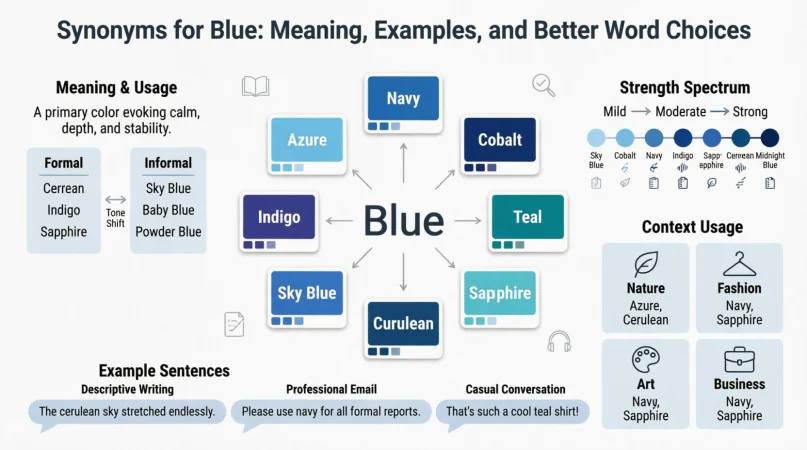
Quick Ans: The best synonyms for blue are azure, cerulean, navy, sapphire, and indigo for color; melancholy, downcast, gloomy, dejected, and somber for mood. The right choice depends on whether you’re describing a shade, an emotion, or a tone.
The best synonyms for blue depend entirely on what you’re describing. If you’re talking about color, words like azure, cerulean, navy, and sapphire offer more precision than “blue” alone. If you’re describing a mood, alternatives like melancholy, downcast, or gloomy may fit better than a simple color word.
Finding the right synonym for blue isn’t about replacing a word. It’s about matching meaning, tone, context, and intensity to what you actually want to say. The right choice can make your writing clearer, more vivid, and more emotionally accurate.
This guide gives you over 50 synonyms for blue, organized by how and when to use them. You’ll find formal and informal options, strong and mild alternatives, context-specific recommendations, and practical examples to help you choose wisely.
What Does Blue Mean?
Blue is a primary color visible in the sky and sea. As an adjective, it describes a range of hues between green and violet on the color spectrum. As an emotion, “blue” refers to feelings of sadness, low spirits, or melancholy.
The word carries both literal and figurative meanings in everyday language.
Examples:
- She painted the walls a soft blue that reminded her of the ocean.
- He’s been feeling blue ever since he got the news.
Core Meaning of Blue
At its simplest, blue is a color. It’s the color of a clear sky on a sunny day, of deep ocean water, and of certain flowers and gemstones. In design and art, blue is considered a cool color, often associated with calmness, stability, and depth.
But blue also lives in the emotional world. When someone says they feel blue, they’re expressing sadness or a low mood. This usage dates back centuries and appears in idioms like “feeling blue” and “the blues” (a genre of music that expresses sorrow).
In business and professional contexts, blue can also refer to something formal, conservative, or traditional think “blue-collar” or “blue-ribbon.”
Understanding which meaning you’re working with is the first step to choosing the right synonym.
Grammar and Usage Notes
Part of Speech:
- Adjective (most common): The blue sky.
- Noun: She wore a shade of blue.
- Verb (less common): The sky began to blue at dawn.
Common Sentence Patterns:
- As a color: [Noun] is/was blue. / The [noun] had a blue hue.
- As an emotion: [Someone] feels blue. / [Someone] has been blue lately.
- As a noun: The blue of the ocean. / A deep blue.
Common Collocations:
- Deep blue
- Bright blue
- Pale blue
- Dark blue
- Feeling blue
- Blue mood
- True blue
- Once in a blue moon
When Blue Sounds Natural:
Blue works well in most contexts. It’s a common, everyday word that nearly everyone understands. Use it when you want straightforward, clear communication without special emphasis.
When a Synonym May Work Better:
Use a synonym when you need more precision (e.g., “azure” for a specific shade), a different tone (e.g., “melancholy” for a formal description of sadness), or stronger emotional impact (e.g., “despondent” for deeper despair).
Best Synonyms for Blue
| Synonym | Meaning | Tone | Best Use Case | Example Sentence |
|---|---|---|---|---|
| Azure | Bright blue, like a clear sky | Neutral to formal | Describing skies, water, or gemstones | The azure water stretched to the horizon. |
| Cerulean | Deep sky blue | Formal, artistic | Creative writing, art description | The cerulean ceiling made the room feel open. |
| Navy | Dark blue, like a sailor’s uniform | Neutral | Describing clothing, paint, or formal colors | She wore a navy blazer to the meeting. |
| Sapphire | Rich blue, like the gemstone | Elegant, formal | Jewelry, luxury, descriptive writing | Her sapphire eyes caught the light. |
| Indigo | Deep purplish blue | Neutral to formal | Color description, design, nature | The indigo dye stained his fingers. |
| Cobalt | Intense blue, like the mineral | Neutral to formal | Art, science, design | The cobalt tiles gave the kitchen a bold look. |
| Turquoise | Greenish-blue | Casual to neutral | Nature, jewelry, casual description | She wore a turquoise necklace. |
| Teal | Blue-green | Neutral | Design, fashion, nature | The teal curtains matched the pillows. |
| Melancholy | Deep sadness | Formal | Writing about emotions, literature | A melancholy mood settled over the room. |
| Downcast | Sad, with low spirits | Neutral | Everyday description of mood | He looked downcast after the news. |
| Gloomy | Dark and sad | Neutral to informal | Weather, moods, general description | The gloomy weather matched his spirits. |
| Dejected | Depressed or disheartened | Formal | Describing someone who’s lost hope | She felt dejected after the rejection. |
| Somber | Dark, serious, or sad | Formal | Serious situations, memorials | The somber crowd stood in silence. |
| Depressed | Extremely sad, clinical | Neutral to formal | Mental health, strong emotions | He’s been depressed for weeks. |
| Despondent | Without hope | Formal | Strong emotional states | They were despondent over the loss. |
Common Synonyms for Blue
Everyday synonyms are the ones you’ll use most often in normal conversation, casual writing, and general communication. They’re familiar, accessible, and usually don’t require explanation.
Navy
Meaning: A very dark shade of blue, like the color of a sailor’s uniform.
Best Context: Fashion, design, paint colors, formal wear.
Example: He chose a navy suit for the interview.
Sky Blue
Meaning: A light, bright shade of blue, like a clear daytime sky.
Best Context: Describing weather, baby items, soft colors.
Example: The nursery was painted a cheerful sky blue.
Turquoise
Meaning: A greenish-blue color, named after the gemstone.
Best Context: Jewelry, tropical settings, Southwestern design.
Example: The turquoise water was so clear she could see the bottom.
Teal
Meaning: A medium to dark blue-green color.
Best Context: Design, fashion, nature writing.
Example: The teal bird had a striking plumage.
Deep Blue
Meaning: Any rich, dark blue shade.
Best Context: Oceans, night skies, dramatic descriptions.
Example: The deep blue ocean stretched for miles.
Feeling Blue
Meaning: Feeling sad, low, or melancholy.
Best Context: Casual conversations about emotions.
Example: I’ve been feeling blue since the trip ended.
Formal Synonyms for Blue
When writing professionally, academically, or formally, you’ll want synonyms that carry a more sophisticated tone. These words work well in essays, reports, business communications, and formal speech.
Azure
Meaning: A bright, clear sky-blue.
Best Use: Formal descriptions of nature, skies, or water. Often used in literature and poetry.
Example: The azure horizon promised a beautiful day ahead.
Cerulean
Meaning: A deep blue like the sky on a clear day.
Best Use: Artistic, poetic, or formal description. Common in art history and color theory.
Example: The cerulean vault of the sky was uninterrupted by clouds.
Sapphire
Meaning: A rich, gemstone blue.
Best Use: Jewelry descriptions, luxury branding, formal writing about color.
Example: The sapphire accents on the dress gave it an air of elegance.
Cobalt
Meaning: An intense, brilliant blue.
Best Use: Scientific, artistic, and design contexts where precision matters.
Example: The cobalt pigment was expensive but produced unmatched brilliance.
Indigo
Meaning: A deep purplish-blue.
Best Use: Color theory, design, historical contexts (e.g., indigo dye).
Example: The indigo fabric was prized throughout history.
Melancholy
Meaning: A thoughtful, pensive sadness.
Best Use: Literary, psychological, or formal writing about emotions.
Example: The scene left her in a melancholy state.
Somber
Meaning: Dark, gloomy, or serious.
Best Use: Formal occasions, memorials, serious discussions.
Example: The somber procession moved slowly through the streets.
Dejected
Meaning: Sad and disheartened.
Best Use: Formal descriptions of emotional states, psychology.
Example: He left the meeting dejected after his proposal was rejected.
Despondent
Meaning: Without hope or enthusiasm.
Best Use: Strong emotional descriptions, formal writing.
Example: The team was despondent after the devastating loss.
Informal Synonyms for Blue
Informal alternatives are great for conversation, social media, friendly writing, and everyday communication. They’re less stuffy and more approachable.
Blue-ish
Meaning: Somewhat blue, not exactly blue.
Best Use: Casual descriptions when you’re not sure of the exact shade.
Example: The water looked blue-ish in the morning light.
Baby Blue
Meaning: A very light, soft shade of blue.
Best Use: Describing soft colors, baby items, nostalgic contexts.
Example: She wore a baby blue dress to the picnic.
Down
Meaning: Feeling sad or low.
Best Use: Casual conversations about mood.
Example: I’ve been feeling down lately.
Low
Meaning: Feeling low-spirited or sad.
Best Use: Everyday talk about mood.
Example: He’s been low ever since the breakup.
Bummed
Meaning: Disappointed or mildly sad.
Best Use: Friendly conversations, social media.
Example: I’m so bummed we can’t go to the concert.
Bummed Out
Meaning: More strongly disappointed or sad.
Best Use: Casual venting or expressing disappointment.
Example: She was bummed out about the test results.
Blah
Meaning: Feeling dull, flat, or mildly sad.
Best Use: Describing a neutral-to-low mood.
Example: I’ve been feeling kind of blah all week.
The Blues
Meaning: A feeling of sadness or depression.
Best Use: Casual idiom, music references.
Example: He’s got the blues again.
Strong Synonyms for Blue
Strong synonyms convey more intensity, emotion, or power. Use these when you need to make an impact or describe something with emphasis.
Depressed
Meaning: Severely sad, often with clinical implications.
Best Use: When describing significant sadness, mental health, or strong emotion. Be mindful of the weight of this word.
Example: She’s been depressed for months and needs support.
Despondent
Meaning: Without hope, deeply discouraged.
Best Use: Describing someone who has lost all optimism.
Example: He became despondent after his business failed.
Crestfallen
Meaning: Sad and disappointed, especially after a letdown.
Best Use: Describing someone who had high hopes that were dashed.
Example: He was crestfallen when he didn’t get the job.
Heartbroken
Meaning: Overwhelmed with grief or sadness.
Best Use: Emotional writing, relationships, loss.
Example: She was heartbroken after the breakup.
Forlorn
Meaning: Pitifully sad, lonely, or abandoned.
Best Use: Literary or emotional writing.
Example: The forlorn child sat alone on the steps.
Doom and Gloom
Meaning: A very negative, pessimistic outlook.
Best Use: Describing an overly negative mood or situation.
Example: Stop with the doom and gloom; things will get better.
Mild Synonyms for Blue
Mild synonyms are softer, less intense, and more neutral. They work when you want to avoid strong language or when you’re describing something subtle.
Gloomy
Meaning: Dark or mildly sad.
Best Use: Weather, moods, general descriptions.
Example: The gloomy day matched his quiet mood.
Downcast
Meaning: Sad or discouraged.
Best Use: Describing someone’s appearance or mood.
Example: She walked with a downcast look.
Low-Spirited
Meaning: In a low or sad mood.
Best Use: Mildly formal descriptions.
Example: He’s been low-spirited since the news.
Sad
Meaning: Unhappy, sorrowful.
Best Use: Everyday emotion description.
Example: She felt sad about moving away.
Melancholy
Meaning: Pensive and slightly sad.
Best Use: Literary or soft emotional descriptions.
Example: The song had a melancholy feel to it.
Downhearted
Meaning: Discouraged, slightly sad.
Best Use: Mild emotional descriptions.
Example: She was downhearted after the rejection.
Synonyms for Blue by Context
The right synonym depends heavily on what you’re writing about. Here are the best options by context.
Everyday Conversation
In casual talk, stick with simple, familiar words:
- Blue – the go-to for most situations
- Sky blue – for light shades
- Navy – for dark shades
- Feeling blue – for emotion
- Down – casual sadness
Professional Writing
Business and formal writing needs precise, professional language:
- Navy – for suits, uniforms, formal colors
- Sapphire – for luxury or product descriptions
- Cobalt – for technical or scientific contexts
- Cerulean – for design or artistic precision
- Somber – for serious moods or tones
Academic Writing
Academic contexts require formal, precise language:
- Melancholy – for psychological or literary analysis
- Cerulean – for color theory or art history
- Indigo – for historical or scientific writing
- Dejected – for psychology or social sciences
- Despondent – for strong emotional states in research
Creative Writing
Creative writing rewards vivid, varied vocabulary:
- Azure – poetic sky descriptions
- Cerulean – artistic color choices
- Sapphire – for striking descriptions
- Melancholy – for emotional depth
- Forlorn – for lonely, sad characters
- Cobalt – for dramatic, intense colors
- Turquoise – for tropical or exotic settings
Marketing Copy
Marketing needs words that evoke emotion and desire:
- Sapphire – luxury, sophistication
- Azure – escape, clarity, calm
- Navy – trust, professionalism
- Cobalt – bold, confident
- Teal – trendy, modern
Emotional Expression
When expressing feelings, choose words that match the intensity:
- Sad – mild, everyday
- Melancholy – thoughtful, artistic
- Depressed – severe, clinical
- Heartbroken – extreme, romantic
- Despondent – hopeless, serious
- Gloomy – mild to moderate
Technical Writing
Technical and scientific writing demands precision:
- Cobalt – pigment, mineral color
- Indigo – dye, light spectrum
- Navy – standardization
- Cerulean – color science
Personal Communication
In messages to friends and family:
- Feeling blue – relatable idiom
- Down – casual and clear
- Bummed – friendly disappointment
- Low – simple and understandable
Another Word for Blue in a Sentence
Here are natural example sentences using different synonyms for blue.
- The azure sky stretched endlessly above the ocean.
- She wore a navy blazer to the business lunch.
- His mood had been melancholy ever since the winter began.
- The cerulean water of the Caribbean was breathtaking.
- He felt down after hearing the bad news.
- The sapphire earrings caught the light beautifully.
- She was dejected after her application was rejected.
- The turquoise tiles gave the kitchen a Mediterranean feel.
- The somber procession moved in silence.
- He’s been bummed about the cancellation all week.
- The indigo dye stained her hands.
- She looked downcast when she realized the mistake.
- The cobalt glass glowed in the sunlight.
- He was despondent after losing everything in the fire.
- The teal curtains matched the throw pillows perfectly.
Blue Synonyms Compared
Some synonyms for blue are so close in meaning that choosing between them can be tricky. Here’s how to tell them apart.
| Synonym | Meaning | Tone | Intensity | Best Use |
|---|---|---|---|---|
| Azure | Bright sky blue | Neutral | Low | Descriptive, nature |
| Cerulean | Deep sky blue | Formal | Low | Artistic, formal |
| Navy | Very dark blue | Neutral | Low | Fashion, design |
| Sapphire | Gemstone blue | Elegant | Medium | Luxury, description |
| Cobalt | Intense blue | Neutral | Medium | Art, science |
| Melancholy | Pensive sadness | Formal | Medium | Literary, emotional |
| Gloomy | Dark, slightly sad | Neutral | Mild | Weather, moods |
| Dejected | Disheartened | Formal | Medium | Formal emotion |
| Depressed | Severe sadness | Clinical | High | Mental health |
| Despondent | Hopeless | Formal | High | Strong emotion |
Azure vs. Cerulean: Both describe sky blues, but azure is brighter and more common. Cerulean is deeper and more formal.
Melancholy vs. Gloomy: Melancholy is a thoughtful, reflective sadness. Gloomy is darker and can apply to weather or atmosphere, not just mood.
Dejected vs. Depressed: Dejected implies disappointment or loss of confidence. Depressed refers to a more severe, often clinical state.
Navy vs. Cobalt: Navy is a dark, muted blue. Cobalt is brighter and more intense.
Words Similar to Blue
Some words are closely related to “blue” but aren’t exact synonyms. They belong to the same semantic field—color, emotion, or description—but mean something slightly different.
Cyan
Meaning: A greenish-blue color, one of the primary colors in printing.
Why it’s related: It’s a specific shade of blue.
Why it’s not an exact match: Cyan is a technical color term, not used in everyday description.
Aqua
Meaning: A light greenish-blue, like water.
Why it’s related: It’s a shade of blue.
Why it’s not an exact match: Aqua leans more toward green than pure blue.
Ultramarine
Meaning: A deep, intense blue pigment.
Why it’s related: It’s a shade of blue.
Why it’s not an exact match: Ultramarine is a specific artistic pigment, not a general synonym.
Moody
Meaning: Prone to changes in emotion, often sad.
Why it’s related: It connects to the emotional side of blue.
Why it’s not an exact match: Moody means changeable, not necessarily sad.
Pessimistic
Meaning: Tending to see the worst aspects of things.
Why it’s related: It shares the negative emotional space of blue.
Why it’s not an exact match: Pessimism is about outlook, not sadness itself.
Glum
Meaning: Looking or feeling gloomy.
Why it’s related: It’s a synonym for the emotional “blue.”
Why it’s not an exact match: Glum specifically describes appearance or attitude.
Antonyms of Blue
Knowing what’s opposite to blue helps clarify its meaning and gives you more vocabulary options.
| Antonym | Meaning | Example Sentence |
|---|---|---|
| Happy | Feeling joy or contentment | After the good news, she felt happy for the first time in days. |
| Joyful | Full of joy | The joyful celebration lifted everyone’s spirits. |
| Cheerful | Bright, optimistic, happy | Her cheerful attitude made the office feel warmer. |
| Red | A warm, primary color (opposite on the color wheel) | The red dress stood out against the blue sky. |
| Orange | A warm color (opposite of blue) | The orange sunset was the opposite of the blue morning sky. |
| Elated | Extremely happy | He was elated when he got the promotion. |
| Upbeat | Optimistic, cheerful | Despite the setbacks, she remained upbeat. |
| Bright | Full of light, lively | The bright room made her feel less blue. |
How to Choose the Right Synonym for Blue
Choosing the right synonym isn’t about finding a fancy word. It’s about matching your word to your meaning, audience, and purpose.
Match the Context
Are you writing about color or emotion? A formal report or a text message? The context determines which words are appropriate.
Match the Tone
If you’re writing seriously, use formal words. If you’re chatting with friends, informal words feel more natural.
Check the Intensity
How strong is the blue? A light blue needs a lighter word. Intense sadness needs a stronger synonym.
Think About the Reader
Will your reader understand the word? If not, choose a simpler alternative. Clarity matters more than vocabulary.
Check Exactness
Is the synonym exact or only related? Words like “aqua” and “turquoise” are related to blue but not always interchangeable. Use them when precision matters.
Keep the Sentence Natural
If the word sounds forced, choose something else. Natural writing is better than impressive writing.
Use Simple Words When Clarity Matters
In most writing, “blue” is perfectly fine. Use synonyms when you need precision, variety, or a specific tone.
Common Mistakes When Using Synonyms for Blue
Even experienced writers make mistakes with synonyms. Here are the most common pitfalls and how to avoid them.
Using a Word with the Wrong Tone
“Despondent” is too heavy for casual conversation. “Bummed” is too light for a serious situation. Match the word to the tone.
Using a Synonym That’s Too Strong
“Heartbroken” is a strong word. Use it only for genuine grief, not for minor disappointment. “Melancholy” is a better choice for mild sadness.
Using a Formal Word in Casual Writing
“Sapphire” sounds unnatural in everyday speech if you’re just talking about a blue shirt. “Navy” or “dark blue” is more appropriate.
Using a Casual Word in Professional Writing
“Feeling blue” may be too informal for a business report. “Low morale” or “somber mood” fits better.
Replacing Blue Without Checking Meaning
“Aqua” and “cerulean” are both blue, but they’re different shades. Choose the one that matches what you’re actually describing.
Treating Related Words as Exact Synonyms
“Moody” is related to “blue,” but it doesn’t mean the same thing. Use it only when that nuance is intended.
Making the Sentence Sound Unnatural
Don’t force a synonym into a sentence just to avoid using “blue.” Natural writing is better than varied writing.
Quick Synonym List for Blue
Common Synonyms
- Navy
- Sky blue
- Turquoise
- Teal
- Deep blue
Formal Synonyms
- Azure
- Cerulean
- Sapphire
- Cobalt
- Indigo
- Somber
- Dejected
- Despondent
- Melancholy
Informal Synonyms
- Blue-ish
- Baby blue
- Down
- Low
- Bummed
- Bummed out
- Blah
Strong Synonyms
- Depressed
- Despondent
- Crestfallen
- Heartbroken
- Forlorn
Mild Synonyms
- Gloomy
- Downcast
- Low-spirited
- Sad
- Melancholy
- Downhearted
Related Words
- Cyan
- Aqua
- Ultramarine
- Moody
- Glum
FAQs
What is the best synonym for blue?
The best synonym depends on context, such as azure for light blue and melancholy for sadness.
What is another word for blue?
Another word for blue includes azure, navy, cerulean, indigo, and sapphire.
What is a formal synonym for blue?
Formal synonyms for blue include cerulean, cobalt, azure, and melancholy.
What is an informal synonym for blue?
Informal synonyms for blue include down, gloomy, low, and bummed.
What is a stronger word for blue?
Stronger emotional synonyms for blue include depressed, despondent, and heartbroken.
What is a milder word for blue?
Milder alternatives for blue include sad, gloomy, downcast, and melancholy.
What words are similar to blue?
Similar words include cyan, aqua, navy, indigo, and sapphire.
What is the opposite of blue?
The opposite of blue depends on context, such as red or orange for color and happy or joyful for emotions.
How do I choose the right synonym for blue?
Choose a synonym based on the meaning, tone, and situation where you use the word.
Conclusion
Blue is a simple word with a broad range of meanings. It describes everything from the color of the sky to a feeling of sadness. The best synonym for blue depends on what you’re describing, your audience, the tone you want to set, and how much intensity you need.
For color, words like azure, navy, and sapphire give more precision than “blue” alone. For emotion, melancholy, downcast, and depressed offer shades of meaning that “blue” can’t capture on its own. For everyday use, simple words like sad or dark blue usually work just fine.
The goal isn’t to replace “blue” every time you write. The goal is to choose the word that fits your exact meaning, matches your tone, and makes your writing clearer and more effective. That’s the art of choosing the right synonym.