Quick Ans: The best synonyms for alone are solitary, isolated, unaccompanied, solo, by yourself, lone, only, and solely. The right choice depends on whether you’re describing physical isolation, emotional loneliness, uniqueness, or doing something without help.
What is another word for “alone”? The best synonyms for alone depend on whether you mean physically by yourself, emotionally isolated, or the only one of something. Common alternatives include solitary, isolated, unaccompanied, and solo. But choosing the right word goes beyond simple substitution it’s about matching tone, intensity, and context.
This guide explores synonyms for alone with clear explanations, example sentences, and practical advice to help you pick the perfect word every time.
What Does Alone Mean?
Alone is an adjective and adverb that describes being separate from others, without companionship, or without help . The word comes from the Middle English “all one,” meaning entirely one by yourself .
Simple definition: Alone means not with other people or things. It can describe physical isolation, uniqueness, or doing something without assistance.
Example sentences:
- She wanted to be alone after the long day.
- He alone knew the truth about what happened.
- The baby stood alone for the first time.
Core Meaning of Alone
The core idea behind “alone” is singleness or separation. It describes a state where you are the only person or thing in a situation. This can mean:
- Physical separation: No one else is with you in a place.
- Emotional isolation: You feel separate from others, even in a crowd.
- Uniqueness: You are the only one who does something or has a certain quality .
- Self-reliance: You accomplish something without help.
Interestingly, being alone can be positive (seeking solitude) or negative (experiencing loneliness) . Someone might choose to be alone for peace and reflection, while another person might feel isolated and unhappy.
Grammar and Usage Notes
Part of speech: Adjective and adverb.
Important grammar rule: Alone is used only after a verb. It cannot go before a noun .
- ✅ Correct: “She is alone.”
- ✅ Correct: “He lives alone.”
- ❌ Incorrect: “She is an alone person.”
Common sentence patterns:
- Verb + alone: “She sits alone.”
- All alone: Used for emphasis, often implying sadness: “He was all alone in the house.”
- Alone + verb: “You alone can make that choice.”
When “alone” sounds natural:
- Describing physical solitude: “I like eating alone.”
- Emphasizing uniqueness: “She alone understood the problem.”
- Expressing a desire for privacy: “Please leave me alone.”
When a synonym may work better:
- Use “lonely” when you want to emphasize the emotional pain of isolation.
- Use “isolated” when describing something physically or socially cut off.
- Use “solo” when describing an activity done by one person, especially in music or performance.
Best Synonyms for Alone
Common Synonyms for Alone
These everyday synonyms work well in normal writing and conversation.
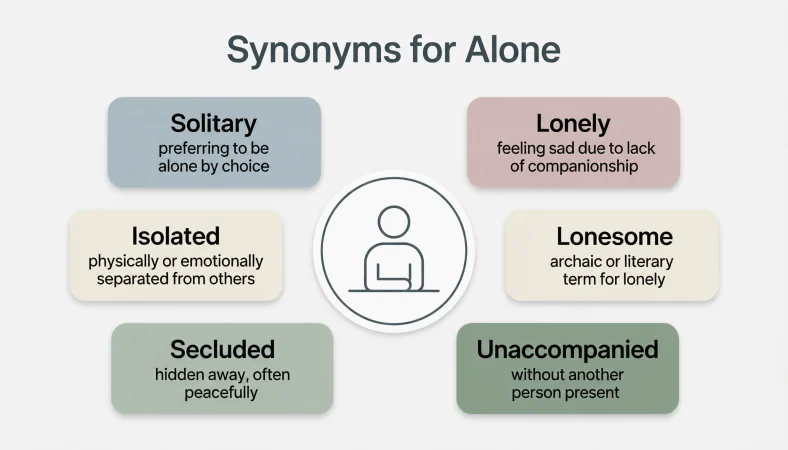
Unaccompanied
Meaning: Without any other person present.
Best context: Travel, formal events, and official situations. It’s a neutral word that simply states a fact.
Example sentence: Children under 12 cannot fly unaccompanied.
Solitary
Meaning: Being or preferring to be alone. It can describe a person who chooses solitude or a thing that stands apart .
Best context: Personality descriptions, nature writing, literary contexts.
Example sentence: The solitary tree stood at the edge of the field.
Isolated
Meaning: Separated from others, either physically or socially. In technical use, it can also describe rare or separate events .
Best context: Medical, social, geographic, or technical writing.
Example sentence: The village was isolated by the heavy snow.
Lone
Meaning: The only person or thing present .
Best context: Journalism, creative writing, descriptive passages.
Example sentence: A lone jogger ran along the beach at dawn.
By yourself
Meaning: Without anyone else present. A neutral, everyday phrase .
Best context: Conversation, casual writing, friendly communication.
Example sentence: Do you mind eating by yourself tonight?
On your own
Meaning: Without help or company. This phrase can also mean independent .
Best context: Personal growth, self-reliance, everyday situations.
Example sentence: She bought her first car all on her own.
Formal Synonyms for Alone
These formal alternatives work well in academic writing, professional communication, and official documents.
Unaccompanied
This word is common in official contexts like travel or events. It simply states that someone is without an escort or companion.
Use when: Writing about travel policies, invitations, or any formal situation involving attendance.
Example: All minors must be accompanied by an adult; unaccompanied children cannot be admitted.
Solitary
Formal enough for academic writing but still clear. It often describes a personality type or a physical state of being alone.
Use when: Describing someone’s habits, a unique object, or a person who prefers solitude.
Example: The prisoner was kept in solitary confinement for three days.
Isolated
Common in scientific, medical, and technical writing. It describes things separated from a larger group.
Use when: Writing about outbreaks, geography, social exclusion, or rare events.
Example: The study identified isolated incidents of the reaction.
Unassisted
A formal word that emphasizes doing something without help. Common in technical contexts and formal reports.
Use when: Describing achievements, tasks, or events where help was not involved.
Example: The athlete completed the triathlon unassisted.
Seclusive
A very formal synonym that describes a person who avoids society and prefers to be alone .
Use when: Writing formal character descriptions, psychological or sociological texts.
Example: The writer was seclusive and rarely gave interviews.
Unaided
Formal and straightforward, this word simply means doing something without assistance.
Use when: Official reports, achievements, descriptions of independent action.
Example: The child reached the top of the climbing frame unaided.
Informal Synonyms for Alone
These casual alternatives are perfect for conversation, social media, and friendly messages.
On your lonesome
A friendly, informal phrase meaning alone. Used more commonly in British English, but understood in American English as well .
Tone: Playful, casual.
Example: “You’re spending Friday night on your lonesome? Come over!”
Solo
This word is borrowed from music and means doing something alone. It’s widely used in travel, hobbies, and everyday conversation.
Tone: Casual, modern.
Example: “I’m going to the concert solo tonight.”
On your tod
A British informal expression meaning alone. It comes from rhyming slang and sounds old-fashioned .
Tone: Playful, very informal, mainly British.
Example: “Left you on your tod, have they?”
By yourself
The most neutral and common informal way to say alone. It works in almost any casual situation.
Tone: Neutral to informal.
Example: “You’re not going by yourself, are you?”
All alone
Adding “all” makes the phrase more emphatic. It often suggests a sad or vulnerable situation .
Tone: Emphatic, often emotional.
Example: “She sat all alone at the back of the room.”
Strong Synonyms for Alone
These synonyms convey more intensity or emotional weight than “alone.”
Lonely
Lonely describes the sad feeling of being isolated or without companionship. It focuses on the emotional experience rather than physical fact .
When to use: When you want to express emotional pain or longing for connection.
Example: She felt lonely even though she was surrounded by people.
Lonesome
A synonym for lonely, used more often in American English. It implies a deep longing for companionship .
When to use: Creative writing, expressive contexts, country music lyrics.
Example: The lonesome traveler missed his family.
Forlorn
This word implies being alone and unhappy, often with a sense of abandonment .
When to use: Describing someone who appears sad and abandoned.
Example: He cut a forlorn figure on the empty street corner.
Desolate
This word means empty, barren, and often suggests extreme loneliness or abandonment .
When to use: When describing places or emotional states that feel completely empty and sad.
Example: After her friends moved away, she felt absolutely desolate.
Abandoned
This word means left behind or deserted, often with a negative emotional connotation .
When to use: Describing people or things that have been left behind.
Example: The abandoned puppy sat alone in the park.
Forsaken
A strong and literary word that means abandoned or isolated, especially by people who should be present .
When to use: Literary or dramatic contexts.
Example: He felt forsaken by his friends when they didn’t visit.
Friendless
This word is direct and describes someone without friends .
When to use: When describing a person’s social situation honestly.
Example: The new student was friendless at first.
Mild Synonyms for Alone
These are softer, more neutral alternatives when a strong word feels too intense.
Solo
Solo is mild and positive. It simply means doing something by yourself without any sadness or isolation implied.
When to use: Everyday activities, hobbies, travel.
Example: “I’m going solo on that project.”
Unaccompanied
Neutral and factual, this word lacks emotion. It just states the situation.
When to use: Official contexts, neutral descriptions.
Example: “The painting was found unaccompanied by any documentation.”
Apart
This word suggests separation from a larger group without the emotional weight of loneliness.
When to use: Describing things or people that are separate.
Example: “The cottage stood apart from the village.”
Single
Using “single” means “only one” and is neutral.
When to use: Describing a single example or a person on their own.
Example: “A single parent can face many challenges.” (This describes status, not loneliness.)
On your own
This phrase balances self-reliance with being alone. It can be positive or neutral.
When to use: Emphasizing independence.
Example: “You can manage this on your own.”
Synonyms for Alone by Context
Everyday Conversation
For daily chat, keep it simple. By yourself and on your own are your best choices. They’re natural and fit most situations . Solo is great for activities .
Examples:
- “Did you go to the store by yourself?”
- “I’m flying solo this weekend.”
Professional Writing
In business or official writing, use unaccompanied, unassisted, or unaided. These words are formal and precise .
Examples:
- “The report was prepared unaided by the team.”
- “Unaccompanied guests must sign in.”
Academic Writing
Academics favor solitary, isolated, and alone for emphasis. Solely is great for exclusive factors .
Examples:
- “The data showed isolated anomalies.”
- “The decision was based solely on evidence.”
Creative Writing
For stories and poems, you have more freedom. Lonely, lonesome, desolate, and lone create vivid images . Use forsaken for dramatic effect .
Examples:
- “The forsaken house stood on a lonely moor.”
- “A lone bird sang in the desolate desert.”
Emotional Expression
If you’re talking about feelings, use lonely, lonesome, or forlorn. These words directly express the sadness of isolation .
Examples:
- “I feel so lonely without you.”
- “He looked forlorn as he sat by himself.”
Another Word for Alone in a Sentence
These example sentences show different synonyms for alone in context:
- He sat alone in the empty room, listening to the silence.
- The solitary hiker enjoyed the quiet of the mountain trail.
- She felt lonely in the new city without any friends.
- A lone tree stood in the middle of the field.
- He completed the project solo after his partner left.
- The prisoner was kept in solitary confinement.
- She went to the movie by herself.
- There were isolated reports of the same problem.
- He traveled unaccompanied on the long journey.
- The lonesome cowboy rode into the sunset.
- She finished the race unassisted.
- The decision was solely his to make.
Alone Synonyms Compared
Alone vs. Lonely vs. Lonesome
These three are often confused. Alone is about the physical state of being without others . Lonely is about the unhappy feeling of being isolated . Lonesome is a more emotional version of lonely, common in American English .
- Alone: “He lives alone.” (Fact)
- Lonely: “He feels lonely.” (Emotion)
- Lonesome: “She grew lonesome for her homeland.” (Emotional longing)
Alone vs. Solitary
Alone is a temporary state. Solitary often describes a personality trait or a permanent situation . A person might be alone for an hour but be solitary by nature.
- Alone: “I’m alone in the office today.” (Temporary)
- Solitary: “He’s a solitary person who rarely socializes.” (Characteristic)
Alone vs. Isolated
Alone can be a choice. Isolated is often an imposed condition, either physically or socially . You can be alone in a crowded room, but isolated means you are cut off from connection.
- Alone: “She wanted to be alone to think.”
- Isolated: “The village was isolated by the flood.”
Alone vs. Only
Alone can mean exclusivity when placed after a noun . Only is more commonly used for the same meaning. Compare:
- “You alone can do this.”
- “Only you can do this.”
These two sentences have the same basic meaning. “Alone” is more dramatic, while “only” is more common.
Words Similar to Alone
These words are related to “alone” but aren’t always direct synonyms. Understanding the difference helps you choose accurately.
Reclusive
A reclusive person lives alone and avoids other people . This describes a lifestyle choice.
Why related: It describes someone who is often alone.
Why not a direct synonym: It implies an active choice to avoid society, not just physical separation.
When to use: Describing someone who withdraws from social life.
Separate
Separate means apart or divided from others . It’s a broader word than “alone.”
Why related: It describes physical or conceptual division.
Why not a direct synonym: It doesn’t necessarily mean without people; it just means apart.
When to use: Describing things or people that are divided from a group.
Unique
Unique means being the only one of its kind . This meaning overlaps with “alone” when used to mean “the only one.”
Why related: “Alone” can mean “the only one” in sentences like “He alone knew.”
Why not a direct synonym: Unique focuses on specialness, while alone focuses on isolation.
When to use: Describing something with no equal.
Secluded
Secluded describes a place that is private and away from people . It can also describe a person.
Why related: It implies being away from others.
Why not a direct synonym: It’s more about privacy and quiet than just being alone.
When to use: Describing places or lifestyles that are quiet and isolated.
Antonyms of Alone
How to Choose the Right Synonym for Alone
Choosing the right word depends on what you actually want to say. Here’s a practical guide:
1. Consider the emotion
- Neutral fact: Alone, unaccompanied, solo
- Sad emotion: Lonely, lonesome, forlorn
- Positive solitude: Solitary, secluded
2. Think about the context
- Formal writing: Unaccompanied, unaided, solely
- Conversation: By yourself, on your own, solo
- Creative writing: Lone, solitary, desolate
3. Check the grammar
- After a verb: Always use “alone” if you need the adjective form
- Before a noun: Use “solitary,” “lone,” or “isolated” (not “alone”)
4. Decide if it’s physical or emotional
- Physical: Alone, isolated, unaccompanied
- Emotional: Lonely, lonesome, forlorn
5. Match the intensity
- Mild: Solo, apart, unaccompanied
- Strong: Forsaken, desolate, abandoned
- Neutral: Alone, solitary, by yourself
6. Consider the meaning of “only”
Common Mistakes When Using Synonyms for Alone
Mistake 1: Using “alone” before a noun
- ❌ “He was an alone person.”
- ✅ “He was a solitary person.”
Remember: “Alone” cannot be used before a noun .
Mistake 2: Confusing “alone” with “lonely”
- ❌ “He was alone without his friends.” (If you mean emotional state)
- ✅ “He was lonely without his friends.”
Mistake 3: Using the wrong tone
- ❌ “The solo child sat in the corner.” (informal in a serious context)
- ✅ “The solitary child sat in the corner.” (better tone)
Mistake 4: Treating “isolated” as always negative
- ❌ “She enjoyed being isolated in her room.” (sounds too severe)
- ✅ “She enjoyed being alone in her room.”
Mistake 5: Overusing “alone” for “only”
- ❌ “She alone finished the cake.” (correct but dramatic)
- ✅ “Only she finished the cake.” (more natural)
Quick Synonym List for Alone
Common Synonyms
- Solitary
- Isolated
- Unaccompanied
- Solo
- Lone
- By yourself
- On your own
Formal Synonyms
- Unaccompanied
- Solitary
- Isolated
- Unassisted
- Unaided
- Seclusive
Informal Synonyms
- On your lonesome
- Solo
- On your tod
- By yourself
- All alone
Strong Synonyms
- Lonely
- Lonesome
- Forlorn
- Desolate
- Abandoned
- Forsaken
- Friendless
Mild Synonyms
- Solo
- Unaccompanied
- Apart
- Single
- On your own
Related Words
- Reclusive (describes a lifestyle of avoiding others)
- Secluded (describes privacy and isolation)
- Unique (being one of a kind)
- Apart (separate from a group)
FAQs
What is the best synonym for alone?
The best synonym for alone depends on the context. Solitary and isolated work well for describing physical separation, while solo fits activities done by one person. For emotional isolation, lonely is more accurate .
What is another word for alone?
Common synonyms for alone include: solitary, isolated, unaccompanied, solo, by yourself, on your own, and lone. The best choice depends on formality, tone, and whether you are describing a physical state or an emotional one .
What is a formal synonym for alone?
Formal synonyms for alone include: unaccompanied, solitary, isolated, unassisted, unaided, and seclusive. These words work well in academic, professional, and official writing .
What is an informal synonym for alone?
Informal synonyms include: on your lonesome, solo, by yourself, and on your own. In British English, on your tod is an old-fashioned informal synonym .
What is a stronger word for alone?
Stronger words for alone emphasize intense emotions or extreme isolation. These include: lonely, lonesome, forlorn, desolate, forsaken, and abandoned .
What is a milder word for alone?
Milder synonyms are more neutral or positive in tone. These include: solo, unaccompanied, apart, and on your own .
What words are similar to alone?
Related words include: reclusive (avoiding others), secluded (private and isolated), unique (the only one), and apart (separate from a group). These share meaning with “alone” but are not always direct replacements .
What is the opposite of alone?
Antonyms of alone include: together, accompanied, escorted, with help, and among others .
How do I choose the right synonym for alone?
Consider the emotion, the context, the grammar, and what you actually mean. For physical facts, use “alone” or “unaccompanied.” For emotions, use “lonely.” For formality, choose “solitary.” For informal conversation, use “by yourself” .
Can alone be used before a noun?
No, “alone” can only be used after a verb. You cannot say “an alone person.” Instead, use solitary, lone, or isolated before a noun .
Conclusion
Finding the right synonym for alone depends on what you are trying to say. Are you describing physical separation, emotional isolation, or uniqueness? Are you writing a formal report or texting a friend? The best synonym matches the context, tone, and intensity of your message.
Remember these key choices:
- For neutral facts: alone, unaccompanied, solo
- For sad feelings: lonely, lonesome, forlorn
- For formal writing: solitary, isolated, unassisted
- For conversation: by yourself, on your own
- For “the only one”: only, solely, alone (after the noun)
Use this guide to choose confidently and communicate clearly. The best word is always the one that says exactly what you mean.