Quick Answer:
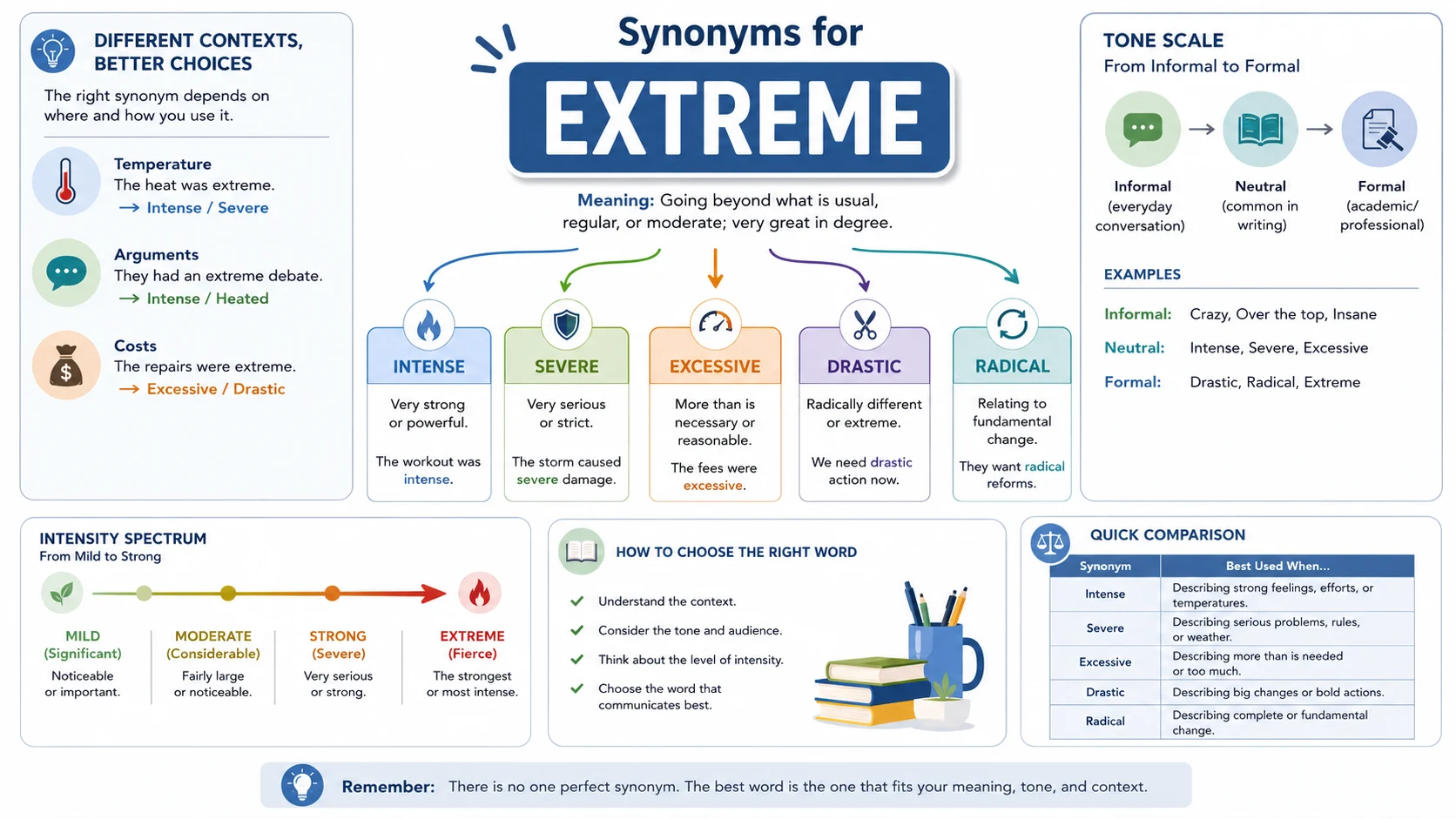
The best synonyms for extreme are intense, severe, excessive, drastic, and radical. Intense and severe work best for describing powerful conditions or feelings. Excessive and drastic fit situations involving overthetop actions or amounts. Radical is ideal for major changes or unconventional ideas. The right choice depends on tone, context, and intensity .
The word extreme describes something that goes far beyond what is considered normal, moderate, or expected. It can refer to intense feelings, severe conditions, unusual behavior, very high or low levels, or situations that reach an exceptional degree. While “extreme” is useful in everyday writing and conversation, using the same word repeatedly can make your language feel predictable. Choosing a more precise synonym can help you communicate the exact level of intensity you mean. Depending on the context, alternatives such as intense, severe, excessive, drastic, radical, extraordinary, profound, or exceptional may express the idea more clearly.
Finding the right synonym also depends on tone and meaning. For example, intense often describes strong emotions or experiences, while severe is more appropriate for serious problems or conditions. Radical can suggest a major change or departure from tradition, whereas extraordinary emphasizes something remarkable or unusual. In this guide, you’ll discover useful synonyms for “extreme,” organized by meaning, tone, and intensity, along with clear example sentences. Whether you’re improving an essay, professional writing, creative work, or everyday vocabulary, these alternatives can help you choose a word that fits your message naturally.
What Does Extreme Mean?
The word extreme functions as both an adjective and a noun. As an adjective, it means “very great in degree,” “very serious or severe,” or “very far from what is normal or moderate” . As a noun, it refers to either of two opposite limits of a range or a degree far beyond what is reasonable .
The core idea is always about being at the outer edge of a scale. It can refer to the highest point of heat, the most serious level of a problem, or the farthest end of a physical space .
Example sentences:
- The region is experiencing extreme drought conditions.
- She holds extreme political views.
- The temperature can fluctuate between the extremes of scorching heat and freezing cold .
Core Meaning of Extreme
At its heart, extreme signifies a departure from the middle ground. It’s about pushing past average, moderate, or ordinary limits. For example, one might be cautious, but during a storm, a driver must use extreme caution, meaning a much higher than usual level of care .
The word is versatile. It can describe something intensely felt, like pain or joy; something severe in its consequences, like weather or punishment; or something radical in its departure from convention, like an opinion or a new policy .
Grammar and Usage Notes
Extreme is a flexible word.
Part of Speech:
- Adjective: Used to modify a noun (e.g., extreme sports, extreme poverty) .
- Noun: Used to refer to a limit or a far end of a spectrum (e.g., the extremes of emotion, going to extremes) .
Common Sentence Patterns:
- As an adjective: “The [noun] is/was extreme.”
- As a noun: “He went from one extreme to the other.”
When it Sounds Natural:
The word fits naturally when something is truly beyond the norm. It may be too strong to describe everyday events. For instance, “a difficult day” is more natural and believable than “an extreme day.” Using it for a slightly challenging task would be an overstatement.
When a Synonym May Work Better:
A synonym is a better choice when you need to specify the type of extremity. Extreme is a general word for a very high degree. If you want to say an action was too much, excessive is more precise. To say a plan is revolutionary, radical is clearer.
Best Synonyms for Extreme
| Synonym | Meaning | Tone | Best Use Case | Example Sentence |
| Intense | Very strong or forceful. | Neutral, descriptive | Describing powerful emotions, physical sensations, or effort. | He felt an intense heat radiating from the fire. |
| Severe | Very serious or harsh. | Serious, formal | Describing negative conditions, weather, pain, or strict punishments. | The storm caused severe damage to the coastline. |
| Excessive | More than is necessary or reasonable. | Judgmental, critical | Describing overthetop actions, prices, or behavior. | The manager’s anger was excessive for such a minor mistake. |
| Drastic | Having a strong or farreaching effect. | Emphatic, formal | Describing radical solutions, measure, or changes. | The company needed to take drastic steps to avoid bankruptcy. |
| Radical | Relating to the fundamental nature of something; very new and different. | Emphatic, intellectual | Describing major changes, political views, or new ideas. | The new policy represents a radical shift in company culture. |
| Acute | Very serious or severe. | Formal, medical | Describing intense, often shortterm, problems like pain or crises. | The patient was suffering from acute abdominal pain. |
| Utmost | Greatest possible; highest. | Formal, emphatic | Emphasizing the maximum degree of something, like importance or effort. | This is a matter of the utmost importance. |
Common Synonyms for Extreme
These are the everyday synonyms used in normal writing and conversation.
Intense
Short meaning: Very strong or forceful.
Best context: Describing powerful feelings, concentration, or physical experiences.
Example sentence: The negotiations were intense, with both sides refusing to back down.
Severe
Short meaning: Very serious or harsh.
Best context: Describing negative conditions, weather, pain, or strict punishments.
Example sentence: The drought had a severe impact on the region’s agriculture.
Excessive
Short meaning: More than is necessary or reasonable.
Best context: Describing overthetop actions, prices, or behavior.
Example sentence: The amount of paperwork required was excessive.
Drastic
Short meaning: Having a strong or farreaching effect.
Best context: Describing radical solutions, measures, or changes.
Example sentence: The city council is planning drastic changes to the traffic system.
High
Short meaning: Greater than the usual level or amount .
Best context: Describing elevated levels of something, like prices or risk.
Example sentence: The project carries a high degree of risk.
Formal Synonyms for Extreme
For academic writing, business reports, or professional communication, these formal alternatives work best.
Utmost
Works best for emphasizing the greatest degree of importance, urgency, or effort. It is a sophisticated choice that adds weight to a statement. The term is commonly used in phrases like “of the utmost importance,” indicating that nothing should take precedence . This word is particularly effective in formal proposals and serious communiqués where you need to underscore the critical nature of a matter.
Supreme
This is ideal for describing the highest level of quality, achievement, or sacrifice. It carries a sense of finality and superiority, as in “the supreme sacrifice” or “a leader of supreme intelligence” . In business writing, this word is less common but can be used for dramatic effect in marketing materials or performance reviews to denote an unmatched level of success.
Acute
Best used to describe a severe, sharp, and often shortlived problem or sensation, especially in medical or technical contexts . “Acute pain” or “an acute shortage” are classic examples. Its precision makes it a favorite in scientific reports and healthrelated fields, as it specifies the nature of the problem without ambiguity.
Informal Synonyms for Extreme
For friendly conversations, social media posts, and personal messages, these casual alternatives are more fitting.
Over the Top (OTT)
This is a perfect phrase for describing something that is excessive in a flashy or dramatic way. It is a familiar expression that immediately conveys that something has crossed a line from reasonable to extravagant. When someone describes a party decoration as “over the top,” they mean it is exaggerated but not necessarily in a negative way.
SkyHigh
Use this to describe prices or levels that are extremely high. It conveys that the price is not just expensive but has reached a peak that is notable. The term is frequently used in everyday conversation, especially when discussing real estate or the cost of living, and provides a visual cue that makes the scale of the word easy to understand.
Mother of All
This is used as an informal superlative to emphasize that something is the biggest, most impressive, or most extreme of its kind. It often appears in casual conversation to add humor or hyperbole . For example, calling a challenge the “mother of all tasks” instantly clarifies that the speaker believes it to be extremely demanding. However, be aware that its tone is very colloquial and may not be suitable for formal writing.
Strong Synonyms for Extreme
These synonyms carry a heavier emotional weight and intensity. They are powerful alternatives that can make your writing more emphatic but should be used carefully to avoid sounding overly dramatic.
Fierce
This word suggests intensity combined with aggression or a relentless nature. It is often used to describe competition (fierce rivals), weather, or strong emotions. Use it when you want to convey not just strength, but a combative or powerful energy. It fits well with “extreme” in scenarios involving conflict or passion.
Fervent
This describes intensely sincere or passionate feeling. It is used for emotions like love, loyalty, or belief. This word works well for emotional expression because it adds a layer of depth beyond simple intensity. It suggests a deeply held conviction or desire that pushes past moderation.
Uncompromising
This describes a strong unwillingness to change one’s views or beliefs. It is an excellent strong synonym for extreme when describing people, rules, or principles . It carries a tone of rigid determination. Use it to describe a person or policy that will not bend, even when facing significant opposition.
Mild Synonyms for Extreme
When extreme is too harsh, or you want to soften your language, these milder alternatives are more appropriate.
Significant
This word suggests that something is noticeable or has a considerable effect, but it stops short of being overwhelming. It is a great choice for describing data changes or progress without the dramatic flair of “dramatic.” This neutral and highly useful word can replace “extreme” in many professional contexts to sound more measured and objective.
Elevated
This is a softer way to say something is “higher than usual” . It is often used in medical reports (elevated blood pressure) or in weather forecasts. Unlike “extreme,” this word suggests a measurable increase. It is more clinical and less alarming, making it ideal for situations where precision and a calm tone are necessary.
Considerable
This implies that something is large in amount, size, or importance, but it does not imply that it is the maximum possible. It is a more moderate and neutral term. A “considerable amount of effort” sounds less taxing than an “extreme amount of effort,” but it still conveys that the effort was substantial and meaningful.
Synonyms for Extreme by Context
Professional Writing
In a business context, you want to sound competent and in control. Overusing strong language can sound unprofessional. Words like significant, substantial, and major are preferable. Instead of “an extreme cost increase,” write “a significant cost increase.” If you need to describe a serious action, decisive is a better choice than “drastic.” For important matters, urgent or critical are more specific and effective.
Academic Writing
In scholarly work, objectivity is key. Words like acute, severe, and substantial are often used for data and findings . When discussing new ideas or concepts, radical or fundamental are appropriate. The goal is to be precise without sensationalizing the subject matter. For example, describing a change as “a fundamental shift” is more academic than saying “an extreme change.”
Creative Writing
Here, you have the most freedom to match tone and character. A villain might take drastic measures, while a hero might show intense passion. In romantic scenes, fierce or fervent love is more vivid than “extreme love” . In a horror story, the atmosphere might be one of dire peril . The choice should reflect the feeling you want the reader to experience.
Another Word for Extreme in a Sentence
Seeing synonyms in full sentences is one of the best ways to understand how they work in practice.
- The hikers were not prepared for the intense heat.
- The new medication can cause severe side effects.
- We were forced to take drastic action to solve the problem.
- His radical ideas set him apart from the other candidates.
- The company’s financial report showed an excessive amount of spending.
- A matter of the utmost urgency requires our immediate attention .
- The patient was admitted with acute abdominal pain .
- The competition was fierce, with several companies vying for the same contract.
- The professor was a fervent believer in his own teaching methods.
- The city is facing a dire financial crisis due to years of mismanagement .
- The prisoner was given an unreasonable and harsh punishment.
- The storm caused unprecedented damage to the coastal town.
- Her political views were considered unconventional and caused a stir .
Extreme Synonyms Compared
Many synonyms for extreme are quite similar, so understanding their nuances helps you select the most precise word.
Drastic vs. Radical
While both imply significant departure from the norm, drastic often has a negative connotation, suggesting a harsh or violent remedy. For example, you would take “drastic measures” to solve a crisis. Radical, on the other hand, can be more neutral or positive, referring to a thorough change or a new, fundamental way of thinking. A “radical new theory” suggests a brilliant shift in understanding.
Intense vs. Severe
Intense focuses on the power or concentration of a feeling, color, or activity. “Intense concentration” is a positive phrase. Severe focuses on the harshness or seriousness of a condition, often negative. “Severe weather” or “severe pain” imply difficulty and suffering . The key difference lies in whether you are describing a powerful force or a difficult situation.
Excessive vs. Extreme
Excessive is a judgment call, meaning something is “too much” . It implies a value judgment that a limit has been crossed. Extreme is more objective, simply describing the degree on a scale. For example, an “extreme temperature” could be a record high, while an “excessive price” means you think it is unreasonably high.
| Synonym 1 | Synonym 2 | Difference |
| Drastic | Radical | Drastic implies a harsh solution; Radical implies a fundamental change. |
| Intense | Severe | Intense focuses on power; Severe focuses on harshness. |
| Excessive | Extreme | Excessive is a judgment of “too much”; Extreme is an objective degree. |
Words Similar to Extreme
These related words belong to the same semantic field as extreme but are not always exact synonyms.
Exorbitant
This word is specifically related to costs or prices that are unreasonably high . It is a great choice when the extremity you are describing involves money. For instance, you would not use it to describe a difficult test; but you would use it to describe the price of a luxury item.
Farthest / Outermost
These words are direct synonyms for the physical meaning of extreme: the point that is most distant from a center . They are not used for intensity or severity. If you say “the extreme edge of the field,” you could easily replace it with “the farthest edge of the field.”
Superlative
An adjective or adverb that expresses the highest degree of a quality. While extreme itself often functions as a superlative in meaning, it is a plain adjective.
Antonyms of Extreme
The opposite of extreme depends on the meaning of the word you are using. Here are some common contrasts to provide a better understanding of the full spectrum .
| Antonym | Short Meaning | Example Sentence |
| Moderate | Average in amount or intensity. | The weather was moderate, with mild temperatures and a gentle breeze. |
| Mild | Gentle; not severe. | The doctor recommended a mild treatment for the patient’s symptoms. |
| Minor | Not important or serious. | The storm caused only minor damage to the houses. |
| Limited | Confined; not extensive. | She had a limited amount of time to complete the task. |
| Normal | Standard; not unusual. | The company’s expenses were within normal limits. |
| Conservative | Moderate; cautious | Her conservative approach to investing meant she took few risks. |
How to Choose the Right Synonym for Extreme
Choosing the right synonym for extreme can make your writing more precise and effective. Follow these guidelines to ensure you choose the best word for your situation.
- Match the context: Are you writing a business email or a short story? Formal writing requires formal words like utmost, while casual writing accepts skyhigh.
- Match the tone: Think about how you want to sound. A strong, dramatic word like fierce creates a different feeling than a mild, neutral word like significant.
- Check the intensity: Is the situation as serious as you are making it sound? Sometimes, a more moderate word is better to avoid overstatement.
- Think about the reader: Choose words that your audience will understand and that will not cause confusion.
- Check whether the synonym is exact or only related: Don’t replace extreme with exorbitant unless you’re talking about high prices.
- Keep the sentence natural: If a synonym sounds awkward in your sentence, it probably is. Choose the word that fits the flow of the sentence the best.
- Use simple words when clarity matters: When in doubt, a simple word like great or high is often a clear and effective choice .
Common Mistakes When Using Synonyms for Extreme
Even careful writers can make mistakes when trying to find the right word. Avoid these pitfalls to keep your writing polished and accurate.
Choosing a Word with the Wrong Tone
Using an informal synonym like over the top in a formal business report will make you sound unprofessional . Similarly, using a formal word like acute in a text message to a friend might seem strange. Always consider your audience and the context of your writing. Tone mismatches can undermine your credibility and confuse your reader.
Using a Synonym That is Too Strong
Calling a minor inconvenience a catastrophe is a sure way to sound like you are exaggerating. Exaggeration can make your writing seem less credible. Choose words that accurately reflect the situation’s severity. For instance, a simple pricing error is not “extreme”; it is “minor” or “slight.”
Using a Formal Word in Casual Writing
If you use the word utmost in an email to a friend, it may sound stiff or unnatural. Casual writing is about a friendly, conversational tone. Overly formal words can be offputting and make you seem distant.
Treating Related Words as Exact Synonyms
A common mistake is using exorbitant to describe something other than a price . It is a specific word, and using it outside its range will confuse your audience. Always check the meaning of a synonym before you use it to ensure it fits your context.
Quick Synonym List for Extreme
Common Synonyms
- Intense
- Severe
- Excessive
- Drastic
- High
Formal Synonyms
- Utmost
- Acute
- Supreme
- Profound
- Uncompromising
Informal Synonyms
- Over the Top (OTT)
- Skyhigh
- Mother of all
- Wayout
- Farout
Strong Synonyms
- Fierce
- Fervent
- Radical
- Outrageous
- Unbending
Mild Synonyms
- Significant
- Elevated
- Considerable
- Substantial
- Major
Related Words
- Exorbitant (for prices)
- Farthest / Outermost (for distance)
- Fundamental (for changes)
- Hyperbolic (for exaggeration)
FAQs
What is the best synonym for extreme?
The best synonym depends on the context. For describing strong feelings, intense is an excellent choice. For serious conditions or problems, severe works best. For describing too much of something, use excessive .
What is another word for extreme in an argument?
In an argument, you might use radical or uncompromising to describe someone’s views . To describe the argument itself, you could call it heated or intense .
What is a formal synonym for extreme?
Utmost, acute, and supreme are all formal synonyms for extreme . They are appropriate for academic and professional contexts.
What is an informal synonym for extreme?
Over the top and skyhigh are common informal synonyms for extreme . These are perfect for everyday conversations and casual writing.
What is a stronger word for extreme?
Fierce, fervent, and radical are stronger synonyms that carry more emotional weight or a sense of fundamental change .
What is a milder word for extreme?
Significant, elevated, and considerable are milder words that soften the intensity of extreme .
What words are similar to extreme?
Words like exorbitant (for cost) and farthest (for distance) are similar in meaning but are used in specific contexts .
What is the opposite of extreme?
The most common opposites are moderate, mild, minor, and limited .
How do I choose the right synonym for extreme?
Match the context, tone, and intensity of your writing. Think about your audience, and choose the word that makes your sentence sound the most natural.
Conclusion
Extreme is a powerful word, but a thesaurus is full of even more precise and colorful alternatives. Whether you choose intense for feelings, severe for conditions, radical for ideas, or excessive for overabundance, each synonym offers a unique shade of meaning that can enhance your writing. The key is to consider the context, tone, and message you want to convey. By mastering these distinctions, you can move beyond simple thesaurus replacements and become a more confident, expressive writer. The best word is always the one that fits your sentence perfectly.