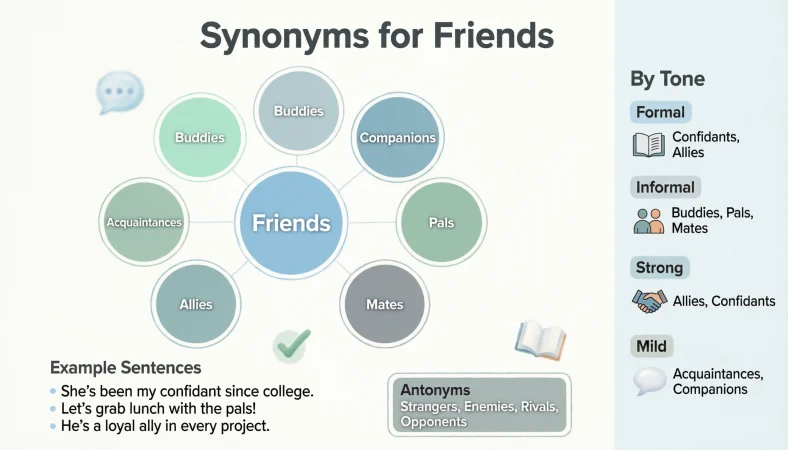
The best synonyms for friends include companions, buddies, pals, allies, confidants, associates, mates, comrades, and acquaintances. The right choice depends on the relationship and context. For example, buddies sounds casual, companions is more neutral, confidants suggests deep trust, and associates is more professional.
Finding the right synonym for friends can make your writing sound more natural, precise, and meaningful. While words such as buddies and pals work well in casual conversations, terms like companions, confidants, allies, and associates communicate different types of relationships.
In this guide, we’ll explore commonly used alternatives to friends, explain what each word means, and show how to use them naturally in sentences. Whether you’re writing an email, creating content, or simply looking for a better word to describe a friendship, these examples will help you choose the right term for the situation.
What Does “Friends” Mean?
At its simplest, “friends” refers to people you know and care about individuals with whom you share a bond of mutual affection, trust, and support. A friend is someone you choose to have in your life, as opposed to family members or romantic partners, and that choice is the foundation of the relationship.
The word functions as a plural noun. Here are two simple examples:
- “My friends and I go to the movies every Friday.”
- “She invited all her friends to the party.”
Core Meaning of Friends
The core meaning of “friends” is built on mutual affection and voluntary connection. Friends are people we turn to for emotional support, companionship, and shared experiences. Unlike acquaintances (people we know casually) or colleagues (people we work with), friends typically share a deeper bond that includes loyalty, honesty, and a genuine interest in each other’s well-being.
The value of friendship comes from trust, shared history, and a willingness to be vulnerable with someone. Friends can be childhood connections, college roommates, or coworkers who become more than just professional contacts. The term implies a relationship that isn’t mandatory—it’s chosen and maintained because both people want it to exist.
Grammar and Usage Notes
Part of Speech: Plural noun. The singular form is “friend.”
Common Sentence Patterns:
- “My friends are…” (subject)
- “I have friends who…” (object)
- “She is friends with…” (prepositional phrase)
- “We’ve been friends since…” (predicate nominative)
Common Phrases and Collocations:
- Close friends
- Best friends
- Old friends
- Childhood friends
- Make friends
- True friends
- Friends forever
- Friends and family
When “Friends” Sounds Natural:
Use “friends” when you’re talking about a general, positive relationship with someone you care about. It’s the standard, neutral term and works in almost any context.
When a Synonym May Work Better:
Consider a synonym when you need to specify the type of relationship (e.g., companion for shared activities, ally for support in a cause), the formality level (e.g., associate for professional contexts), or the regional tone (e.g., mate for British or Australian English). A synonym can also add variety to your writing or make your meaning more precise.
Best Synonyms for Friends
| Synonym | Meaning | Tone | Best Use Case | Example Sentence |
| Buddies | Close friends; often used for shared activities | Informal, friendly | Casual conversation, childhood friendships | “The two buddies have known each other since kindergarten.” |
| Companions | People who spend time together; emphasizes shared experience | Neutral to formal | Literary writing, travel, describing activity partners | “We were traveling companions on the trip through Europe.” |
| Pals | Close friends; slightly old-fashioned but warm | Informal, affectionate | Everyday speech, personal messages | “He’s been my pal since we were five years old.” |
| Mates | Friends; very common in British, Australian, New Zealand English | Informal | British/Australian contexts, casual speech | “I’m meeting my mates at the pub tonight.” |
| Allies | Friends united by a common cause or goal | Neutral to formal | Political, professional, or social justice contexts | “She found allies among other activists in the movement.” |
| Confidants | Close friends you trust with secrets or private matters | Formal | Expressing deep trust, discussing emotional support | “We trusted our closest confidants with the news first.” |
| Associates | Friends in a professional or business context | Formal | Professional writing, workplace relationships | “He invited his business associates to the dinner.” |
| Comrades | Friends who share a mission, hardship, or common identity | Formal, slightly old-fashioned | Military, political, or historical contexts | “They were comrades in the fight for civil rights.” |
| Acquaintances | People you know but aren’t close to | Neutral | Describing casual or limited relationships | “We exchanged pleasantries, but we’re just acquaintances.” |
Common Synonyms for Friends
These everyday words for friends are easy to use and widely understood.
Buddies
Buddy is informal and often used for friends you do activities with sports, hobbies, or just hanging out. It feels warm and approachable.
Example: “I’m going hiking with my buddies this weekend.”
Pals
Pal is another informal synonym that feels slightly more affectionate than buddy. It has a friendly, cheerful tone and is often used to describe childhood or long-term friendships.
Example: “She called her old pal to catch up after years apart.”
Mates
Mate is the go-to synonym in British, Australian, and New Zealand English. It’s casual and commonly used among friends in everyday conversation.
Example: “He went to the football game with his mates.”
Chums
Chum is a slightly old-fashioned, British-influenced word for a close friend. It carries a cheerful, vintage feel.
Example: “The two chums have been inseparable since grade school.”
Formal Synonyms for Friends
In professional or academic writing, choose words that sound more polished and less casual.
Companions
A companion is someone you spend time with, often because of shared activities or experiences. The word emphasizes togetherness rather than emotional closeness.
Best context: Travel writing, professional descriptions, literary contexts.
Example: “We were dinner companions at the formal gala.”
Associates
Associate describes a person you know in a professional context a coworker, client, or industry connection. It doesn’t imply deep friendship.
Best context: Business writing, networking, professional introductions.
Example: “Our company’s associates have contributed to this project.”
Confidants
A confidant is a person you trust deeply with private information or emotions. It describes a special kind of friendship built on secrecy and trust.
Best context: Discussing trust, emotional support, or personal relationships in a serious tone.
Example: “We shared our fears with only our closest confidants.”
Allies
An ally is a friend who supports you in a specific mission, cause, or struggle. The term implies a partnership rooted in shared objectives.
Best context: Political writing, professional strategy, social movements.
Example: “We found important allies in our campaign for better housing policies.”
Comrades
Comrade suggests a strong bond formed through shared experiences, often in challenging situations. It has a slightly old-fashioned or literary tone.
Best context: Historical writing, military contexts, political movements.
Example: “They were comrades in arms during the war.”
Informal Synonyms for Friends
When you’re writing conversationally, posting on social media, or sending a personal message, these casual alternatives sound natural and friendly.
Buddies
Casual, easygoing, and perfect for talking about friends you hang out with regularly.
Example: “We’ve been buddies since summer camp.”
Pals
A warm, affectionate word for a close friend. It’s a little old-fashioned but still charming and widely used.
Example: “I’m going shopping with my pals tomorrow.”
Mates
The casual standard in British English. If you’re writing for a UK audience, mates fits right in.
Example: “I’m off to the pub with my mates.”
Sidekicks
A fun, playful word for a friend who’s your partner in crime someone you team up with regularly.
Example: “We’ve been sidekicks ever since we started the school newspaper.”
Besties
Short for “best friends,” besties is slang used heavily on social media and among younger people. It’s very casual and affectionate.
Example: “My besties and I are planning a weekend trip.”
Strong Synonyms for Friends
These synonyms emphasize strong bonds, loyalty, or intense support.
Allies
Allies implies a friend who sticks by you, especially in difficult or competitive situations. It suggests a partnership built on shared goals and mutual defense .
Example: “Our allies in the community supported us when we needed them most.”
Confidants
A confidant is the ultimate trusted friend someone who knows your secrets and never betrays your confidence. This word carries emotional weight.
Example: “She was my confidant during the hardest year of my life.”
Comrades
Comrade evokes a bond formed through hardship, struggle, or shared purpose. It’s a powerful word for describing friends who have faced challenges together.
Example: “The comrades who served with her remain her closest friends.”
Soulmates
While often associated with romantic relationships, soulmate can describe a friend with whom you share an exceptionally deep, intuitive connection.
Example: “We were friends immediately—we’re still soulmates to this day.”
Mild Synonyms for Friends
These words are softer, more neutral, or describe more distant relationships.
Acquaintances
An acquaintance is someone you know but aren’t close to—a person you’ve met but don’t have a deep friendship with .
Example: “We’ve met a few times, but we’re just acquaintances.”
Contacts
Contact emphasizes utility and practical value rather than emotional connection. It’s often used in professional settings.
Example: “She has contacts in the publishing industry.”
Associates
An associate is a professional contact—someone you work with or know through business.
Example: “The firm’s associates are respected in the field.”
Peers
Peer refers to people at a similar level, age, or status—it doesn’t necessarily imply friendship.
Example: “The research was reviewed by academic peers.”
Synonyms for Friends by Context
The best word for “friends” changes depending on where and how you’re using it.
Everyday Conversation
Buddies, pals, and mates are the most natural choices for casual talk. They’re short, familiar, and don’t sound stiff.
Example: “I’m heading out with my buddies tonight.”
Professional Writing
Associates or colleagues work well in business contexts. Allies is useful when discussing partnerships or support.
Example: “We’ve developed strong relationships with our business associates.”
Academic Writing
Companions, peers, and confidants suit formal research or essays. These words sound authoritative and precise.
Example: “Participants identified their closest confidants as primary sources of emotional support.”
Creative Writing
Comrades, companions, and pals work well in fiction. Chums and sidekicks can add personality to characters.
Example: “The two comrades made their way across the desert together.”
Emotional Expression
Confidants, soulmates, and allies convey deep emotional connection and trust.
Example: “We were not just friends—we were confidants who shared everything.”
Another Word for Friends in a Sentence
Here are 15 example sentences using different synonyms for friends.
- The two buddies met for coffee every Saturday morning.
- She and her companions traveled across the country in a van.
- We’ve been pals since we were in kindergarten together.
- He went to the cinema with his mates from work.
- Our allies in the campaign helped us reach a wider audience.
- We trusted our closest confidants with the most sensitive news.
- The dinner included business associates from three different countries.
- They were comrades who had fought side by side in the war.
- We’re not close—we’re simply acquaintances who see each other at events.
- She invited a few of her besties to her birthday party.
- My old pal from high school moved back to town.
- He and his sidekicks decided to start their own business.
- They’ve been friends since childhood, so the bond runs deep.
- Two of his closest associates joined him at the conference.
- My peers in the program all share similar research interests.
Friends Synonyms Compared
Though these words all describe people we know, each has a different shade of meaning.
| Synonym | Meaning | Tone | Formality | Best Context |
| Buddy | Close friend; activity partner | Warm, friendly | Informal | Casual conversation |
| Companion | Someone you spend time with | Neutral | Formal | Travel, literary, professional |
| Pal | Close, affectionate friend | Affectionate | Informal | Everyday speech |
| Mate | Friend (British/Australian) | Casual | Informal | UK/Australian contexts |
| Associate | Professional contact | Neutral | Formal | Business, professional |
| Confidant | Trusted friend who knows secrets | Deeply trusting | Formal | Emotional discussions |
| Ally | Friend with shared goals | Loyal, supportive | Neutral to formal | Political, professional |
| Acquaintance | Someone you know casually | Distant, neutral | Neutral | Describing limited relationships |
Words Similar to Friends
These related words aren’t exact synonyms but belong to the same family of relationships.
Colleagues
Colleague describes someone you work with. While colleagues can become friends, the word itself emphasizes shared employment, not emotional connection.
Neighbors
Neighbor refers to someone who lives nearby. A neighbor might be a friend, but not by definition—the word only implies proximity.
Classmates
Classmate is someone in the same class or educational setting. Again, friendship is possible but not guaranteed.
Peers
Peers are people at the same level, age, or status. In social science writing, peers often substitutes for friends when describing social groups.
Supporters
Supporter describes someone who backs a cause, person, or idea. It’s often used in political or sports contexts .
When to use them: Use these words when you need to be more specific than friends but don’t want to claim a close personal bond.
Antonyms of Friends
These words represent the opposite of friendship—hostility, distance, or opposition.
| Antonym | Short Meaning | Example Sentence |
| Enemies | People actively opposed to you | “They used to be friends, but now they’re enemies.” |
| Foes | Hostile opponents (slightly old-fashioned) | “The two foes argued about politics constantly.” |
| Rivals | Competitors who want to outdo you | “They were academic rivals from the beginning.” |
| Adversaries | Opponents in a conflict or disagreement | “The adversaries faced each other in court.” |
| Strangers | People you don’t know at all | “We were strangers until we met at the conference.” |
| Opponents | People who take an opposing side | “The debate turned the friends into opponents.” |
How to Choose the Right Synonym for Friends
Picking the best synonym doesn’t have to be complicated. Here’s a simple process:
Match the context. Is this a casual text message or a formal email? Use buddies or pals for casual writing; use associates or companions for professional content.
Consider the tone. Do you want to sound warm, distant, or somewhere in between? Confidants sounds deeply personal; acquaintances sounds neutral and reserved.
Think about intensity. Are you describing lifelong best friends or casual work relationships? Soulmates and confidants imply deep bonds; contacts or peers suggest a lower emotional connection.
Check regional usage. Mate is common in British and Australian English but may sound odd in American writing. Buddy is more American.
Keep your sentence natural. If a synonym sounds forced or changes the meaning of your sentence, use friends. Simplicity often works best.
Common Mistakes When Using Synonyms for Friends
Even experienced writers make these errors. Here’s what to avoid:
Choosing a word with the wrong tone. Using acquaintances when you mean besties confuses your reader. If you’re describing a close, trusted friend, don’t call them an acquaintance it feels dismissive .
Using a regional word for the wrong audience. Mate sounds natural in the UK but might confuse American readers. Buddy works better for US audiences.
Overcomplicating your writing. Some writers use fancy synonyms to sound sophisticated. Simple words like friends or buddies are often clearer and more effective.
Treating related words as exact synonyms. Not every word in this list is interchangeable. Associate doesn’t mean the same thing as companion. Check the meaning before you swap .
Ignoring the plural form. This article focuses on friends (plural). Many synonyms also change form in the plural don’t forget the plural S.
Quick Synonym List for Friends
Common Synonyms: buddies, pals, mates, chums, besties
Formal Synonyms: companions, associates, confidants, allies, comrades
Informal Synonyms: buddies, pals, mates, sidekicks, besties
Strong Synonyms: allies, confidants, comrades, soulmates
Mild Synonyms: acquaintances, contacts, associates, peers
Related Words: colleagues, neighbors, classmates, supporters
FAQs
What is the best synonym for friends?
The best synonym depends on context. Buddies and pals work well for casual situations. Companions suits formal writing. Mates is common in British English. Allies works for shared causes or support networks .
What is another word for friends in professional contexts?
Associates or colleagues are the most common professional alternatives. For business relationships, partners or affiliates also work. Acquaintances fits for casual professional contacts .
What is a formal synonym for friends?
Companions, confidants, associates, and allies are formal options. Comrade works in historical or political writing. These words suit academic, professional, or literary contexts .
What is an informal synonym for friends?
Buddies, pals, mates, besties, and chums are informal. These words work best in conversation, social media, and personal messages .
What is a stronger word for friends?
Confidants and soulmates imply deep emotional bonds. Allies suggests strong support in difficult situations. Comrades evokes a bond formed through shared hardship .
What is a milder word for friends?
Acquaintances is the mildest option someone you know but aren’t close to. Contacts and peers are neutral alternatives .
What words are similar to friends but not exact synonyms?
Colleagues (work relationships), neighbors (proximity), classmates (school context), and supporters (backing a cause or person) are related but not exact synonyms .
How do I choose the right synonym for friends?
Match the context, tone, and intensity of your message. Consider your audience (professional vs. casual) and whether you’re writing for American, British, or international readers. If you’re unsure, friends is always safe.
What is the opposite of friends?
Enemies, foes, rivals, adversaries, and strangers are common antonyms. Each represents a different kind of opposition or distance .
Conclusion
The word “friends” describes one of the most important connections in life, but English offers many ways to capture the nuances of these relationships. Buddies feels warm and casual, companions suits formal writing, allies conveys support and shared purpose, and mates fits British and Australian English.
The best synonym depends on who you’re writing for, what tone you want, and how close the relationship is. Use strong words like confidants or soulmates for deep emotional bonds. Use milder words like acquaintances or contacts for more distant relationships. And when in doubt, friends remains clear, trustworthy, and always appropriate.