Quick Answer:
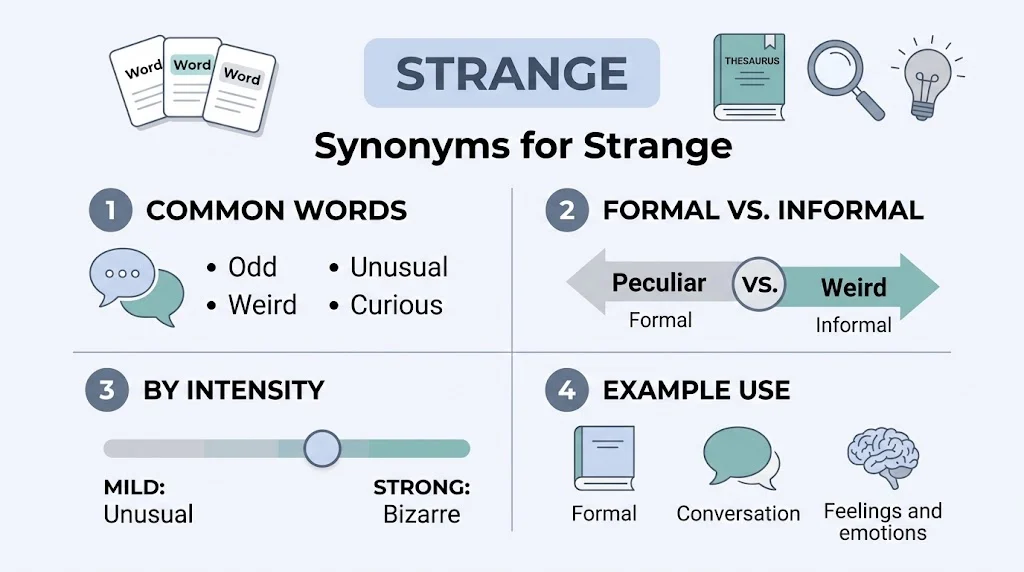
The most effective synonyms for strange are odd, weird, bizarre, peculiar, and unusual. For everyday conversation, weird or odd work best. Formal writing often calls for peculiar or unusual. When something is extremely out of the ordinary, bizarre or outlandish can convey that intensity. Context is everything when selecting the perfect replacement.
When you want to describe something that feels unusual, unexpected, or different from what is considered normal, strange is often the first word that comes to mind. However, using the same word repeatedly can make your writing feel predictable. Choosing the right synonym can help you express exactly what you mean, whether something is simply unusual, slightly odd, mysterious, or completely bizarre. Words such as unusual, peculiar, odd, eccentric, curious, bizarre, and mysterious can all replace “strange,” but each carries a slightly different meaning and tone.
Understanding these differences is important when choosing the best word for a sentence. A formal article may call something peculiar or unorthodox, while casual conversation might use weird or odd. If something is extremely unusual, bizarre or outlandish may be more appropriate. In this guide, you’ll discover useful synonyms for strange, organized by meaning, tone, and intensity, along with clear examples to help you choose the right alternative for everyday conversation, academic writing, professional communication, and creative work.
What Does Strange Mean?
The word strange describes something that is unusual, unfamiliar, or difficult to explain. It points to things that stand apart from what is normal, expected, or ordinary. This could be an odd behavior, an unexpected event, or a person you have never met.
Something can be strange because it is new, foreign, or outside your usual experience. Alternatively, it can be strange because it simply does not fit the expected pattern of daily life.
Here are some simple examples:
- “The empty house had a strange feeling about it.”
- “His laughter sounded strange, almost forced.”
The word has been in use since the Middle Ages, coming from the Old French estrange, meaning “foreign” or “external.” Over time, its meaning shifted to include anything that feels unusual or out of place, not just things from other countries .
Core Meaning of Strange
At its heart, strange signals a deviation from the ordinary. It carries a sense of wonder, confusion, or mild unease. This can apply to the unfamiliar. Waking up in a hotel room in a new city often feels strange. It can also apply to the unusual. A person who collects vintage typewriters might be considered a bit strange.
The word almost always suggests that you are observing something that does not quite fit your mental model of how things should be. As sources note, strange “implies that the thing or its cause is unknown or unexplained” .
Grammar and Usage Notes
Part of Speech: Strange is primarily used as an adjective. As an adjective, it can modify a noun (“a strange noise”) or follow a linking verb (“That sounds strange”).
Common Sentence Patterns:
- Strange + noun: “I saw a strange car in the driveway.”
- Be + strange: “Her reaction was strange.”
- It is strange that + clause: “It is strange that no one called.”
Common Phrases:
The word appears in common expressions like “strange to say” (meaning surprisingly), “strange bedfellows” (unlikely allies), and “a strange turn of events” (an unexpected development) .
When strange works best: Use it to describe a general sense of something being off, unfamiliar, or simply new to you.
When a synonym may work better: If you need a stronger word for something extremely unusual, choose bizarre. For a more neutral term, unusual is often safer. For a more personal, slightly uncomfortable feeling, peculiar works well.
Best Synonyms for Strange
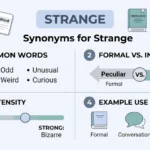
This table groups the most common synonyms by tone, intensity, and the context where they are most effective .
| Synonym | Meaning | Tone | Best Use Case | Example Sentence |
| Odd | Slightly unusual; not what you would expect. | Neutral | Everyday conversation; when something is a little off. | “His outfit looked a bit odd for a formal dinner.” |
| Weird | Strikingly unusual; almost supernatural or unnatural. | Casual/Informal | Conversation; describing something that seems inexplicable. | “I had a weird dream that I could fly.” |
| Bizarre | Very strange; grotesquely or conspicuously unusual. | Moderate to Strong | Creative writing; describing shocking or surreal situations. | “The film featured a bizarre scene with dancing animals.” |
| Peculiar | Unusual in a noticeable or distinctive way. Often implies curiosity. | Formal | Academic or professional writing; describing a unique characteristic. | “She has a peculiar way of pronouncing that word.” |
| Unusual | Not common or ordinary; rare. | Neutral/Formal | General use; describing anything that is out of the ordinary. | “We had unusual weather for this time of year.” |
Common Synonyms for Strange
These are the everyday alternatives you can easily use in writing and conversation. They are widely understood and carry a natural, unforced tone .
Odd
- Meaning: Slightly different from what is normal or expected.
- Best context: Perfect for casual observations.
- Example sentence: “There is something odd about the way he looks at you.”
Unusual
- Meaning: Not happening or seen often; out of the ordinary.
- Best context: A versatile word for general descriptions.
- Example sentence: “Her unusual hobby involves studying fungi.”
Weird
- Meaning: Strange in a way that seems mysterious or eerie.
- Best context: Ideal for informal storytelling.
- Example sentence: “The house makes a weird sound every night.”
Curious
- Meaning: Strange and unusual, but often in a way that makes you want to know more.
- Best context: British English or literary contexts .
- Example sentence: “A curious thing happened on my way home.”
Formal Synonyms for Strange
In professional, academic, or official documents, choose words with a more sophisticated tone. These alternatives sound intelligent without being pretentious. They are suitable for reports, essays, and business correspondence .
Peculiar
- Meaning: Noticeably unusual or distinctive.
- Best context: Academic writing and professional analysis.
- Example sentence: “The researcher noted a peculiar pattern in the data.”
Eccentric
- Meaning: Unconventional or strange, especially regarding a person’s behavior.
- Best context: Describing personality or personal habits.
- Example sentence: “The professor was known for his eccentric teaching methods.”
Outlandish
- Meaning: Bizarre and visibly strange.
- Best context: Describing extreme behaviors or appearances.
- Example sentence: “The senator’s outlandish claims were widely criticized.”
Singular
- Meaning: Exceptionally unusual or remarkable.
- Best context: Literary or formal criticism.
- Example sentence: “He was a man of singular character.”
Uncanny
- Meaning: Strange or mysterious, especially in an unsettling way.
- Best context: Describing something eerily accurate or familiar.
- Example sentence: “She has an uncanny ability to predict the ending.”
Informal Synonyms for Strange
When texting friends, posting on social media, or having a casual conversation, these words feel more natural and relaxed .
Weird
- Meaning: Very strange; this is the goto word for casual contexts.
- Best context: Everyday conversation.
- Example sentence: “That movie was so weird.”
Odd
- Meaning: A little strange; also common in informal speech.
- Best context: Casual, friendly observations.
- Example sentence: “It’s odd that she didn’t call.”
Wacky
- Meaning: Funny or amusingly strange.
- Best context: Describing silliness or goofiness.
- Example sentence: “He always wears wacky ties to work.”
Fishy
- Meaning: Strange in a suspicious way.
- Best context: When something feels dishonest.
- Example sentence: “The story sounds fishy to me.”
Offbeat
- Meaning: Unconventional and unusual.
- Best context: Describing quirky people or art.
- Example sentence: “I like his offbeat sense of humor.”
Strong Synonyms for Strange
For moments that call for a powerful word, these synonyms carry more emotional weight and intensity. They are perfect for creative writing, dramatic descriptions, or expressing strong reactions .
Bizarre
- Meaning: Extremely odd and unconventional. It implies a shocking or grotesque strangeness.
- When to use: When something is almost unbelievable.
- Example sentence: “The crime scene presented a bizarre puzzle for detectives.”
- Caution: Can sound theatrical if used for mundane things.
Abnormal
- Meaning: Deviating from what is normal or usual, often in a negative way.
- When to use: In medical, psychological, or statistical contexts.
- Example sentence: “The test results showed abnormal cell growth.”
Eerie
- Meaning: Strange and frightening, often implying a supernatural presence.
- When to use: For haunted houses, creepy forests, or unsettling silences.
- Example sentence: “An eerie silence fell over the town.”
Outlandish
- Meaning: Conspicuously or grossly unconventional.
- When to use: For costumes, claims, or behavior that is shocking.
- Example sentence: “She wore an outlandish purple wig.”
Mild Synonyms for Strange
If the situation is only slightly strange, or if you want to avoid alarming the reader, use milder alternatives .
Unusual
- Meaning: Not common or ordinary; the most neutral word on the list.
- When to use: When you notice a change but are not concerned.
- Example sentence: “It’s unusual for him to be late.”
Different
- Meaning: Not like something else; not the same.
- When to use: To avoid judgment or negativity.
- Example sentence: “Her style is different from the other designers.”
Curious
- Meaning: Strange in a way that sparks interest.
- When to use: When you want to emphasize intrigue over alarm.
- Example sentence: “I found his question curious.”
Quaint
- Meaning: Attractively oldfashioned or unusual.
- When to use: Describing charming older things.
- Example sentence: “They live in a quaint little cottage by the sea.”
Offbeat
- Meaning: Unconventional but usually in a harmless way.
- When to use: Describing art, hobbies, or personalities.
- Example sentence: “The offbeat restaurant was surprisingly popular.”
Synonyms for Strange by Context
The best synonym depends heavily on why you are writing and who will read it. Here is a breakdown of the best choices for specific contexts .
Everyday Conversation
Use simple, common words that flow naturally. Aim for clarity rather than showing off a large vocabulary. Weird, odd, and funny are excellent choices here.
Professional Writing
In business emails and reports, specificity and professionalism matter. Choose words that are serious but not overly emotional. Unusual, peculiar, and unfamiliar work well.
Academic Writing
Essays and research papers require precise language. The tone should be formal and objective. Peculiar, atypical, anomalous, and exceptional are strong options .
Creative Writing
Here you can have more fun. The word you choose helps build your story’s atmosphere and mood. Use bizarre for shock value, eerie for suspense, or outlandish for humor.
Emotional Expression
When you want to convey personal feelings about something strange, choose words that match your emotional state. Use uneasy for discomfort, perplexing for confusion, or uncanny for a haunting familiarity .
Technical Writing
In manuals or technical documentation, precision is critical. Use specific terms like anomalous, irregular, or unexpected to indicate when something deviates from the standard.
Another Word for Strange in a Sentence
Seeing synonyms in action helps you understand their exact tone and usage. Here are realistic examples using different alternatives :
- “Her odd remark ruined the mood of the party.”
- “There is a bizarre statue in the center of the village square.”
- “My dog is acting weird today; he won’t eat.”
- “He has a peculiar habit of humming while he reads.”
- “The atmosphere in the room was distinctly uncomfortable.”
- “The movie’s ending was so surreal that it haunted me for days.”
- “Her eccentric fashion sense always turns heads on the street.”
- “It is curious that you should mention that just now.”
- “The situation felt outlandish, like something from a dream.”
- “His story had an uncanny resemblance to the book I was reading.”
- “We heard a mysterious sound coming from the cellar.”
- “She asked a perplexing question that no one could answer.”
Strange Synonyms Compared
Choosing between close synonyms can be tricky. Here is a closer look at the subtle differences .
Odd vs. Weird: Odd is milder and suggests a slight deviation from the norm. Weird is stronger and often implies a sense of mystery or unease.
- “He wore odd socks.” (One blue, one red slightly unusual.)
- “He had weird dreams.” (Vivid, unsettling dreams more intense.)
Peculiar vs. Bizarre: Peculiar highlights a distinctive or individual trait. Bizarre is much stronger and suggests something grotesquely unusual.
- “She had a peculiar accent.” (Unique and noticeable.)
- “She had a bizarre outfit.” (Ridiculous or shocking.)
Eccentric vs. Unusual: Eccentric is almost always used for people (or their actions) and implies quirky behavior. Unusual applies to almost anything and is more neutral.
- “He is an eccentric millionaire.” (Implying he is quirky.)
- “It is an unusual painting.” (Implying it is not common or typical.)
Words Similar to Strange
Some words are related to strange but do not mean exactly the same thing. They fall into the same semantic field but often describe a different quality .
Unique: This means one of a kind. A unique item is not just strange; there is nothing else like it in the world.
Exotic: This refers to something from another part of the world. It is strange because it is foreign, not necessarily because it is inherently odd.
Unexpected: This describes something that surprises you. It is strange because you did not see it coming, not because it is inherently abnormal.
Unfamiliar: This means you have not seen it before. It is strange to you, personally.
Mysterious: This means the reason or explanation for the strangeness is hidden.
When to use them: Use these words when you need to be more specific. If you are trying to say that something is simply not known to you, unfamiliar is better than strange. If you are trying to say something is fascinating because it is from a foreign culture, exotic is more accurate.
Antonyms of Strange
Antonyms help define a word by its opposite. These are the most common antonyms for strange .
| Antonym | Short Meaning | Example Sentence |
| Familiar | Wellknown; frequently encountered. | “The face looked familiar, but I could not place it.” |
| Normal | Conforming to a standard; usual. | “Everything felt normal again after the storm passed.” |
| Ordinary | Common; not special or different. | “It was just an ordinary Tuesday.” |
| Typical | Having the characteristics of a particular type. | “That reaction is typical of him.” |
| Common | Occurring often; widespread. | “In this area, that type of bird is common.” |
| Usual | Habitual or customary. | “He took his usual route to work.” |
How to Choose the Right Synonym for Strange
Picking the perfect word is a matter of balancing several factors. Following these guidelines will help you choose the best synonym every time.
- Match the context: Consider the setting. Are you writing a legal document or a text to a friend? Formal contexts call for formal language.
- Match the tone: Are you trying to be funny, scary, or informative? The tone of your writing should guide your word choice.
- Check the intensity: How strange is it? Use a mild word like unusual for a slight deviation and a strong word like bizarre for something shocking.
- Consider the reader: Will the reader understand your word? Avoid overly obscure synonyms in simple writing. Clear communication should always be the goal.
- Check for exactness: Ask yourself if strange is the perfect word or if a more specific one is needed. Is it eerie (frightening) or exotic (foreign)? Use the word that fits best.
- Keep it natural: Read the sentence out loud. If the word sounds awkward or forced, try another one. Good writing should sound smooth.
- Clarity matters most: There is no shame in using simple words. Unusual is often perfectly adequate and should not be swapped for a confusing synonym.
Common Mistakes When Using Synonyms for Strange
Even experienced writers can misstep when trying to avoid repetition. Here are some pitfalls to avoid.
- Using the wrong tone: Using bizarre in a professional email can seem hyperbolic. Using weird in an academic paper can seem childish.
- Using a word that is too strong: Describing a slightly odd painting as grotesque is an overstatement. Choose a word that matches the situation.
- Using a formal word casually: Saying “her outfit was outlandish” when you mean “it was a bit different” sounds pretentious.
- Ignoring the reader: Avoid jargon or uncommon words if you are writing for a general audience. Not everyone knows the exact definition of anomalous.
- Treating related words as exact synonyms: Remember, unique does not mean the same thing as weird. If you swap them, you are changing the meaning of your sentence.
- Making the sentence unnatural: Forcing a synonym into a sentence where strange would sound more natural often makes the writing seem clunky. The goal is smooth, clear communication.
Quick Synonym List for Strange
If you need a quick reference, use this comprehensive list to find the right word for your situation .
Common Synonyms:
odd, weird, unusual, curious
Formal Synonyms:
peculiar, eccentric, outlandish, singular, anomalous, atypical, uncanny
Informal Synonyms:
funny, weird, wacky, fishy, offbeat, kooky
Strong Synonyms:
bizarre, abnormal, eerie, outlandish, grotesque, surreal, unearthly
Mild Synonyms:
unusual, different, curious, quaint, offbeat
Related Words:
exotic, unique, unfamiliar, unexpected, mysterious, oddball
FAQs
What is the best synonym for strange?
The best synonym depends on context. In most situations, odd or unusual is a safe, effective choice for general use. Peculiar works for formal writing, and weird is best for casual conversations.
What is another word for strange in a formal way?
Common formal synonyms include peculiar, eccentric, singular, anomalous, and outlandish .
What is a casual or informal synonym for strange?
Weird is the most common casual synonym. You can also use funny or odd in informal contexts .
What is a stronger word for strange?
Stronger synonyms include bizarre, which suggests shocking strangeness, and abnormal, which implies a deviation from the standard .
What is a milder word for strange?
If you want to soften your language, use unusual, different, or curious. These words imply strangeness without sounding harsh .
What words are similar to strange but not exact synonyms?
Words like unique (one of a kind), exotic (foreign), unfamiliar (unknown), and mysterious (unexplained) are related but have specific definitions that set them apart from strange.
What is the opposite of strange?
The most common opposite of strange is familiar, which means known or wellknown. Other opposites include normal, usual, and ordinary .
How do I choose the right synonym for strange in my writing?
To choose the right synonym, consider your context (formal or informal), the tone of your message, and the intensity of the strangeness. Always prioritize clarity and naturalsounding language.
Conclusion
Choosing the right synonym for strange is about more than just avoiding repetition. It is about precise, effective communication.
A single word can change the mood of a sentence. It can make your writing more formal or more conversational. It can convey shock, curiosity, or mild amusement. By understanding the subtle differences between words like odd, weird, bizarre, and peculiar, you gain more control over your language.
The best choice always depends on the situation. Think about your audience, your tone, and the message you want to send. Use the lists and guidelines in this article, but always trust your ear. If a sentence sounds off, try another word. The goal is clear, engaging, and human writing.