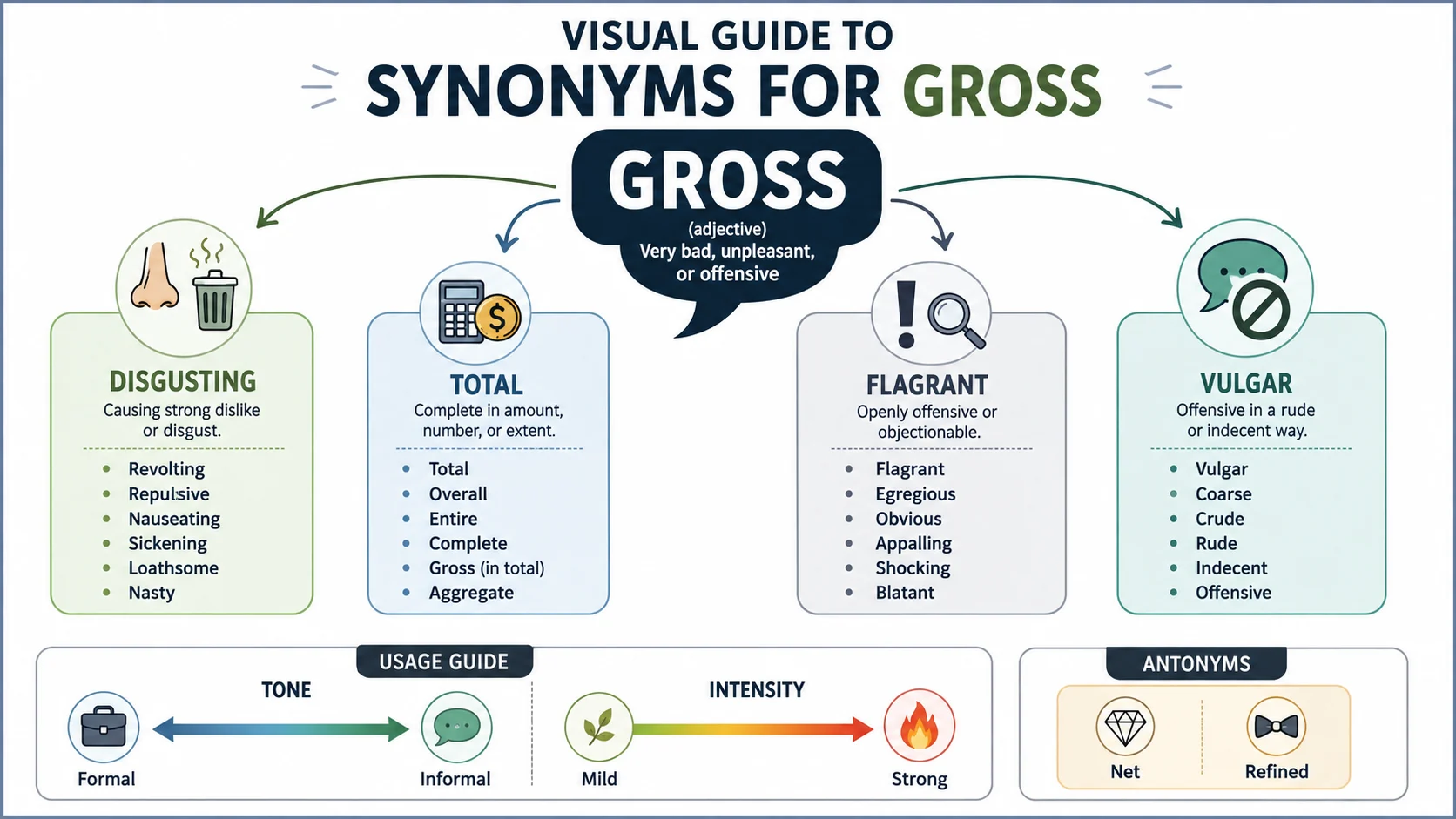
Common synonyms for gross include disgusting, nasty, revolting, unpleasant, filthy, repulsive, offensive, and vulgar. The best synonym depends on the meaning. For example, disgusting works for something unpleasant or dirty, while total, entire, or overall can replace gross when it means the total amount before deductions.
When you use the word gross, the meaning can change depending on the context. It may describe something disgusting, unpleasant, dirty, offensive, or even excessive. Because of these different meanings, choosing the right synonym can make your writing more accurate and natural. Words such as disgusting, repulsive, revolting, nasty, unpleasant, offensive, vulgar, and distasteful can express different levels of negativity, while terms such as total, overall, or aggregate may fit contexts where “gross” refers to a total amount before deductions. Understanding these distinctions helps you avoid using a synonym that sounds too strong, too casual, or simply incorrect.
In this guide, you’ll discover useful synonyms for gross organized by meaning, tone, and intensity. Whether you’re describing an unpleasant smell, disgusting behavior, an offensive comment, or a financial amount, you’ll find alternatives that fit the situation. Each word can carry a slightly different nuance, so examples and context are important when deciding which one works best. The goal is not just to replace “gross,” but to choose a more precise word that communicates exactly what you mean.
What Does Gross Mean?
In this guide, you’ll discover useful synonyms for gross organized by meaning, tone, and intensity. Whether you’re describing an unpleasant smell, disgusting behavior, an offensive comment, or a financial amount, you’ll find alternatives that fit the situation. Each word can carry a slightly different nuance, so examples and context are important when deciding which one works best. The goal is not just to replace “gross,” but to choose a more precise word that communicates exactly what you mean.
“Gross” is an adjective with several distinct definitions, though it can also function as a noun or verb in specific contexts.
Part of Speech:
- Adjective (most common)
- Noun (a quantity of 144 items, or total income)
- Verb (to earn a total amount before deductions)
Simple Definition:
At its core, “gross” refers to something that is either very unpleasant, completely obvious and bad, or the total amount of something before any deductions.
Common Usage:
- Disgusting: “The kitchen floor was absolutely gross after the party.”
- Financial/Total: “Her gross salary was $75,000 before taxes.”
- Extreme/Flagrant: “The judge called it a gross violation of the law.”
- Vulgar/Coarse: “His gross jokes made everyone uncomfortable.”
- Excessively Fat/Bulky: “The gross figure blocked the doorway.”
Core Meaning of Gross
The English language borrowed “gross” from Old French gros, meaning “large” or “thick.” This original sense of “bulk” or “largeness” has evolved into the multiple meanings we use today.
Think of “gross” as having two main clusters of meaning:
1. Unpleasantness and Offensiveness
In everyday conversation, “gross” is the go to word for things that make you recoil. A moldy sandwich, a crass comment, or an obnoxious person might all earn the label. It’s a strong, informal word that expresses genuine disgust or disapproval.
2. Extremeness and Totality
In more formal settings, “gross” often means “complete” or “total.” It describes the entire amount of something (income, weight) before deductions, or the sheer extremity of a mistake or injustice. The word adds weight and seriousness, suggesting something is not just wrong, but outrageously so.
Grammar and Usage Notes
Common Sentence Patterns:
- Before a noun: “The gross weight was over 500 pounds.”
- After a linking verb: “That movie was so gross.”
- With a noun phrase: “She earns a gross salary of $60,000.”
Formality and Tone:
- Using “gross” to mean “disgusting” is informal. For formal writing, choose alternatives like “repulsive,” “revolting,” or “offensive.”
- Using “gross” to mean “total” or “flagrant” is neutral and appropriate in business, legal, and academic settings.
- Using “gross” to describe a person’s size can be perceived as rude or offensive. Use “overweight,” “obese,” or “large” with care.
When Alternatives Work Better:
Choose a synonym when:
- You need a more formal word for “disgusting” in academic or professional writing.
- You want to be more specific about why something is unpleasant.
- You need a milder word to avoid sounding too harsh or judgmental.
- You’re referring to a financial amount and “total” sounds more natural.
Best Synonyms for Gross
| Synonym | Meaning | Tone | Best Use Case | Example Sentence |
| Disgusting | Very unpleasant; causing strong dislike | Informal, strong | Everyday conversation; describing food, smells, or habits | “The leftovers in the fridge were absolutely disgusting.” |
| Total | Complete amount before deductions | Neutral, formal | Financial contexts; describing sums and quantities | “The total cost of the project was over budget.” |
| Flagrant | Shockingly obvious and bad | Formal, strong | Legal, journalistic, or critical writing | “The report exposed the company’s flagrant disregard for safety.” |
| Egregious | Extremely bad and noticeable | Formal, strong | Academic, legal, or professional contexts | “This was an egregious error that cost the team the game.” |
| Vulgar | Lacking taste; crude or offensive | Formal | Describing offensive language or behavior | “His vulgar jokes were not appropriate at the office.” |
| Revolting | Extremely disgusting; repulsive | Strong, emphatic | Emphasizing intense disgust | “The smell coming from the dumpster was revolting.” |
| Crude | Rude, simple, or unrefined | Neutral to formal | Describing jokes, manners, or simplified things | “She found his crude sense of humor off-putting.” |
| Obese | Very overweight | Clinical, neutral (when used respectfully) | Medical, health, or statistical contexts | “The study focused on the health risks for obese patients.” |
Common Synonyms for Gross
These everyday synonyms work well in normal writing and conversation.
Disgusting
- Meaning: So unpleasant it makes you feel sick or repulsed.
- Best Context: Describing food, smells, sights, or habits.
- Example: “The bathroom after the party was utterly disgusting.”
Nasty
- Meaning: Unpleasant, unkind, or dirty. A highly versatile word.
- Best Context: Casual conversation for people, situations, or things.
- Example: “He made a nasty comment about her cooking.”
Offensive
- Meaning: Causing hurt, anger, or disgust; insulting.
- Best Context: Describing words, jokes, or actions that cross a line.
- Example: “The comedian’s offensive jokes got him booed off stage.”
Repulsive
- Meaning: Causing a strong feeling of disgust.
- Best Context: Describing something that makes you want to look away or avoid it.
- Example: “The mold on the cheese was utterly repulsive.”
Obvious
- Meaning: Easily seen or understood; clear.
- Best Context: Describing a mistake or problem that is impossible to miss.
- Example: “There was an obvious error in the final report.”
Formal Synonyms for Gross
Use these formal alternatives in academic writing, business reports, legal documents, and professional communication.
Egregious
- Meaning: Outstandingly bad; shocking.
- Formality Level: Very formal. Best in legal, academic, and critical reviews.
- When It Works Best: When you need to emphasize the seriousness of a mistake, injustice, or offense.
- Example: “The court found the company guilty of egregious misconduct.”
Flagrant
- Meaning: So bad it is obvious and cannot be ignored.
- Formality Level: Formal. Common in journalism and legal writing.
- When It Works Best: Highlighting a violation of rules, laws, or common decency.
- Example: “The politician’s flagrant disregard for the truth was widely condemned.”
Glaring
- Meaning: Very clear, obvious, and often troubling.
- Formality Level: Formal.
- When It Works Best: Describing an obvious mistake, error, or omission that stands out.
- Example: “There was a glaring flaw in the research methodology.”
Coarse
- Meaning: Rough, crude, or lacking refinement in behavior or language.
- Formality Level: Formal. Used as a polite or technical alternative to “vulgar.”
- When It Works Best: Describing speech, manners, or materials in a neutral but critical way.
- Example: “The diplomat apologized for his colleague’s coarse remarks.”
Indecent
- Meaning: Offensive to accepted standards of decency.
- Formality Level: Formal. Used in legal, moral, and professional discussions.
- When It Works Best: Describing behavior, images, or language that is morally or socially unacceptable.
- Example: “The scandal involved indecent conduct by several executives.”
Total (Financial Context)
- Meaning: The complete amount before deductions.
- Formality Level: Neutral to formal. Standard in business.
- When It Works Best: In financial reports, budgets, and salary discussions.
- Example: “The project’s total cost exceeded the initial estimate.”
Informal Synonyms for Gross
These casual alternatives are perfect for conversation, social media, friendly writing, and personal messages.
Yucky
- Tone: Playful, childish, informal.
- Best Use: Describing something mildly unpleasant, especially around children.
- Example: “The bottom of the lake is all slimy and yucky.”
Grody
- Tone: Slang, retro, informal.
- Best Use: Expressing disgust in a casual, sometimes humorous, way.
- Example: “He wore the same socks for a weekgrody to the max.”
Nasty
- Tone: Strong, informal.
- Best Use: Describing unpleasant people, situations, or things with a bit of bite.
- Example: “I can’t believe he left that nasty mess in the sink.”
Revolting
- Tone: Strong, informal, but can be used in many contexts.
- Best Use: Adding extra emphasis to how disgusting something is.
- Example: “The eggs were overcooked and tasted revolting.”
Grimy
- Tone: Informal, descriptive.
- Best Use: Describing something that is physically dirty or covered in grime.
- Example: “My hands were all grimy after fixing the bike.”
Disgusting
- Tone: The standard, all-purpose informal synonym.
- Best Use: The go-to replacement in any casual setting.
- Example: “This coffee is absolutely disgusting.”
Gross
- Tone: Still the most common informal term. Sometimes you just need the original word to keep it real.
- Best Use: Any casual, everyday conversation.
- Example: “Don’t show me that; it’s so gross.”
Strong Synonyms for Gross
These synonyms carry more emotional weight. They are useful when you want to emphasize extreme unpleasantness, a serious error, or a powerful reaction.
Heinous
- Meaning: Utterly odious or wicked.
- Intensity Level: Extremely strong. Usually reserved for serious crimes or moral failings.
- When To Use: To describe an act or person that is deeply evil and shocking.
- When It Sounds Too Strong: You wouldn’t call a dirty floor “heinous.” Use it for serious offenses.
- Example: “The dictator was responsible for heinous acts of cruelty.”
Repellent
- Meaning: Causing strong disgust; repulsive.
- Intensity Level: Very strong.
- When To Use: Describing something so off-putting it literally drives you away.
- When It Sounds Too Strong: For a bad smell in a fridge, it’s overkill. Save it for extreme situations.
- Example: “His political views were repellent to the majority of voters.”
Abhorrent
- Meaning: Inspiring disgust and loathing.
- Intensity Level: Very strong.
- When To Use: Moral disgust; something you find completely unacceptable.
- When It Sounds Too Strong: Not for everyday messes. Use it for ideas, actions, or policies you strongly oppose.
- Example: “Racism is morally abhorrent.”
Outrageous
- Meaning: Shockingly bad or excessive.
- Intensity Level: Strong.
- When To Use: To describe behavior, prices, or situations that are wildly beyond what is reasonable.
- Example: “The prices at that restaurant are outrageous.”
Sheer
- Meaning: Pure; complete and utter.
- Intensity Level: Emphatic.
- When To Use: Adding emphasis to a noun, often with negative connotations.
- Example: “The idea was dismissed with sheer contempt.”
Utter
- Meaning: Complete; absolute.
- Intensity Level: Emphatic.
- When To Use: Similar to “sheer” – it emphasizes the totality of a bad quality.
- Example: “He stared at me in utter disbelief.”
Mild Synonyms for Gross
These are softer, more neutral alternatives for when you want to tone things down.
Unpleasant
- Meaning: Not pleasant; causing discomfort.
- Softness Level: Very mild.
- When To Use: When you want to be polite or objective.
- Example: “There was an unpleasant smell in the waiting room.”
Distasteful
- Meaning: Offensive to taste or sensibilities.
- Softness Level: Mild.
- When To Use: Describing something that is inappropriate but not deeply offensive.
- Example: “I found his comments rather distasteful.”
Unrefined
- Meaning: Not polished or elegant; coarse.
- Softness Level: Mild.
- When To Use: Describing a person’s manners or tastes without being too harsh.
- Example: “His eating habits are somewhat unrefined.”
Improper
- Meaning: Not in accordance with accepted standards.
- Softness Level: Mild to neutral.
- When To Use: Professional or social contexts where you need to criticize something politely.
- Example: “The employee’s conduct was deemed improper.”
Overweight
- Meaning: Above a normal weight.
- Softness Level: Neutral, clinical. More polite than “gross” or “fat.”
- When To Use: Medical or polite discussions about body size.
- Example: “The doctor advised her to lose weight because she is overweight.”
Synonyms for Gross by Context
Everyday Conversation
The most natural replacements are disgusting, nasty, and yucky. These casual words fit seamlessly into everyday dialogue.
Example:
- “This soup tastes disgusting.”
- “Don’t touch that; it’s nasty.”
Professional Writing
In business emails, reports, and professional communication, choose the right meaning:
- Financial: Use total, overall, or aggregate.
- Describing an error: Use obvious, significant, or egregious.
Example:
- “The total revenue was lower than expected.”
- “We identified a significant error in the calculations.”
Academic Writing
Academic writing requires precision. For a “gross” error or injustice, use flagrant, egregious, or glaring. For financial or statistical terms, overall is standard.
Example:
- “The study revealed a glaring oversight in the experimental design.”
- “This demonstrates an egregious misuse of statistical methods.”
Creative Writing
Creative writing is your chance to be vivid. Choose words that evoke the strongest images and feelings:
- Disgust: Revolting, repulsive, putrid
- Size: Bulky, massive, portly
- Coarseness: Crass, boorish, unseemly
Example:
- “The putrid smell of decay filled the air.”
- “A boorish man pushed his way to the front of the line.”
Emotional Expression
When you want to express strong feelings of disgust or disapproval, use strong synonyms like abhorrent, heinous, or repellent. For milder displeasure, unpleasant or distasteful works better.
Example:
- “His behavior was abhorrent.”
- “The movie was distasteful and left me feeling dirty.”
Another Word for Gross in a Sentence
These examples show how different synonyms work in real sentences:
- “The rotten eggs smelled absolutely disgusting.”
- “The judge described the crime as a flagrant violation of trust.”
- “Her coarse manners were a constant source of embarrassment.”
- “We need to calculate the total sales for the quarter.”
- “This is an egregious error that must be corrected immediately.”
- “His vulgar jokes cleared the room in minutes.”
- “The smell from the dumpster was revolting.”
- “He made a nasty remark about her weight.”
- “The politician’s shameful conduct led to his resignation.”
- “There was a glaring mistake in the final report.”
- “The CEO called the rival’s comments crude and irresponsible.”
- “Some people find his sense of humor offensive.”
- “The program’s sheer incompetence was breathtaking.”
- “The sight of the dead animal was utterly repulsive.”
- “She was taken aback by his indecent proposal.”
Gross Synonyms Compared
Sometimes it’s hard to pick between two similar words. This comparison helps clarify the small differences.
Disgusting vs. Revolting vs. Repulsive
All three mean “causing disgust,” but with different intensities. Disgusting is the common, all-purpose term. Revolting suggests something is so bad it makes you feel sick or want to turn away. Repulsive focuses on the feeling of being actively repelledpushed away by something. A bad smell can be disgusting, but a war crime is revolting and repulsive.
Flagrant vs. Egregious vs. Glaring
These are all formal ways to say “very obvious and bad.” Flagrant emphasizes a bold, shameless violation of rules or standards. Egregious emphasizes the sheer badness of the thing itself. Glaring emphasizes how visibly obvious the mistake or problem is. A flagrant foul in sports is one the referee can’t miss. An egregious error is a terrible one. A glaring omission is one that stands out clearly.
Crude vs. Coarse vs. Vulgar
These describe a lack of refinement. Crude can mean simple and unpolished, or rude and offensive. Coarse is similar but often suggests roughness of texture or behavior. Vulgar specifically means lacking in taste, refinement, or decency. Crude oil is unrefined. Coarse cloth is rough. Vulgar language is indecent.
Obese vs. Overweight vs. Fat
Overweight is a neutral, clinical term for being above a healthy weight. Obese is a medical term for a more severe degree of excess body fat. Fat is a simple, often blunt or rude, everyday term.
Words Similar to Gross
These words belong to the same general area of meaning but are not always direct replacements.
Dense
- Why It’s Related: It can mean “thick” or “heavy,” similar to “gross” in its archaic sense.
- Why It’s Not Exact: It usually describes compactness, difficulty seeing through, or, informally, stupiditynot disgust or financial totals.
Rank
- Why It’s Related: Can mean “offensive” or “strong and unpleasant” in smell.
- Why It’s Not Exact: It doesn’t cover the financial, legal, or “total” meanings of “gross.”
Blatant
- Why It’s Related: Means very obvious, like “gross” in the sense of “glaring.
- Why It’s Not Exact: Doesn’t carry the financial or unpleasant meanings. It’s a specific synonym for “obvious and bad.”
Overall
- Why It’s Related: Means considering everything, similar to “total” or “general.”
- Why It’s Not Exact: It lacks the sense of “badness,” “disgust,” or “seriousness” that “gross” often carries.
Appalling
- Why It’s Related: Means causing shock or dismay, similar to “gross” when describing badness.
- Why It’s Not Exact: It can refer to things that are surprisingly bad, but not necessarily “disgusting” in the physical sense.
Antonyms of Gross
Net
- Meaning: The amount remaining after all deductions (the opposite of “gross” in financial and weight contexts).
- Example: “After taxes, her net income was significantly less than her gross pay.”
Dainty
- Meaning: Delicately small and pretty (the opposite of “gross” meaning large or bulky).
- Example: “She had dainty hands that were perfect for playing the piano.”
Detailed
- Meaning: Having many details (the opposite of “gross” meaning broad or general).
- Example: “The detailed report contained information that the general overview missed.”
Refined
- Meaning: Elegant and cultured (the opposite of “gross” meaning vulgar or coarse).
- Example: “He had refined tastes and avoided anything vulgar.”
Tasteful
- Meaning: Showing good taste (the opposite of “gross” meaning offensive or indecent).
- Example: “The tasteful decoration in the restaurant impressed all the guests.”
Pleasant
- Meaning: Giving a sense of happiness or satisfaction (the opposite of “gross” meaning disgusting).
- Example: “After the awful smell outside, the pleasant aroma of baking bread was a welcome relief.”
How to Choose the Right Synonym for Gross
Follow these practical steps to select the best word:
1. Match the Context
First, decide which meaning you need. Are you talking about money, a bad smell, a serious mistake, or poor manners? This immediately narrows your options.
2. Match the Tone
Consider your audience and setting. Are you writing a formal report, a text to a friend, or a story? Choose a synonym that fits the tone. Avoid “yucky” in a job application and “egregious” in a text about a dirty dish.
3. Check the Intensity
How strong do you need to be? If you want to be polite and mild, use “unpleasant” or “distasteful.” If you want to express strong disgust or outrage, use “revolting,” “repulsive,” or “flagrant.”
4. Think About Your Reader
Will your reader understand the word? Using “egregious” to a general audience might confuse them. Often, a simpler word like “obvious” or “terrible” is more effective.
5. Check If It’s a Direct Replacement
Does your chosen synonym fit grammatically and logically? “Total” can replace “gross” in “gross income,” but it can’t replace it in “that’s gross.” Always make sure the synonym makes sense in the sentence.
6. Keep the Sentence Natural
Read your sentence aloud. Does it sound like something you would say or write? If the synonym feels forced or awkward, it’s the wrong choice. Find a word that flows naturally.
Common Mistakes When Using Synonyms for Gross
Choosing the Wrong Tone
Using “abhorrent” in a casual conversation about a messy kitchen will sound strange. Using “yucky” in a formal report about corporate negligence will undermine your credibility. Match the tone to the situation.
Using a Synonym That Is Too Strong
A slightly messy room is “unpleasant,” not “revolting.” Save the strongest words for situations that genuinely warrant them. Overusing strong language makes you seem dramatic or untrustworthy.
Using a Formal Word in Casual Writing
“I found the movie’s ending to be deeply egregious” sounds stiff and unnatural in a text to a friend. Stick with “disgusting,” “nasty,” or “terrible.”
Using a Casual Word in Professional Writing
You wouldn’t tell your boss, “The company’s gross profits this year are yucky.” Use “total” or “overall” in financial contexts.
Replacing Gross Without Checking the Meaning
If you replace “gross income” with “disgusting income,” you’ve changed the meaning entirely. Similarly, replacing “gross negligence” with “disgusting negligence” is grammatically awkward and semantically wrong. Always confirm that the synonym fits the intended meaning.
Treating Related Words as Exact Synonyms
“Rank” can mean “offensive,” but it usually refers to a strong smell or obvious badness. It’s not the best choice for the financial or total meanings of “gross.” Be careful with related words.
Making the Sentence Sound Unnatural
If your sentence sounds like you consulted a thesaurus, rewrite it. Natural language is usually the most effective. Simple, clear words often work best.
Quick Synonym List for Gross
- Disgusting
- Nasty
- Offensive
- Repulsive
- Obvious
- Egregious
- Flagrant
- Glaring
- Coarse
- Indecent
- Total (Financial)
Informal Synonyms
- Yucky
- Grody
- Nasty
- Revolting
Strong Synonyms
- Heinous
- Repellent
- Abhorrent
- Outrageous
- Sheer
- Utter
Mild Synonyms
- Unpleasant
- Distasteful
- Unrefined
- Improper
- Overweight
Related Words
- Dense
- Rank
- Blatant
- Overall
- Appalling
FAQs
What is the best synonym for gross?
The best synonym depends on the meaning you intend with “disgusting,” disgusting or revolting works well. For financial contexts, total is best. For a serious error, egregious or flagrant is appropriate.
What is another word for gross?
Common alternatives include disgusting, nasty, total, flagrant, vulgar, crude, and obese.
What is a formal synonym for gross?
“disgusting,” consider repulsive or offensive. For “total,” use overall. For “obviously bad,” use flagrant, egregious, or glaring.
What is an informal synonym for gross?
Informal alternatives include yucky, grody, and nasty. These are perfect for casual conversation and personal messages.
What is a stronger word for gross?
Stronger words include heinous, repellent, abhorrent, and outrageous. Use these when you want to emphasize extreme badness or disgust.
What is a milder word for gross?
Milder alternatives include unpleasant, distasteful, and improper. These are good choices when you want to be polite or objective.
What words are similar to gross?
Words in the same general area include dense, rank, blatant, overall, and appalling. They share some characteristics but are not exact synonyms.
What is the opposite of gross?
The most common antonym is net, used in financial contexts. Other opposites include dainty, detailed, refined, tasteful, and pleasant, depending on the meaning of “gross.”
How do I choose the right synonym for gross?
Consider the context, tone, intensity, and your audience. Match the synonym to the situation, and make sure your sentence sounds natural.
Conclusion
The English language offers a rich variety of synonyms for “gross.” The perfect choice depends on your meaning, your audience, and the tone you want to set. If something is unpleasant, disgusting, revolting, or nasty might work. If you’re discussing money, total or overall is the way to go. For a serious mistake or injustice, use egregious, flagrant, or glaring. And when describing a lack of refinement, vulgar, crude, or coarse are excellent options.
The key is to be intentional with your word choice. By understanding the subtle differences between these synonyms, you can communicate more clearly, more powerfully, and more precisely. So next time you want to say “gross,” take a moment to think about what you really meanand choose the word that fits best.