Quick Answer:
The best synonyms for promote are advertise, publicize, encourage, and champion. Each one shifts the meaning slightly, so the right choice depends on tone, context, and intensity.
Use advertise or publicize when talking about products, events, or public awareness.
Use encourage or support when the focus is on backing an idea, person, or cause.
Use champion or spearhead when you want a stronger, more determined tone.
Use elevate or advance when referring to a job title or rank.
What Does Promote Mean?
At its core, “promote” describes an action that helps something gain attention, support, or a higher standing. It’s a verb, and it shows up constantly in marketing, workplace conversations, and everyday speech.
The word carries two common meanings:
- To help something become known or popular a company might promote a new product through ads and social media.
- To raise someone to a higher rank or position a manager might promote an employee after years of strong performance.
- The bakery used flyers and social media to promote its new menu.
- After two successful projects, she was promoted to team lead.
Core Meaning of Promote
Underneath both definitions sits the same basic idea: movement forward or upward. Whether it’s a product moving into public awareness or a person moving up a career ladder, “promote” always implies progress driven by someone’s active effort. It’s rarely a passive word someone is doing the promoting, and something (or someone) benefits from it.
Grammar and Usage Notes
“Promote” is a regular transitive verb, meaning it needs a direct object. You promote something or someone you don’t just “promote” in isolation.
Common sentence patterns:
- promote + product/idea/cause (to advertise or support)
- promote + person (to raise in rank)
- be promoted to + position (passive voice, common in workplace contexts)
Common collocations: promote awareness, promote growth, promote a brand, promote peace, promote an employee, promote healthy habits.
“Promote” sounds natural in marketing, HR, health, and advocacy contexts. When a sentence needs more warmth or a personal tone such as encouraging a friend a softer synonym like “support” or “encourage” often reads better than “promote.”
Best Synonyms for Promote
| Synonym | Meaning | Tone | Best Use Case | Example Sentence |
| Advertise | Make known through paid or public means | Neutral | Marketing, business | The store advertised its summer sale on the radio. |
| Publicize | Bring public attention to something | Neutral | Media, events, announcements | The charity publicized its fundraiser through local news. |
| Encourage | Give support or confidence to something | Warm | Personal, motivational | Teachers encourage curiosity in young students. |
| Champion | Actively defend or support strongly | Strong | Advocacy, leadership | She champions fair wages across the industry. |
| Boost | Increase visibility or momentum | Casual | Social media, sales | The influencer helped boost the app’s downloads. |
| Advance | Move something forward, often in rank | Formal | Career, policy | His steady work helped advance his career. |
| Foster | Encourage growth or development | Formal | Relationships, environments | The program fosters teamwork among new hires. |
| Endorse | Publicly support or approve | Formal | Politics, reviews | The senator endorsed the new housing bill. |
Common Synonyms for Promote
These are everyday alternatives that fit naturally into both spoken and written English.
Advertise to make a product or service known to the public. Best context: marketing, retail, business announcements. Example: They advertised the concert on every local station.
Encourage to give someone confidence or support to continue doing something. Best context: personal relationships, education, motivation. Example: Her parents encouraged her to apply for the scholarship.
Support to back an idea, cause, or person. Best context: everyday conversation, community efforts. Example: The neighborhood came together to support the new community garden.
Boost to lift something up in visibility or performance. Best context: casual writing, sales, social media growth. Example: A single viral post can boost a small business overnight.
Formal Synonyms for Promote
Formal writing calls for words that sound polished and precise, without losing clarity.
Advocate for works well in academic or policy writing when someone actively pushes for a cause. “The report advocates for stricter safety regulations.”
Endorse fits business, political, or professional writing where public approval matters. “The board formally endorsed the merger proposal.”
Foster suitable for essays or reports discussing growth, culture, or development. “The initiative aims to foster collaboration between departments.”
Advance often used in professional or career-related writing. “Her research helped advance the field of renewable energy.”
Further a slightly older but still formal choice, common in reports and essays. “These policies further the company’s long-term goals.”
Informal Synonyms for Promote
Casual conversation and social writing often call for shorter, punchier words.
Push common in everyday speech about marketing or persuasion. “They’re really pushing that new phone this month.”
Plug a light, casual way to mention promotion, often used with humor. “He plugged his friend’s podcast during the interview.”
Hype used when excitement is part of the promotion. “Fans hyped up the movie for weeks before release.”
Big up informal British-leaning slang, mostly used in speech. “Let’s big up the local team for their win.”
Strong Synonyms for Promote
These words add force, determination, or urgency.
Champion implies someone stands firmly behind a cause, often facing resistance. Use it when describing dedicated advocacy. It can sound too intense for casual small talk.
Spearhead suggests leading an effort from the front. Works well for describing major initiatives. “She spearheaded the company’s diversity program.”
Drive implies energetic, forceful momentum. “His leadership drove the campaign’s early success.”
Propel suggests rapid forward movement, often dramatic. Best kept for writing about fast growth or sudden success, since it can feel exaggerated in ordinary contexts.
Mild Synonyms for Promote
Softer words work well when a sentence needs a gentler, less assertive tone.
Support quietly backs something without pushing hard. Ideal for everyday writing.
Favor leans toward something without strong action behind it. “Most reviewers favor the simpler design.”
Back casual and mild, common in speech. “Several coworkers backed her proposal.”
Mild synonyms suit situations where you want to show approval without sounding forceful, such as workplace emails or neutral summaries.
Synonyms for Promote by Context
Everyday Conversation
“Support,” “encourage,” and “push” all sound natural in casual talk. They’re short, familiar, and don’t require explanation.
Professional Writing
“Advance,” “foster,” and “endorse” read as polished choices for reports, emails, and formal proposals.
Marketing Copy
“Advertise,” “boost,” and “hype” capture the energy marketing writing usually needs.
Academic Writing
“Advocate for,” “further,” and “foster” fit research papers and essays where precision matters.
Emotional Expression
“Encourage” and “champion” carry warmth or passion, useful when writing about personal support or causes someone cares about deeply.
Another Word for Promote in a Sentence
- The company plans to advertise its new app across social media.
- Local leaders are working to publicize the upcoming election.
- Her manager decided to promote her, though colleagues often described it as helping her advance.
- Volunteers encouraged residents to recycle more often.
- The nonprofit champions access to clean water in rural areas.
- A short video helped boost interest in the fundraiser.
- Teachers try to foster independent thinking in their students.
- The mayor publicly endorsed the new transportation plan.
- Word of mouth alone helped push the small bakery’s sales.
- His latest album got a lot of buzz after a popular podcast plugged it.
- The coach worked to advance the team’s reputation across the league.
- Community members backed the proposal for a new park.
- Marketing efforts helped drive attention to the underfunded shelter.
- She spearheaded a campaign to raise awareness about food waste.
- The startup used clever ads to hype its product launch.
Promote Synonyms Compared
| Synonym | Meaning Focus | Tone | Intensity | Best Fit |
| Advertise | Public product awareness | Neutral | Medium | Marketing |
| Encourage | Emotional support | Warm | Low | Personal |
| Champion | Active defense of a cause | Strong | High | Advocacy |
| Boost | Quick rise in visibility | Casual | Medium | Social media |
| Advance | Career or rank progress | Formal | Medium | Workplace |
| Foster | Gradual, gentle growth | Formal | Low | Education, culture |
“Advertise” and “publicize” often get treated as interchangeable, but advertising usually involves paid or deliberate marketing, while publicizing simply spreads awareness, sometimes through free media coverage. “Encourage” and “champion” both show support, yet champion carries far more determination and public commitment.
Words Similar to Promote
These words share meaning with “promote” but don’t always work as direct replacements.
Market refers specifically to business strategies aimed at selling something. It’s related to promotion but focuses more on positioning a product than simply making it known.
Sponsor involves financial or material backing, not just verbal support. A company can sponsor an event without actively promoting it themselves.
Recommend suggests something is good, but doesn’t necessarily involve active effort to spread awareness. Recommending a book is quieter than promoting one.
Elevate closely tied to the “raise in rank” meaning of promote, but it can also apply to abstract things like mood or status, which promote rarely covers.
These words belong to the same general idea but shift the focus toward strategy, funding, suggestion, or status rather than active promotion itself.
Antonyms of Promote
| Antonym | Meaning | Example Sentence |
| Discourage | To reduce someone’s confidence or interest | The high price discouraged new customers. |
| Hinder | To slow down or block progress | Poor planning hindered the project’s launch. |
| Suppress | To hold back or prevent from spreading | Officials tried to suppress the rumor quickly. |
| Demote | To lower someone’s rank or position | He was demoted after missing several deadlines. |
| Oppose | To actively resist or disagree with something | Several council members opposed the new policy. |
How to Choose the Right Synonym for Promote
Picking the right word takes more than swapping one term for another. A few quick checks can help:
- Match the context. Marketing language doesn’t always fit workplace or academic writing.
- Match the tone. A warm, personal sentence needs a softer word than a business report.
- Check the intensity. “Champion” and “spearhead” carry far more weight than “support” or “back.”
- Think about the reader. Formal audiences expect polished vocabulary, while casual readers respond better to simple, familiar words.
- Check whether the synonym is exact or only related. Words like “market” or “sponsor” overlap with promote but aren’t always interchangeable.
- Keep the sentence natural. If a synonym forces awkward phrasing, it’s not the right fit, even if the meaning is technically correct.
- Use simple words when clarity matters. Complex synonyms can sometimes confuse readers instead of impressing them.
Common Mistakes When Using Synonyms for Promote
Even strong writers slip up when swapping synonyms carelessly. Watch out for these common issues:
- Choosing a word with the wrong tone, such as using “spearhead” in a casual text message.
- Picking a synonym that’s too strong for the situation, making a simple update sound dramatic.
- Using formal words like “advocate for” in relaxed, everyday writing.
- Dropping casual slang like “hype” or “plug” into professional reports.
- Replacing “promote” without confirming the sentence still makes sense “market” and “promote” aren’t always identical.
- Treating loosely related words, such as “recommend” or “sponsor,” as exact substitutes.
- Forcing a synonym into a sentence structure it doesn’t naturally fit, which makes writing feel stiff.
Quick Synonym List for Promote
Common synonyms: advertise, publicize, encourage, support, boost
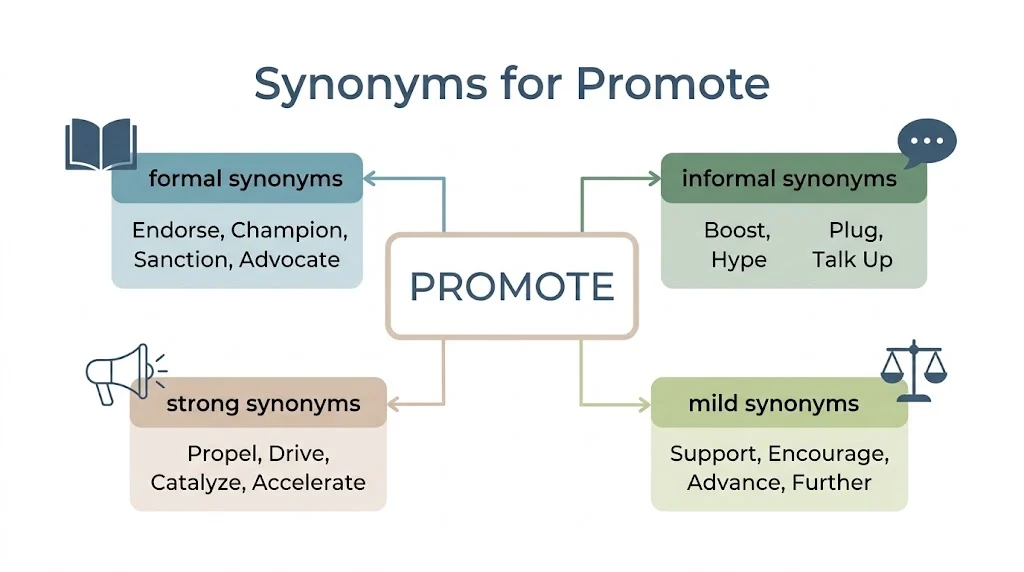
Formal synonyms: advocate for, endorse, foster, advance, further
Informal synonyms: push, plug, hype, big up
Strong synonyms: champion, spearhead, drive, propel
Mild synonyms: support, favor, back
Related words: market, sponsor, recommend, elevate
FAQs
What is the best synonym for promote?
“Advertise” or “encourage” work as the best general synonyms, depending on context. Advertise fits marketing and business settings, while encourage suits personal or motivational writing.
What is another word for promote?
Publicize” is a strong everyday alternative. It focuses on spreading awareness, which matches one of the core meanings of promote.
What is a formal synonym for promote?
“Advocate for” or “endorse” work well in formal writing. Both carry a professional tone suited to reports, essays, and business communication.
What is an informal synonym for promote?
“Push” or “plug” fit casual conversation and social writing. They’re short, familiar, and common in everyday speech.
What is a stronger word for promote?
“Champion” or “spearhead” both add intensity. They suggest active leadership or determined support rather than simple encouragement.
What is a milder word for promote?
“Support” or “favor” work as gentler alternatives. They show approval without sounding forceful or dramatic.
What words are similar to promote?
“Market,” “sponsor,” and “recommend” share meaning with promote but don’t always work as direct replacements, since each one shifts the focus slightly.
What is the opposite of promote?
“Discourage” and “demote” are common antonyms. Discourage reduces interest or confidence, while demote lowers someone’s rank or position.
Conclusion
Choosing among synonyms for promote comes down to reading the room. A marketing email calls for a different word than a heartfelt note of encouragement, and a formal report needs different vocabulary than a casual text. Once the meaning, tone, context, and intensity line up, the right word tends to stand out on its own.