Quick Answer
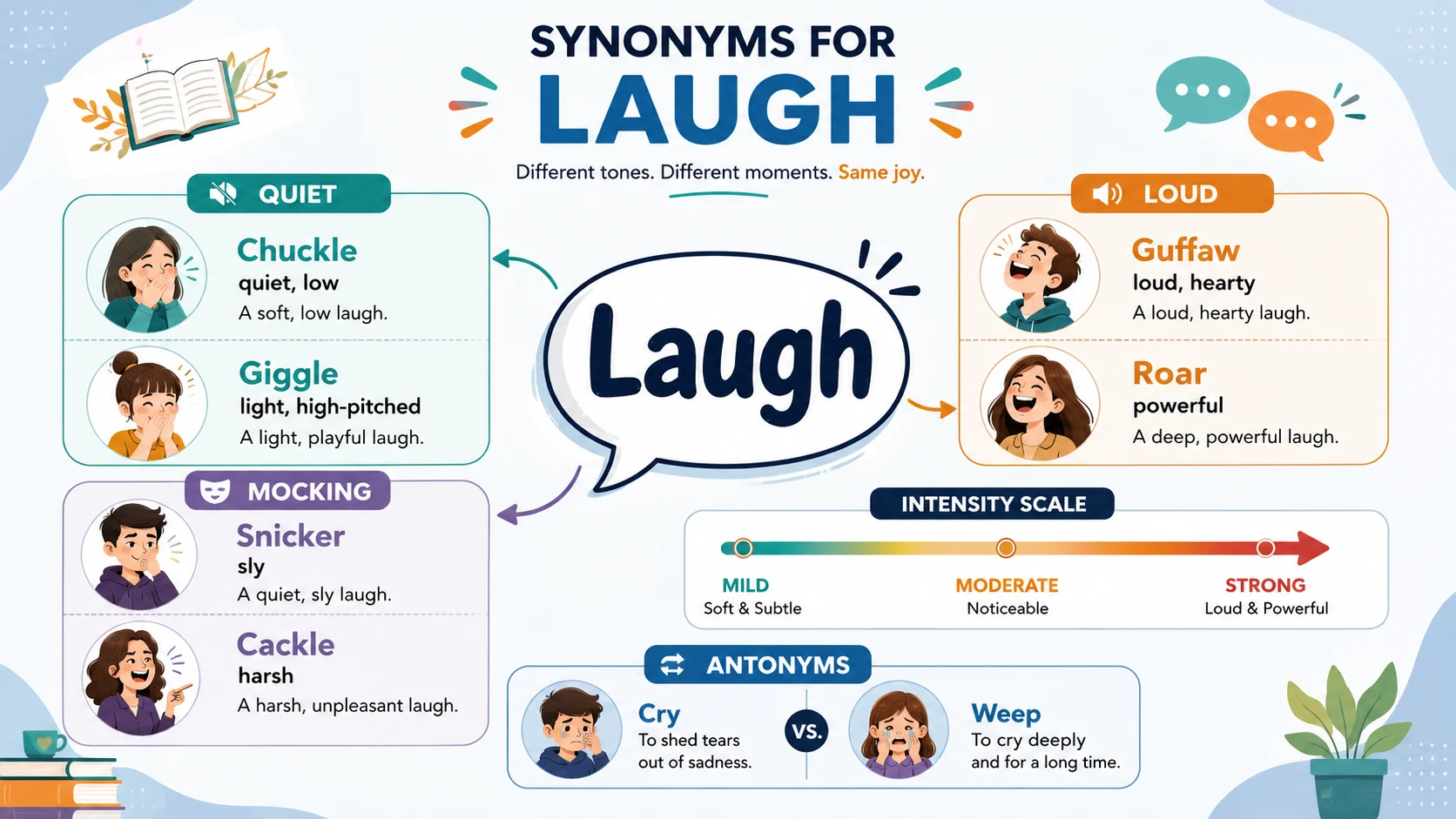
The best synonyms for laugh are chuckle, giggle, guffaw, and chortle. A chuckle is quiet and low, a giggle is light and high-pitched, a guffaw is loud and hearty, and a chortle is a gleeful combination of a chuckle and a snort. The right choice depends on the sound you want to describe
Laughter is a natural way to express happiness, amusement, excitement, or even nervousness, but using the word “laugh” repeatedly can make your writing feel plain. The right synonym can add personality and precision, whether you are describing a quiet giggle, a loud burst of laughter, a playful chuckle, or an uncontrollable fit of amusement. Understanding different synonyms for laugh helps you choose words that better match the emotion, situation, and tone of your sentence.
In this guide, you’ll discover useful alternatives to “laugh,” along with their meanings and examples. From everyday words such as giggle, chuckle, grin, and snicker to more descriptive expressions for intense laughter, these alternatives can make your conversations, stories, essays, and other writing more engaging. You’ll also learn which words work best in formal, casual, humorous, and emotional contexts so you can choose the most natural option every time.
What Does Laugh Mean?
At its simplest, to laugh means to make the sounds and facial movements that show you are amused or happy. It is a vocal expression of mirth, joy, or even nervousness . While usually a sign of finding something funny, people also laugh when they feel uncomfortable or want to mock someone.
- Part of speech: Verb and noun.
- Common usage: We use it to describe a reaction to humor, joy, or social bonding.
Example sentence: The comedian made the whole audience laugh with his opening joke .
Core Meaning of Laugh
The core concept behind laugh is a spontaneous, often involuntary reaction to something perceived as humorous or enjoyable. It is a social signal that bonds people together . Laughter usually involves a particular facial expression, sounds from the throat, and sometimes body movements like shaking or slapping a knee. It is more than just a smile; it is an audible expression that communicates shared joy or amusement .
Grammar and Usage Notes
As a verb, laugh is usually intransitive, meaning it does not take a direct object. You laugh at something or someone, not laugh something.
- Common sentence patterns: “She laughed at the joke,” “They laughed together,” “He made me laugh.”
- Common phrases: “laugh out loud,” “burst out laughing,” “have a good laugh,” “laugh it off.”
- When it sounds natural: Laugh is versatile and works in almost any context.
- When a synonym may work better: Use a synonym when you need to be more specific about the type of laugh or to add more vivid detail to your writing.
Best Synonyms for Laugh
Here is a table of the most accurate synonyms, from the quietest to the loudest.
| Synonym | Meaning | Tone | Best Use Case | Example Sentence |
| Chuckle | A quiet, low, and often private laugh . | Mild, amused | Expressing quiet satisfaction or private amusement. | He read the old letter and gave a soft chuckle. |
| Giggle | A light, high-pitched, and often nervous or silly laugh . | Light, childish, informal | Describing children, nervous excitement, or silliness. | The group of friends couldn’t stop giggling at the silly meme. |
| Chortle | A gleeful, snorting laugh, often combined with a chuckle . | Joyful, gleeful | Showing great delight and amusement. | She chortled with glee when she won the game. |
| Guffaw | A loud, boisterous, and hearty laugh . | Loud, uninhibited | Describing a big, contagious laugh that is hard to control. | He let out a loud guffaw at the punchline of the joke. |
| Snicker | A quiet, sly, or partly suppressed laugh, often mocking . | Mocking, disrespectful | Describing a laugh that is mean-spirited or disrespectful. | The students began to snicker when the teacher made a mistake. |
| Snigger | Similar to a snicker, a sly, disrespectful, or suppressed laugh . | Disrespectful, sly | Similar to snicker, often used in British English. | The bully sniggered at the new student’s accent. |
| Cackle | A harsh, shrill laugh that sounds like a hen . | Harsh, unpleasant | Describing an evil, witch-like laugh or a loud, annoying one. | The villain in the movie let out a menacing cackle. |
| Roar (with laughter) | A very loud and deep laugh . | Powerful, unrestrained | Showing extreme amusement or joy. | The entire theater roared with laughter at the performance. |
| Titter | A short, nervous, or high-pitched laugh . | Nervous, restrained | Describing a polite, suppressed, or embarrassed laugh. | The audience gave a nervous titter at the controversial joke. |
Common Synonyms for Laugh
These are everyday words you can use in conversation and general writing.
- Chuckle – A quiet, low laugh.
- Example: “She was reading a book and chuckled to herself.”
- Giggle – A light, silly laugh.
- Example: “The little girl giggled as she played with the puppy.”
- Snicker – A quiet, mocking laugh.
- Example: “He tried not to snicker at his brother’s bad luck.”
Formal Synonyms for Laugh
For academic or professional writing, use words that are precise and avoid slang .
- Express amusement – A formal way to say you found something funny.
- Example: “The report expressed amusement at the marketing team’s error.”
- Chortle – Acceptable in writing to describe a joyful laugh.
- Example: “The professor chortled at the clever pun.”
- Cachinnate – A highly technical, rare word for laughing loudly. Good for formal or scholarly writing about psychology or behavior .
- Example: “The behavior is characterized by a tendency to cachinnate.”
Informal Synonyms for Laugh
These casual alternatives are perfect for talking with friends or using on social media .
- Crack up – To suddenly start laughing a lot.
- Example: “We cracked up when we saw the video.”
- Burst out laughing – To start laughing suddenly and loudly.
- Example: “I just burst out laughing when she told me the story.”
- Laugh out loud (LOL) – Used in texts and online to show you think something is funny.
- Example: “That meme made me laugh out loud.”
- Bust a gut – To laugh very hard.
- Example: “We were busting a gut at the comedy show.”
- Be in stitches – To be laughing uncontrollably.
- Example: “The entire audience was in stitches.”
Strong Synonyms for Laugh
These are high-intensity words that convey powerful emotion .
- Guffaw – A loud and explosive laugh.
- Use when: Someone is being completely uninhibited.
- Roar – To laugh with great force and noise.
- Use when: A whole group, like an audience, is laughing loudly.
- Howl – To laugh loudly and for a long time.
- Use when: Laughter is almost painful, like a wolf’s howl.
- Scream – To be so funny you scream with laughter.
- Use when: Something is hilariously funny.
Mild Synonyms for Laugh
These are softer, more neutral words for when a big laugh feels too strong.
- Smile – Not a laugh, but a facial expression of pleasure . Use this for a more reserved reaction.
- Example: “He smiled at the compliment.”
- Grin – An exaggerated smile that shows teeth . Use this to show amusement without the sound.
- Example: “She grinned when she saw the surprise.”
- Snort – A laugh that is a sudden, noisy air expulsion through the nose. Use this for a reflexive, involuntary laugh.
- Example: “She snorted at his ridiculous suggestion.”
Synonyms for Laugh by Context
Everyday Conversation
In daily chit-chat, simple words like “chuckle,” “giggle,” and “laugh” work best. Use “crack up” or “couldn’t stop laughing” to tell stories.
“We were just having a laugh about old times.”
Professional Writing
Stick to neutral and formal words in business settings. “Chuckle” is often safe. “Express amusement” or “smile” are better than “giggle” or “snicker.”
Example: “The team leader chuckled at the feedback.”
Creative Writing
This is where you can be specific. Choose words that match your character and the mood.
- A villain might cackle .
- A romantic lead might chuckle.
- A nervous character might titter or give a nervous giggle .
Marketing Copy
You want to show fun and joy. Use “laugh out loud,” “crack up,” or “roar” to convey that a product or joke is extremely funny. Avoid negative words like “snicker” or “cackle,” which can have a mocking or mean tone.
Another Word for Laugh in a Sentence
- The comedian’s joke made the entire stadium roar with laughter.
- He couldn’t help but chuckle at the memory of their first date.
- The children giggled incessantly as they played.
- A few people in the crowd began to snicker disrespectfully.
- She let out a loud guffaw, startling the people nearby.
- He tittered nervously during the awkward speech.
- The witch let out a high-pitched cackle.
- We all cracked up when we saw the cat wearing a tiny hat.
- The story was so funny, I burst out laughing.
- He gave a friendly grin when he saw his friend’s joke .
- The audience roared with laughter at the performance.
- He chortled with glee at the clever pun.
Laugh Synonyms Compared
While many synonyms mean “to laugh,” they have subtle but important differences.
- Chuckle vs. Giggle: A chuckle is a quiet, deep sound of satisfaction. A giggle is a high-pitched, light sound, often associated with children or nervousness .
- Snicker vs. Snigger: These words are very similar. Both can describe a sly, disrespectful, or partly suppressed laugh . Snigger is more common in British English.
- Guffaw vs. Roar: A guffaw is a loud laugh from one person. A roar of laughter usually describes a large group laughing together .
Words Similar to Laugh
These words are related to laughter and humor but are not always exact synonyms.
- Joke: This is the reason for a laugh, not the laugh itself .
- Humor: This is the quality of being funny that causes a laugh .
- Wit: This is the intelligence or cleverness to create humor .
- Smile: A silent, non-vocal facial expression that can suggest amusement .
Antonyms of Laugh
- Cry – The most direct opposite, where you shed tears from sadness or pain .
- Weep – Similar to cry, expressing grief or sorrow .
- Sob – To cry noisily, showing great distress.
- Groan – A sound of disapproval, pain, or boredom, the opposite of a happy sound .
- Example: “The team groaned in disappointment, instead of laughing with joy.”
How to Choose the Right Synonym for Laugh
Picking the right synonym is easy if you follow these steps:
- Think about the sound: Is it loud or quiet? High-pitched or deep? A guffaw is loud, a chuckle is quiet.
- Consider the emotion: Is it joy, nervousness, or mockery? A snicker is mocking, a giggle is often nervous.
- Know your audience: Use informal words like “crack up” with friends. Use “chuckle” or “express amusement” in professional settings.
- Avoid forcing it: Don’t use a complex word if a simple one like “laugh” works perfectly. The goal is natural, clear writing.
Common Mistakes When Using Synonyms for Laugh
- Using “guffaw” for a small laugh: A guffaw is loud and boisterous . Using it for a quiet laugh is confusing.
- Using “snicker” in a positive context: A snicker is usually mean or disrespectful .
- Using “cackle” for a normal laugh: A cackle is a harsh, shrill sound often associated with villains.
- Forgetting the tone: Don’t use an informal word like “bust a gut” in a formal report. Context is critical.
Quick Synonym List for Laugh
Common Synonyms
- Chuckle
- Giggle
- Snicker
- Guffaw
- Chortle
Formal Synonyms
- Express amusement
- Chortle
- Cachinnate
Informal Synonyms
- Crack up
- Burst out laughing
- Laugh out loud
- Bust a gut
- Be in stitches
Strong Synonyms
- Roar
- Guffaw
- Howl
- Scream
Mild Synonyms
- Smile
- Grin
- Snort
- Titter
Related Words
- Joke
- Humor
- Wit
FAQs
What is the best synonym for laugh?
The best synonym is chuckle for a quiet laugh, giggle for a light laugh, guffaw for a loud laugh, and chortle for a gleeful laugh. The best word always depends on the specific sound and feeling you want to describe .
What is another word for laugh in a story?
When writing a story, use descriptive synonyms that paint a picture for your reader. A villain might cackle, a hero might chuckle, and a nervous character might give a titter. This adds depth and shows the character’s emotion.
What is a formal synonym for laugh?
A formal synonym is express amusement. For a more scholarly term, you might use cachinnate, which means to laugh loudly .
What is an informal synonym for laugh?
Informal synonyms include crack up, burst out laughing, bust a gut, and be in stitches. These are great for casual conversation .
What is a stronger word for laugh?
Stronger synonyms include roar, guffaw, howl, and scream. These words show extreme, powerful laughter .
What is a mild or softer word for laugh?
Milder words include smile, grin, snort, and titter. These represent more subdued or restrained reactions .
What words are similar to laugh?
Similar words include joke (the thing that makes you laugh), humor (the quality of being funny), and wit (the ability to be funny).
What is the opposite of laugh?
The opposite of laugh is cry or weep .
How do I choose the right synonym for laugh?
Think about the sound (loud vs. quiet), the emotion (joy, nervousness, mockery), and your audience (formal vs. informal). Choose the word that best fits your context and creates the image you want .
Conclusion
The English language offers a rich variety of words to describe laughter, far beyond just “laugh.” The most accurate synonym depends on the context, tone, and intensity you want to express. By understanding the small differences between words like chuckle, giggle, and guffaw, you can make your writing more vivid and precise . Next time you’re telling a story, think about the sound of the laugh and choose the word that fits best.
Discover More Articles
- Synonyms for Bored| Meaning, Examples and Better Word Choices For 2026
- Synonyms for Allow: Meaning, Examples and Better Word Choices For 2026
- Synonyms for Obvious: Meaning, Examples and Better Word Choices In 2026