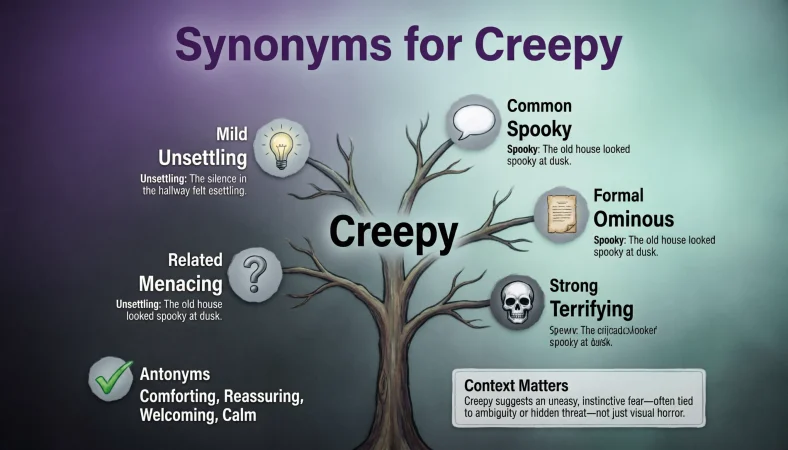
The best synonyms for creepy are eerie, spooky, sinister, and unnerving. If you’re describing a frightening atmosphere, “eerie” or “spooky” often work well. For something that feels threatening or evil, “sinister” or “ominous” are stronger choices. Choose the right word based on your tone and the intensity of the feeling you want to convey.
Some places, people, or situations just make your skin crawl. That unsettling feeling a mix of fear, discomfort, and unease is what we call “creepy.” But what if you need another way to describe it? The best synonyms for creepy depend on the situation, the intensity of the feeling, and your audience.
Whether you’re writing a horror story, describing an uncomfortable encounter, or explaining why an old house gave you the shivers, this guide will help you find the perfect word. We’ve gathered over 30 alternatives, from mild and common to strong and formal, complete with example sentences and context tips.
What Does Creepy Mean?
“Creepy” is an adjective used to describe something that causes a sensation of unease, fear, or disgust. It often involves a feeling similar to having something crawl on your skin . The word is usually used informally and can describe situations, places, or people that make you feel uncomfortable or frightened.
Example Sentences:
- The old, abandoned house on the hill looked creepy in the moonlight.
- I don’t like his stare; he gives me a creepy feeling.
- That creepy sound from the attic kept me awake all night.
The word also has a slang meaning to describe an obnoxious or weird person .
Core Meaning of Creepy
At its heart, “creepy” describes a physical and emotional reaction to something unsettling. It’s not the same as being outright terrified. Instead, it’s a slow-building unease, a sense that something is just not right. This feeling can come from a quiet, foggy forest, a person who stands too close and smiles strangely, or a strange noise in the dark. The core idea is a combination of fear and revulsion, often tied to the unknown or the supernatural .
Grammar and Usage Notes
“Creepy” is an adjective and follows standard adjective forms.
- Comparative: creepier
- Superlative: creepiest
- Adverb: creepily
- Noun: creepiness
It’s commonly used in informal settings and works well in everyday conversation, creative writing, and social media. You’ll often hear it in phrases like:
- “That gave me the creeps.” (Noun form)
- “A creepy-crawly feeling.”
While “creepy” is perfectly fine for most writing, a synonym might work better if you need a more formal or specific tone. For instance, “sinister” or “ominous” often sound more sophisticated than “creepy.”
Best Synonyms for Creepy
Here is a table of the most accurate and useful synonyms, categorized for easy selection.
| Synonym | Meaning | Tone | Best Use Case | Example Sentence |
| Eerie | Strange and frightening, often in a mysterious or ghostly way. | Formal/Literary | Describing an unsettling atmosphere or place. | An eerie silence fell over the graveyard. |
| Spooky | Suggestive of ghosts or the supernatural; slightly frightening. | Informal | Describing a fun or mildly scary experience. | The Halloween decorations made the house look spooky. |
| Sinister | Suggesting evil or harm; threatening. | Formal | Describing a person or thing that seems dangerous. | The villain let out a sinister laugh. |
| Unnerving | Causing one to lose confidence or composure; disturbing. | Formal | Describing a situation that makes you feel anxious. | His ability to read her mind was unnerving. |
| Ominous | Giving the impression that something bad is going to happen. | Formal | Describing a threatening sign or portent. | Dark, ominous clouds gathered on the horizon. |
| Macabre | Disturbing because of a focus on death or injury. | Formal/Literary | Describing gruesome or death-related themes. | The museum had a collection of macabre art. |
| Ghastly | Causing great horror or fear. | Formal | Describing something shockingly frightful. | A ghastly scream echoed through the halls. |
Common Synonyms for Creepy
These everyday synonyms are useful in most casual and general writing.
Spooky
- Meaning: Suggesting ghosts or the supernatural, causing mild fear .
- Context: Perfect for Halloween, ghost stories, or describing a place like an old, abandoned building.
- Example: “The forest trail was even spookier than I remembered.”
Scary
- Meaning: Causing fear or alarm .
- Context: A general-purpose word for anything that makes you afraid. It’s broader and more common than “creepy.”
- Example: “I don’t like scary movies. They give me nightmares.”
Weird
- Meaning: Very strange or unusual, often in a way that is unsettling .
- Context: Use this when something is odd or bizarre, but not necessarily frightening.
- Example: “There was a weird smell in the air.”
Freaky
- Meaning: Very weird and slightly frightening .
- Context: An informal word for something or someone that is bizarre or unsettling.
- Example: “He had a freaky obsession with dolls.”
Formal Synonyms for Creepy
When writing a report, an academic paper, or professional correspondence, these words are more appropriate than “creepy.”
Eerie
- Best for: Academic writing, essays, and literary descriptions where you want to evoke a mysterious and unsettling atmosphere. It is more subtle and sophisticated than “creepy.”
- Example: “The scientist couldn’t explain the eerie energy readings from the abandoned lab.”
Sinister
- Best for: Business reports, professional communication, and formal writing to suggest evil or threat without being overly emotional.
- Example: “The acquisition had a sinister undertone that worried the company’s employees.”
Ominous
- Best for: Formal writing where you want to warn or suggest future danger.
- Example: “The political situation was growing increasingly ominous.”
Unnerving
- Best for: Professional settings to describe something that is disturbing or makes people uncomfortable.
- Example: “The CEO’s sudden, unnerving silence concerned the board members.”
Macabre
- Best for: Academic papers, literary criticism, or medical contexts involving death.
- Example: “The novel explores the macabre details of a Victorian murder.”
Informal Synonyms for Creepy
These are the words you use in conversation, text messages, and casual online posts.
Spooky
- Tone: Fun, lighthearted, slightly scary. It’s the go-to word for a thrilling but safe feeling of unease.
- Example: “Let’s tell spooky stories around the campfire!”
Creepy-crawly
- Tone: Playful, describes the feeling of things like insects or spiders crawling on your skin .
- Example: “Ugh, I hate that creepy-crawly feeling when I see a centipede.”
Freaky
- Tone: Strongly weird, bizarre, or unsettling. It’s more intense than “weird” but still informal.
- Example: “Did you see that? That was freaky!”
Weird
- Tone: The most neutral of the group, perfect for describing something simply odd.
- Example: “She gave me a weird look. I wonder what I did.”
Hairy
- Tone: Old-fashioned slang for scary or dangerous .
- Example: “That was a hairy situation we just got out of!”
Strong Synonyms for Creepy
When “creepy” isn’t strong enough, use these more powerful words.
Terrifying
- Meaning: Causing extreme fear.
- Use Case: For describing something that is not just uncomfortable but genuinely horrifying.
- Example: “The monster in the movie was absolutely terrifying.”
Nightmarish
- Meaning: Like a bad dream; extremely frightening or unpleasant .
- Use Case: Describing a surreal or horrific experience.
- Example: “The warzone was a nightmarish landscape of destruction.”
Bloodcurdling
- Meaning: Extremely terrifying; capable of making one’s blood run cold .
- Use Case: Often used for sounds, like a scream.
- Example: “A bloodcurdling scream pierced the silent night.”
Horrifying
- Meaning: Causing intense shock, fear, or disgust.
- Use Case: For something that is both scary and shocking.
- Example: “The conditions in the abandoned prison were horrifying.”
Petrifying
- Meaning: Making someone so afraid they are unable to move.
- Use Case: Describing a fear that paralyzes.
- Example: “The thought of speaking in front of such a large crowd was petrifying.”
Mild Synonyms for Creepy
Sometimes, you want to describe a slight unease without being dramatic. These softer words are perfect for that.
Unsettling
- Meaning: Causing mild anxiety or discomfort.
- Context: A good choice for a situation that feels wrong or off, but not necessarily frightening.
- Example: “There was something unsettling about the way he glanced over his shoulder.”
Disconcerting
- Meaning: Causing one to feel confused and a bit uncomfortable.
- Context: Use this for a situation that makes you lose your composure.
- Example: “The teacher’s sudden silence was disconcerting.”
Disquieting
- Meaning: Causing a feeling of anxiety or unease.
- Context: A more formal way to describe a mild disturbance.
- Example: “The disquieting news about the virus spread quickly.”
Unnerving
- Meaning: Causing a loss of courage or confidence.
- Context: Perfect for describing a situation that makes you feel vulnerable or anxious.
- Example: “Walking alone down the dark alley was unnerving.”
Synonyms for Creepy by Context
The best word depends on your specific situation. Here’s how to choose based on context.
Everyday Conversation
For casual chats, “spooky,” “weird,” or “freaky” are your best bets. They’re easy to understand and fit perfectly in most informal settings. Use “spooky” for a fun kind of scary, “weird” for something odd, and “freaky” for something a bit more intense.
Professional Writing
In business or formal communication, stick to “sinister,” “ominous,” “unnerving,” or “disconcerting.” These words are professional and precise, allowing you to express unease without resorting to informal language. For example, a business report might describe a competitor’s actions as “sinister” to imply unethical behavior.
Academic Writing
If you’re writing a formal paper, use “eerie,” “macabre,” or “uncanny.” “Eerie” works for describing mysterious phenomena, while “macabre” is for research related to death or the gruesome. “Uncanny” is useful for discussing things that are strangely similar or unpleasantly mysterious .
Creative Writing
This is where you have the most freedom. A horror writer might use “bloodcurdling,” “nightmarish,” or “ghastly” to elicit a strong reaction. For a more subtle, psychological thriller, “ominous,” “eerie,” or “sinister” are excellent choices. Each word sets a different tone and mood.
Emotional Expression
When you want to describe a personal feeling of unease, “unnerving,” “unsettling,” or “disquieting” are the most accurate. They directly express your internal state of discomfort.
Another Word for Creepy in a Sentence
Seeing words used in context is the best way to understand them. Here are 15 example sentences using different synonyms.
- The eerie glow from the swamp made us turn back.
- I saw a spooky shadow move across the wall.
- There was something sinister about his calm demeanor.
- His constant staring was extremely unnerving.
- The ominous warning made us decide to leave early.
- The horror movie featured a macabre scene that made me look away.
- A ghastly scream from the attic sent chills down my spine.
- The old house had a distinctly unsettling atmosphere.
- My brother finds the sound of crickets disquieting.
- The situation in the room felt threatening.
- She had an uncanny ability to know what I was thinking.
- The man in the trench coat looked menacing.
- I felt a creepy-crawly sensation on my arm.
- The news report painted a nightmarish picture of the future.
- I find clowns to be incredibly disturbing.
Creepy Synonyms Compared
While many words are similar to “creepy,” they have distinct nuances.
| Synonym | Meaning | Tone | Difference from “Creepy” |
| Eerie | Strange and mysterious . | Formal | “Eerie” is more about a strange, ghostly atmosphere, whereas “creepy” is about a personal feeling of disgust or fear. |
| Sinister | Suggesting evil . | Formal | “Sinister” implies active malice or threat, while “creepy” is often a more passive feeling of unease. |
| Spooky | Suggestive of ghosts or fun scares . | Informal | “Spooky” often has a fun or playful connotation, while “creepy” is generally more negative. |
| Uncanny | Strange or mysterious, especially in an unsettling way . | Formal | “Uncanny” refers to something that is strangely familiar or unnatural, while “creepy” is a more general feeling of unease. |
Words Similar to Creepy
These words are related to the idea of “creepy” but have different meanings or are not perfect synonyms.
Menacing
- Why it’s related: Both suggest a threat.
- Why it’s not a perfect match: “Menacing” is more aggressive and implies a clear and present danger, while “creepy” can be more of a passive, unsettling feeling .
- When to use it: Use “menacing” to describe someone or something that appears dangerous and ready to cause harm.
Threatening
- Why it’s related: Both can describe something that causes fear.
- Why it’s not a perfect match: “Threatening” is more direct. A person can be threatening, while a situation or atmosphere is often described as “creepy.”
- When to use it: Use “threatening” when there is an explicit or implied danger of violence or harm.
Ghostly
- Why it’s related: Both can be associated with the supernatural.
- Why it’s not a perfect match: “Ghostly” specifically relates to ghosts or spirits, whereas “creepy” is a broader feeling.
- When to use it: Use “ghostly” to describe something that resembles a ghost or is pale, pale, and ethereal .
Weird
- Why it’s related: Both describe something that is not normal.
- Why it’s not a perfect match: “Weird” simply means strange; it doesn’t necessarily carry the frightening or unsettling connotation of “creepy.”
- When to use it: Use “weird” for anything that is odd or unusual without the negative emotional charge.
Antonyms of Creepy
Antonyms are words with opposite meanings. Here are some for “creepy.”
Comforting
- Meaning: Providing comfort and a feeling of security.
- Example: “Her warm smile was comforting after a long day.”
Reassuring
- Meaning: Removing doubts and fear.
- Example: “The doctor’s calm voice was reassuring.”
Normal
- Meaning: Conforming to a standard; usual, typical.
- Example: “After the strange events, he was relieved to see everything was back to normal.”
Pleasant
- Meaning: Giving a sense of happy satisfaction or enjoyment.
- Example: “The garden had a pleasant, welcoming atmosphere.”
Soothing
- Meaning: Having a calming effect.
- Example: “The sound of the waves was soothing.”
How to Choose the Right Synonym for Creepy
Picking the perfect word for “creepy” is about understanding the situation and what you want to convey. Here’s a simple guide.
- Match the Context: Are you writing a horror story, a professional email, or a text to a friend? Choose a word that fits the setting. “Sinister” works in an email, while “spooky” is better for a text.
- Match the Tone: What mood do you want to create? “Eerie” creates a subtle, mysterious tone; “horrifying” is for intense fear; and “unnerving” is for psychological discomfort.
- Check the Intensity: Is the feeling a mild unease or sheer terror? For a slight discomfort, use “unsettling.” For extreme fear, go with “terrifying” or “nightmarish.”
- Think About Your Reader: Will your audience understand the word? Don’t use “macabre” in a children’s book or “freaky” in a formal report.
- Is it an Exact Match? Weird” is related but doesn’t always mean frightening. Ensure the synonym you choose truly conveys the fear and unease of “creepy.”
Common Mistakes When Using Synonyms for Creepy
Even with a great list of words, people often make mistakes.
- Choosing the Wrong Tone: Using an informal word like “freaky” in a formal report makes you sound unprofessional.
- Using a Word That’s Too Strong: Describing a situation as “horrifying” when it was just a little unusual will make you sound dramatic and exaggerate the truth.
- Using a Word That’s Too Mild: Describing a near-death experience as “weird” undersells the event and doesn’t accurately convey the fear.
- Treating Related Words as Exact Synonyms: “Menacing” and “creepy” are not the same. Using “menacing” for a quiet, unsettling forest is incorrect. The forest can be “eerie,” but the man with the knife is “menacing.”
- Making Sentences Sound Unnatural: Don’t force a synonym into a sentence if it doesn’t sound right. For example, “The gloomy night was very macabre” sounds forced. It’s better to say “The gloomy night was eerie.”
Quick Synonym List for Creepy
Here’s a clean, scannable summary of all the synonyms and related words we’ve covered.
- Common Synonyms: Spooky, Scary, Weird, Freaky
- Formal Synonyms: Eerie, Sinister, Ominous, Unnerving, Macabre, Ghastly
- Informal Synonyms: Spooky, Creepy-crawly, Freaky, Weird, Hairy
- Strong Synonyms: Terrifying, Nightmarish, Bloodcurdling, Horrifying, Petrifying
- Mild Synonyms: Unsettling, Disconcerting, Disquieting
- Related Words: Menacing, Threatening, Ghostly, Uncanny
FAQs
What is the best synonym for creepy?
The best synonym depends on the context. For a general, slightly spooky feeling, “eerie” or “spooky” are great choices. For something threatening or evil, “sinister” or “ominous” are better. For a mild unease, use “unsettling” .
What is another word for creepy that means scary?
“Scary” itself is a synonym for creepy. However, if you want a stronger word, try “terrifying,” “horrifying,” or “frightening.” “Spooky” is another common and slightly milder alternative .
What is a formal synonym for creepy?
Excellent formal synonyms include “eerie,” “sinister,” “ominous,” “unnerving,” and “macabre.” These are suitable for academic writing, business reports, or professional communication .
What is an informal synonym for creepy?
Good informal synonyms include “spooky,” “freaky,” “weird,” and “creepy-crawly.” These words are perfect for conversation, social media, and casual writing .
What is a stronger word for creepy?
Powerful alternatives include “terrifying,” “nightmarish,” “bloodcurdling,” “petrifying,” and “horrifying.” Use these when you want to describe intense fear .
What is a milder word for creepy?
Softer options include “unsettling,” “disconcerting,” “disquieting,” and “unnerving.” These are ideal for describing a slight unease or discomfort .
What words are similar to creepy but not exact synonyms?
Words like “menacing,” “threatening,” and “weird” are related but not perfect matches. “Menacing” implies a direct threat, while “creepy” is more of a general, uneasy feeling .
What is the opposite of creepy?
Antonyms include “comforting,” “reassuring,” “pleasant,” “normal,” and “soothing.”
How do I choose the right synonym for creepy?
Match the word to your context, tone, and the intensity of the feeling you want to describe. Consider your audience and whether the synonym accurately conveys the sense of fear and unease .
Conclusion
“Creepy” is a useful word, but English offers a rich vocabulary to describe fear and unease more precisely. Whether you need the casual familiarity of “spooky,” the formal threat of “sinister,” or the intense horror of “nightmarish,” the right word is always available.
The key is to understand the subtle differences in meaning, tone, and intensity. By choosing carefully, you can make your writing more vivid, your communication clearer, and ensure your audience feels exactly what you intend.