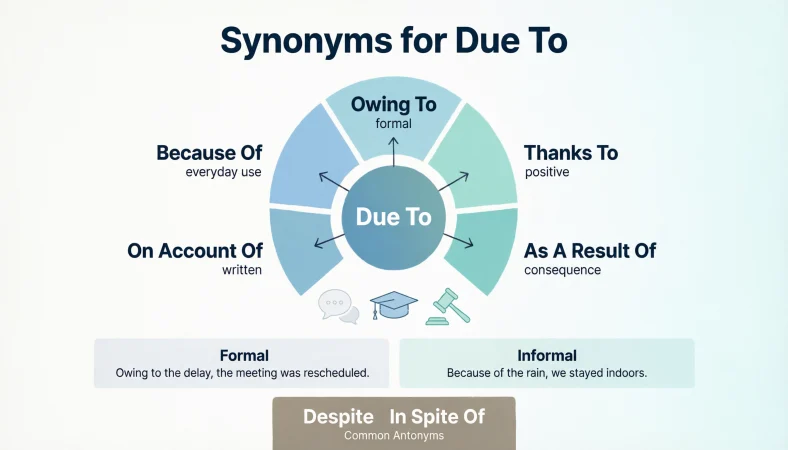
The best synonyms for “due to” are because of, owing to, as a result of, and on account of . Choose because of for everyday use, owing to for formal writing, as a result of when emphasizing consequences, and on account of for slightly more formal situations .
Need a fresh way to explain why something happened? You’re probably looking for synonyms for “due to.” The best alternatives include because of, owing to, as a result of, and on account of. But the right choice depends on your context, tone, and how formal you need to be .
English offers many ways to express cause and effect. Some options work better in casual conversation, while others fit academic papers or business reports. This guide explains the meaning of “due to,” provides a complete list of synonyms organized by formality and context, and helps you pick the perfect word every time.
What Does Due To Mean?
“Due to” is a prepositional phrase that explains the cause or reason for something . When you say something happened “due to” a particular factor, you’re telling your reader what caused that event or situation.
- The game was canceled due to heavy rain. (The rain caused the cancellation)
- His death was due to natural causes. (Natural causes caused his death)
“Due to” functions as a preposition and must be followed by a noun or noun phrase, not a full clause .
Core Meaning of Due To
At its heart, “due to” points to causation. It answers the question “Why?” by identifying the factor that produced a result. Think of it as a bridge connecting an outcome to its source.
The phrase carries a neutral tone. It doesn’t express emotion or judgment—it simply states a factual relationship between cause and effect. This neutrality makes it useful across many writing situations, from technical reports to everyday conversation.
Grammar and Usage Notes
Part of speech: Prepositional phrase (functioning as a preposition)
Common sentence patterns:
- [Result] happened due to [cause]
- [Result] was due to [cause]
- Due to [cause], [result] happened
Key grammar rule: “Due to” must be followed by a noun or noun phrase .
- Correct: The meeting was canceled due to bad traffic. (noun phrase)
- Incorrect: The meeting was canceled due to the traffic was bad. (full clause)
Usage debate: Some grammar purists object to using “due to” as a preposition (like “because of”) and insist it should only follow a form of “to be” (e.g., “The delay was due to traffic”) . However, this distinction has largely faded in modern usage. Most dictionaries now accept both uses . Still, if you want to avoid criticism, “because of,” “owing to,” and “on account of” are safer alternatives in certain contexts .
Best Synonyms for Due To
| Synonym | Meaning | Tone | Best Use Case | Example Sentence |
| Because of | On account of; as a result of | Neutral | Everyday writing and speech | The event was postponed because of the rain . |
| Owing to | Because of | Formal | Professional reports, academic writing | The flight was delayed owing to technical issues . |
| As a result of | Caused by; as a consequence of | Neutral to formal | Emphasizing cause-and-effect | Traffic was heavy as a result of the accident . |
| On account of | For the reason of | Slightly formal | Written communication | The school was closed on account of the snowstorm . |
| Thanks to | Due to (often positive) | Informal, positive | Giving credit or expressing gratitude | She got the job thanks to her hard work . |
| By reason of | On the grounds of | Highly formal | Legal or official documents | His resignation was by reason of health concerns . |
Common Synonyms for Due To
These everyday alternatives work well in most situations and are widely understood.
Because of
Meaning: On account of; as a result of
Best context: Everyday conversation, casual writing, emails to colleagues
Example: We canceled the picnic because of the thunderstorm.
Thanks to
Meaning: Due to the help or action of someone or something; often carries a positive connotation
Best context: Giving credit, expressing gratitude, informal situations
Example: Thanks to her quick thinking, we avoided a disaster.
Note: While typically positive, “thanks to” can be used sarcastically. “Thanks to his mistake, we lost the client” .
As a result of
Meaning: Because of something; caused by
Best context: Emphasizing consequences, both casual and formal
Example: As a result of the budget cuts, three positions were eliminated.
Formal Synonyms for Due To
When writing academic papers, business reports, or professional documents, these alternatives project authority and precision.
Owing to
Meaning: Because of
Best context: Formal reports, academic writing, professional communication
Example: The project timeline was extended owing to unexpected complications.
Usage tip: Like “due to,” “owing to” should be followed by a noun phrase .
On account of
Meaning: For the reason of
Best context: Formal written communication, business correspondence
Example: On account of your extensive experience, we’d like to offer you the position.
By reason of
Meaning: On the grounds of; because of
Best context: Legal documents, official correspondence, highly formal contexts
Example: The contract was terminated by reason of breach of terms .
Attributable to
Meaning: Able to be credited to; caused by
Best context: Analytical writing, research papers, data analysis
Example: The increase in sales is attributable to the new marketing strategy.
In view of
Meaning: Considering; because of
Best context: Formal reports, decision-making contexts
Example: In view of recent events, we’ve revised our safety protocols.
Informal Synonyms for Due To
Casual alternatives work well in conversation, social media, personal messages, and friendly writing.
Because
Meaning: For the reason that
Best context: Everyday conversation, personal writing
Example: I stayed home because I wasn’t feeling well.
Since
Meaning: Because; as
Best context: Casual explanations, conversation
Example: Since you’re here anyway, let’s get started.
For
Meaning: Because; since
Best context: Brief explanations, casual speech
Example: I couldn’t sleep for the noise outside.
Seeing as
Meaning: Since; because
Best context: Very casual conversation
Example: Seeing as it’s already late, let’s finish tomorrow.
Strong Synonyms for Due To
These alternatives carry more weight or emphasize causation more strongly.
By virtue of
Meaning: As a result of; because of a particular quality or fact
Best context: Formal writing, emphasizing inherent qualities
Example: She won the case by virtue of her thorough preparation.
In consequence of
Meaning: As a result of
Best context: Formal writing, emphasizing direct causation
Example: In consequence of the policy change, all applications must be resubmitted.
By dint of
Meaning: By means of; because of
Best context: Formal or literary writing, emphasizing effort
Example: He succeeded by dint of sheer determination.
Consequently
Meaning: As a result; therefore
Best context: Formal writing, connecting cause and effect
Example: The data was corrupted; consequently, we could not complete the analysis .
Mild Synonyms for Due To
When you want a softer or more neutral expression of causation, these options work well.
Considering
Meaning: In view of; because of
Best context: Thoughtful explanations, persuasive writing
Example: Considering the circumstances, she handled the situation well.
In light of
Meaning: Considering; because of
Best context: Gentle explanations, diplomatic writing
Example: In light of recent feedback, we’ve made several changes.
Given that
Meaning: Considering; since
Best context: Neutral explanations, conditional statements
Example: Given that we have limited time, let’s focus on the main issues.
Through
Meaning: By means of; because of
Best context: Casual or neutral, emphasizing the medium
Example: She succeeded through hard work and perseverance .
Synonyms for Due To by Context
Everyday Conversation
In casual conversation, because of and thanks to are your go-to options. They’re natural, widely understood, and don’t sound forced. “I’m late because of traffic” sounds normal; “I’m late owing to traffic” sounds pretentious.
Professional Writing
Business emails and internal reports benefit from owing to and on account of. These sound professional without being overly formal. “We’ve rescheduled the meeting owing to scheduling conflicts” is professional but accessible .
Academic Writing
Research papers and essays often require precision and formality. Owing to, as a result of, and attributable to work well because they clearly establish causation and sound authoritative.
Legal and Official Documents
Legal writing demands formality and specificity. By reason of, by virtue of, and in view of are appropriate for these high-stakes contexts .
Giving Credit
When you want to thank someone or acknowledge a positive cause, thanks to is the clear choice. “Thanks to your guidance, I passed the exam” sounds appreciative and natural .
Another Word for Due To in a Sentence
Here are 15 example sentences using different synonyms for “due to”:
- Because of the power outage, the office closed early.
- The event was postponed owing to unforeseen circumstances .
- As a result of the new policy, employee morale improved .
- The meeting was rescheduled on account of the director’s absence .
- Thanks to her mentorship, I advanced quickly in my career .
- His resignation was by reason of personal health concerns .
- The company’s success is attributable to its innovative culture.
- In view of the weather forecast, we’ve moved the event indoors.
- Since you’re interested, I’ll explain the process in detail.
- Considering his experience, he’s the obvious choice for the role.
- In light of the new evidence, the case was reopened.
- The delays occurred as a consequence of supply chain issues.
- By virtue of her qualifications, she was hired immediately.
- Given that we’re short-staffed, we’ll need to prioritize tasks.
- The team succeeded through collaboration and dedication.
Due To Synonyms Compared
Due To vs. Because Of
In modern usage, these are largely interchangeable. “Because of” is more flexible and can appear anywhere in a sentence. Some grammar purists insist “due to” should only follow a form of “to be” (“The delay was due to traffic”), while “because of” works in all positions (“The game was canceled because of rain”). However, both are widely accepted in most contexts .
Due To vs. Owing To
“Owing to” is slightly more formal than “due to” and is often preferred in British English. Both are followed by a noun phrase. Use “owing to” when you want a more refined tone in professional writing .
Due To vs. Thanks To
“Thanks to” carries a positive connotation and is often used to give credit. Use “due to” or “because of” when the cause is neutral or negative. “He was late due to traffic” vs. “Thanks to her efforts, we finished early” .
Words Similar to Due To
These related words are connected to causation but may not directly replace “due to” in every sentence.
Because (conjunction)
“Because” introduces a full clause with a subject and verb. “The game was canceled because it was raining” is a complete sentence. “Due to” introduces a noun phrase. “The game was canceled due to rain.” Both express cause, but their grammatical patterns differ .
Since (conjunction)
“Since” can mean “because” but also refers to time. Use it carefully to avoid confusion. “Since you asked, I’ll explain” clearly means because. “Since Tuesday” clearly means from that time. Context usually clarifies the meaning .
As (conjunction)
“As” can also mean “because” but is generally more formal. “As we were running late, we took a taxi.” Like “because,” “as” introduces a full clause, not a noun phrase.
Antonyms of Due To
These words express the opposite of causation—they suggest something happened despite an obstacle, or they deny a causal connection.
| Antonym | Meaning | Example Sentence |
| Despite | In spite of; regardless of | She succeeded despite the challenges. |
| In spite of | Despite; regardless of | In spite of the rain, we went hiking. |
| Regardless of | Without regard to; despite | Regardless of the cost, we purchased it. |
| Irrespective of | Regardless of; without considering | Irrespective of the outcome, we’ll continue. |
| Although | Even though; despite the fact that | Although it was raining, we went outside. |
| Though | Despite the fact that | Though she was tired, she kept working. |
How to Choose the Right Synonym for Due To
Match the context: Formal writing calls for formal synonyms like “owing to” or “on account of.” Casual conversations work well with “because of” or “because.
Consider your audience: Technical audiences appreciate precision. “Attributable to” suggests careful analysis. General audiences prefer simpler options like “because of.”
Check the grammar: Most alternatives require a noun phrase. If you need a full clause, use “because,” “since,” or “as” .
Think about tone: “Thanks to” sounds grateful. “Due to” sounds neutral. “By reason of” sounds legal. Choose accordingly.
Avoid redundancy: “Due to the fact that” is wordy. Replace it with “because” or “since” . “Because we were late” is better than “due to the fact that we were late.”
Test for naturalness: Read your sentence aloud. If a synonym sounds forced, choose a different one or rephrase.
Common Mistakes When Using Synonyms for Due To
Using the Wrong Formality Level
“Owing to” sounds out of place in casual conversation. “Thanks to” might sound too informal in a legal document. Match the synonym to the situation .
Forgetting the Noun Phrase Rule
Most synonyms for “due to” must be followed by a noun or noun phrase. “He was late because of traffic” (noun) is correct. “He was late because of traffic was bad” (clause) is incorrect .
Using “Thanks To” for Negative Causes
“Thanks to” typically has a positive connotation. Use “because of,” “due to,” or “owing to” for neutral or negative causes .
Treating “Due To” and “Because Of” as Always Identical
While interchangeable in many contexts, “because of” is more flexible grammatically. Use “because of” when you need a prepositional phrase that can appear anywhere in a sentence .
Overusing Formal Synonyms
Many learners use “owing to” too frequently in casual contexts. Reserve formal synonyms for formal writing .
Quick Synonym List for Due To
Common synonyms: because of, thanks to, as a result of
Formal synonyms: owing to, on account of, attributable to, by reason of, in view of
Informal synonyms: because, since, for, seeing as
Strong synonyms: by virtue of, in consequence of, by dint of, consequently
Mild synonyms: considering, in light of, given that, through
Related words: consequently, hence, therefore, thus
FAQs
What is the best synonym for due to?
The best synonym depends on your context. Because of is the most versatile and works in most situations. Owing to works well in formal writing, and thanks to is best for giving credit .
What is another word for due to?
Common alternatives include because of, owing to, as a result of, and on account of . The right choice depends on your context and desired tone.
What is a formal synonym for due to?
Owing to, on account of, by reason of, and attributable to are formal alternatives suitable for academic, business, or legal writing .
What is an informal synonym for due to?
Because, since, and for are informal alternatives used in casual conversation and personal writing .
What is a stronger word for due to?
By virtue of, by dint of, and in consequence of are stronger alternatives that emphasize the power of causation .
What is a milder word for due to?
Considering, in light of, and given that are milder alternatives that suggest causation more gently .
What words are similar to due to?
Because, since, and as are related words that express causation. However, these are conjunctions (requiring a full clause), while “due to” is a preposition (requiring a noun phrase) .
What is the opposite of due to?
Despite, in spite of, and regardless of express the opposite—something happened even though an obstacle existed.
How do I choose the right synonym for due to?
Consider your context (formal or casual), audience, desired tone, and grammatical structure. Test the synonym in your sentence to ensure it sounds natural .
Can I use “due to” and “because of” interchangeably?
Yes, in most modern usage. “Because of” is more flexible grammatically and can appear anywhere in a sentence. Some grammar purists still prefer “due to” only after forms of “to be,” but this distinction is fading .
Conclusion
“Due to” is a useful phrase, but English offers many alternatives to express causation. Because of works for everyday situations, owing to suits formal writing, and thanks to carries a positive tone . The key to choosing the right synonym is matching your context, considering your audience, and ensuring natural phrasing.
When you need to explain why something happened, you don’t have to rely on the same phrase repeatedly. Use the alternatives in this guide to vary your language and communicate with greater precision. Whether you’re writing a casual email or a formal report, the right synonym can make your writing clearer and more engaging.