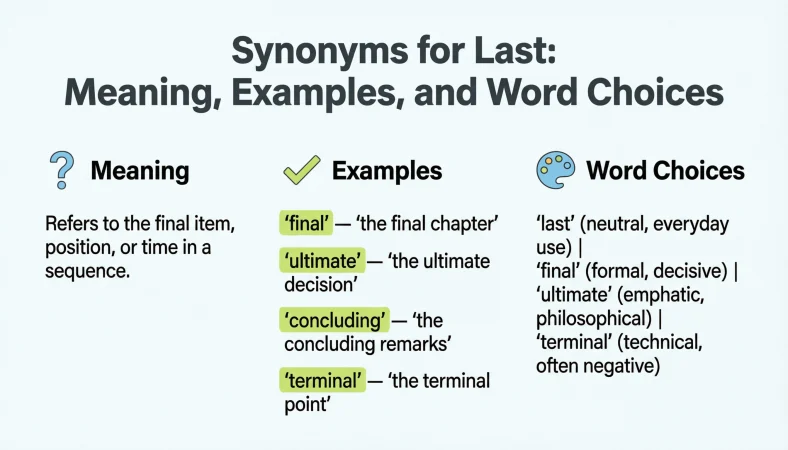
The best synonyms for last are final, latest, endure, and ultimate. The right choice depends on tone, context, and intensity. Use “latest” for recent events, “final” to close a series, “endure” for lasting over time, and “ultimate” for the final stage in a long process.
The best synonym for “last” depends entirely on how you are using the word. Are you talking about the final item in a series? The most recent event? Something that endures over time? The word “last” carries several distinct meanings, so choosing the right synonym requires understanding the specific context.
This article serves as your complete guide to synonyms for last, covering more than 100 alternatives across its different definitions. You’ll learn the subtle differences between similar words like “final,” “ultimate,” and “latest,” and discover which option works best in formal writing, casual conversation, and everything in between.
What Does Last Mean?
The word “last” functions primarily as an adjective, adverb, noun, and verb, which explains why it has so many synonyms. Its meaning shifts depending on how you use it.
Core Meanings and Definitions
- Final in order: Coming after all others in a sequence. Example: “She was the last person to leave the room.”
- Most recent: Happening immediately before the present time. Example: “I saw him last Tuesday.”
- To continue: To exist, remain, or endure over time. Example: “This battery will last for hours.”
- Only remaining: The final opportunity or remaining item. Example: “This is your last chance.”
- Final in importance: Least important or likely. Example: “That is the last thing I would do.”
Grammar and Usage Notes
“Last” is a versatile word that appears in several parts of speech. Understanding how it functions grammatically helps you select the right synonym.
Part of speech: Adjective, adverb, noun, and verb.
Adjective patterns:
- Before a noun: “the last chapter,” “our last meeting”
- After a linking verb: “She was last in line,” “This is my last dollar”
Adverb patterns:
- At the end of a clause: “He arrived last,” “She spoke last”
- Before the main verb: “When did you last see him?”
Verb patterns:
- With a duration: “The meeting lasted three hours”
- With an adverb: “The supplies lasted well”
Common collocations:
- At last, last but not least, last-minute, last-ditch, last resort, last word, last call, last chance.
When “last” sounds natural: Use it for everyday conversation, general writing, and most informal contexts. It’s direct and clear.
When a synonym may work better: Consider alternatives in academic writing, formal reports, creative writing where you need variety, or when “last” feels too blunt or repetitive.
Best Synonyms for Last
This table shows the top synonyms for last organized by their core meaning. Choose the word that best fits your specific context.
| Synonym | Meaning | Tone | Best Use Case | Example Sentence |
| Final | Closing a series; no more following | Neutral to formal | Ending a sequence or process | “This is the final step in the process.” |
| Latest | Most recent in time | Neutral | News, updates, recent events | “Have you seen the latest report?” |
| Ultimate | Final in a long process or degree | Formal, emphatic | Concluding a lengthy development | “This is the ultimate goal of the project.” |
| Endure | To withstand and continue | Formal, strong | Describing survival against difficulty | “Despite the challenges, the traditions endure.” |
| Concluding | Relating to the end of an event or text | Formal | Writing, speeches, final sections | “The concluding chapter ties everything together.” |
| Previous | The one immediately before the current one | Neutral to formal | Referencing something that came before | “I preferred the previous version.” |
| Rearmost | Furthest back in physical position | Neutral | Physical locations or queues | “We were seated in the rearmost row.” |
| Continue | To keep going without stopping | Neutral | General continuation | “The tradition will continue for years to come.” |
| Terminal | Ending, often with a sense of finality | Formal, medical/technical | Situations involving an end point or illness | “The disease reached its terminal stage.” |
| Persist | To continue despite opposition or difficulty | Formal | Situations involving obstacles | “Symptoms may persist for several days.” |
Common Synonyms for Last
These everyday synonyms work well in normal writing and conversation. They are direct, widely understood, and rarely sound out of place.
Final
- Meaning: Closing a series; no more to follow.
- Best context: Everyday situations where something ends. Example: “This is the final stop on the route.”
- Example sentence: “We made it to the final round of the competition.”
Latest
- Meaning: The most recent occurrence or version.
- Best context: News, updates, technology, and current events. Example: “The latest model has improved features.”
- Example sentence: “I haven’t heard the latest news yet.”
Previous
- Meaning: The one before the current one.
- Best context: Referencing a specific earlier item in a series. Example: “The previous chapter covered the basics.”
- Example sentence: “Her previous job was in marketing.”
End
- Meaning: The point at which something stops.
- Best context: Describing the conclusion of a duration or journey. Example: “They stayed until the end of the party.”
- Example sentence: “I want to see the project through to the end.”
Close
- Meaning: The concluding moment of an event or period.
- Best context: Events, seasons, or chapters. Example: “At the close of the event, everyone applauded.”
- Example sentence: “The book brings the story to a satisfying close.”
Formal Synonyms for Last
For academic writing, business communication, or professional reports, choose one of these polished alternatives. They add precision and sophistication.
Concluding
- Meaning: Relating to the end, particularly of a text or speech.
- Best context: Academic essays, presentations, and formal writing. Example: “In the concluding section, we outline our recommendations.”
- Example sentence: “The concluding remarks were particularly inspiring.”
Ultimate
- Meaning: The final stage or highest degree after a long process; beyond which nothing further can happen.
- Best context: Describing long-term goals, final outcomes, or extreme degrees. Example: “The ultimate objective of the policy is to reduce emissions.”
- Example sentence: “He said it is still not possible to predict the ultimate outcome.”
Terminal
- Meaning: Relating to or indicating an end, often with a sense of finality.
- Best context: Medical, technical, or formal descriptions of an end point. Example: “The patient is in the terminal phase of the illness.”
- Example sentence: “The terminal stage of the project involves final testing.”
Previous
- Meaning: Occurring earlier in time or order.
- Best context: Formal references to an earlier item. Example: “The previous administration had different priorities.”
- Example sentence: “Our previous findings support this conclusion.”
Utmost
- Meaning: The highest degree or furthest extent.
- Best context: Describing intensity, effort, or limits in formal writing. Example: “The team worked with the utmost care.”
- Example sentence: “The challenge tested our patience to its utmost limits.”
Informal Synonyms for Last
For conversations, social media, and casual writing, these alternatives sound natural and friendly.
Last-mentioned
- Meaning: The most recently named item in a list.
- Best context: Casual conversation or informal writing when referring back to a previous point. Example: “The last-mentioned option is probably the best.”
- Example sentence: “We discussed the proposal, and the last-mentioned idea seemed most practical.”
Hold out
- Meaning: To continue resisting or surviving, often through difficulty.
- Best context: Describing people or things that persist against odds. Example: “The old bridge can hold out a bit longer.”
- Example sentence: “He can only hold out for a few more weeks.”
Go on
- Meaning: To continue without stopping.
- Best context: Events, conversations, or activities. Example: “The party went on until midnight.”
- Example sentence: “I don’t know how much longer this conversation will go on.”
Keep going
- Meaning: Continue an action or movement.
- Best context: Motivating or describing ongoing activity. Example: “You’re doing great; keep going.”
- Example sentence: “The noise kept going for hours.”
Live on
- Meaning: To continue to exist or be remembered.
- Best context: Memories, traditions, or legacies. Example: “His legacy will live on.”
- Example sentence: “The stories live on through generations.”
Strong Synonyms for Last
These words carry extra emotional weight, power, or intensity. Use them when you need to emphasize finality, endurance, or significance. Be careful not to overuse them.
Ultimate
- Meaning: The final, decisive, or greatest possible stage.
- Intensity: High – implies the culmination of a long process.
- Best use: Emphasizing a final outcome after significant effort. Example: “Achieving world peace is the ultimate goal.”
- Warning: May sound over-the-top if used for minor matters.
Utmost
- Meaning: The greatest degree or furthest limit.
- Intensity: High – emphasizes reaching an absolute limit.
- Best use: Describing maximum effort, importance, or extent. Example: “We will proceed with the utmost caution.”
Terminus
- Meaning: The final point or end, often of a journey or process.
- Intensity: High – suggests a definitive, unchangeable end.
- Best use: Formal writing about the end of a process or route. Example: “The terminus of the railway line is in the city center.”
Persist
- Meaning: To continue firmly or obstinately in a state or course of action.
- Intensity: High – implies determination or stubbornness.
- Best use: Describing situations that continue despite resistance. Example: “Symptoms can persist for weeks.”
Abide
- Meaning: To remain stable or constant over time; to last.
- Intensity: High – suggests permanence and stability.
- Best use: Describing enduring values, principles, or relationships. Example: “A love that abides through 40 years of marriage.”
Mild Synonyms for Last
For a softer, more neutral tone, these synonyms work well. They maintain the meaning of “last” without sounding too strong or dramatic.
Concluding
- Meaning: Relating to the end.
- Tone: Mild and formal – sounds measured and polite.
- Best use: Academic, business, or gentle conclusions. Example: “Let me share my concluding thoughts.”
Closing
- Meaning: The ending part.
- Tone: Neutral and mild.
- Best use: Events, ceremonies, or periods. Example: “The closing session will begin at 4 PM.”
Final
- Meaning: Last in a series.
- Tone: Neutral – not as dramatic as “ultimate.”
- Best use: Everyday situations where something ends. Example: “This is the final piece of the puzzle.”
Continue
- Meaning: To keep going.
- Tone: Neutral and factual.
- Best use: Straightforward descriptions of ongoing activity. Example: “The program will continue for another month.”
Remain
- Meaning: To stay in the same place or condition.
- Tone: Neutral – often used in formal writing.
- Best use: Describing things that stay unchanged. Example: “Several questions remain unanswered.”
Synonyms for Last by Context
The right word for “last” depends heavily on your context. Here are the best synonyms for common situations.
Everyday Conversation
Use direct, simple synonyms:
- final: “This is the final step.”
- latest: “What’s the latest?”
- end: “We made it to the end.”
Professional Writing
Choose formal, precise alternatives:
- concluding: “The concluding section summarizes our findings.”
- ultimate: “The ultimate goal is to increase efficiency.”
- previous: “As mentioned in the previous report.”
Academic Writing
Use formal words that sound scholarly:
- concluding: “In the concluding chapter, the author synthesizes the arguments.”
- ultimate: “The ultimate objective of this study is to establish a framework.”
- terminal: “The terminal phase of the experiment involves data analysis.”
Creative Writing
Choose vivid and varied language:
- ultimate: “The ultimate truth was finally revealed.”
- closing: “The closing lines of the poem left a lasting impression.”
- finale: “The finale brought the story to a dramatic conclusion.”
Technical Writing
Use precise, unambiguous terms:
- terminal: “The terminal point of the process is clearly marked.”
- final: “The final output is generated by the algorithm.”
- rearmost: “The rearmost connector should be secured first.”
Another Word for Last in a Sentence
See how different synonyms for “last” work in natural sentences.
- We finally reached the final stage of the project.
- Did you catch the latest episode last night?
- The previous attempt failed, but we’ve learned from it.
- Despite the damage, the building will endure for another century.
- The concluding chapter ties all the themes together.
- We waited until the end of the show before leaving.
- The ultimate responsibility rests with the board.
- She was the rearmost runner in the race.
- His patience had reached its utmost limit.
- The symptoms may persist for several more days.
- The meeting will continue after a short break.
- The closing ceremony was surprisingly moving.
- Their traditions abide through generations of change.
- The terminal phase of the journey was the most dangerous.
- Her career continued to flourish despite the challenges.
Last Synonyms Compared
Some synonyms for “last” are very close in meaning, but small differences in tone and usage matter.
Final vs. Ultimate vs. Terminal
All three suggest an end point, but they differ in nuance:
- Final simply means no more follow; it’s neutral and widely used. Example: “the final chapter.”
- Ultimate implies the final stage in a long progression, often with a sense of culmination. Example: “the ultimate goal.”
- Terminal often suggests an irreversible end point, particularly in medical or technical contexts. Example: “terminal illness.”
Endure vs. Persist vs. Continue
These three show how long something “lasts” in time, but they carry different implications:
- Endure suggests resisting destructive forces over time. Example: “Despite everything, their love endured.”
- Persist implies outlasting the normal period, often with a sense of stubbornness. Example: “The guilt persisted.”
- Continue is neutral and simple, just meaning “keep going.” Example: “The game continued.
Latest vs. Previous
These synonyms relate to order and timeline:
- Latest means the most recent right now. Example: “the latest model.”
- Previous means the one immediately before the current one. Example: “the previous model.”
Words Similar to Last
These related words belong to the same semantic family as “last” but are not always direct synonyms. Understanding their relationship helps you avoid misusing them.
Latter
- Relationship: Used to refer to the second of two items previously mentioned. It implies “the last one” in a pair.
- Why it’s not always a direct synonym: It only works when comparing two things.
- When it can be useful: Formal writing that contrasts two options. Example: “Between the two proposals, the latter seems more feasible.”
Preceding
- Relationship: Means occurring before something else, similar to “previous.”
- Why it’s not always a direct synonym: “Preceding” is more formal and emphasizes a direct chronological relationship.
- When it can be useful: Academic or legal writing. Example: “The preceding paragraph outlines the main argument.”
Lattermost
- Relationship: An older term meaning furthest in the rear or most last.
- Why it’s not always a direct synonym: It’s uncommon in modern usage.
- When it can be useful: Literary or historical writing.
Antonyms of Last
Understanding the opposite of “last” helps clarify its meaning. The correct antonym depends on which sense of “last” you’re using.
| Antonym | Meaning | Context | Example Sentence |
| First | Preceding all others in time or order. | Time, order, sequence | “She finished first in the race.” |
| Beginning | The point at which something starts. | Duration, events | “We made changes at the beginning of the project.” |
| Start | The commencement of an action or process. | Duration, events | “The start of the movie was delayed.” |
| Initial | Occurring at the very beginning. | Time, order, sequence | “The initial plan was different.” |
| Leading | In front; ahead of others. | Physical position, competition | “The leading runner was far ahead.” |
| Earliest | Happening or done before all others in time. | Time, order | “The earliest records show a different pattern.” |
How to Choose the Right Synonym for Last
Use these practical guidelines to pick the best word for your situation.
Match the context: Consider where your writing appears. “Concluding” works better in a report; “latest” sounds natural in an email.
Match the tone: Choose formal alternatives for academic or business writing. Use informal words for personal communication.
Check the intensity: Don’t use “ultimate” for a minor detail, or “persist” for a routine continuation. Save strong words for strong situations.
Think about the reader: Will they understand the word easily? Clarity often beats fancy vocabulary.
Check whether the synonym is exact or only related: “Latter” is related but not always a direct replacement. Verify the meaning before you substitute.
Keep the sentence natural: Read your sentence aloud. If the word feels forced, choose a simpler option.
Use simple words when clarity matters: “Final” and “latest” are almost always safe choices.
Common Mistakes When Using Synonyms for Last
Avoid these pitfalls when choosing alternatives.
Choosing a word with the wrong tone: Using “ultimate” in casual conversation can sound pompous. Save it for formal contexts.
Using a synonym that is too strong: “Terminal” carries a sense of finality or fatality. Don’t use it casually for minor endings.
Using a formal word in casual writing: “Concluding” sounds out of place in a text message. Use “final” or “last” instead.
Using a casual word in professional writing: “Go on” is fine for conversation but too vague for a business report. Use “continue” or “persist.”
Replacing “last” without checking meaning: If you mean “most recent,” “final” might be wrong. The “last episode” could be the most recent or the final one.
Treating related words as exact synonyms: “Latter” isn’t a general synonym for “last.” It only works for the second of two items.
Making the sentence sound unnatural: Forcing in a fancy synonym often reads poorly. Trust simple, clear language.
Quick Synonym List for Last
Here is a scannable reference to the most common categories.
Common Synonyms
final, latest, previous, end, close
Formal Synonyms
concluding, ultimate, terminal, previous, utmost
Informal Synonyms
last-mentioned, hold out, go on, keep going, live on
Strong Synonyms
ultimate, utmost, terminus, persist, abide
Mild Synonyms
concluding, closing, final, continue, remain
Related Words
latter, preceding, lattermost
FAQs
What is the best synonym for last?
The best synonym depends on context. Use final for ending a series, latest for recent events, and endure for lasting over time. For formal writing, ultimate and concluding are excellent choices.
What is another word for last in time?
For time-related uses, the best alternatives are latest (most recent), previous (before now), and ultimate (final in a sequence).
What is a formal synonym for last?
Formal synonyms include concluding, ultimate, terminal, previous, and utmost. These words appear in academic, business, and professional writing.
What is an informal synonym for last?
Informal alternatives include last-mentioned, hold out, go on, keep going, and live on. These work well in conversation and casual writing.
What is a stronger word for last?
Stronger words include ultimate, utmost, terminus, persist, and abide. These carry extra emphasis, emotion, or intensity.
What is a milder word for last?
Milder alternatives include concluding, closing, final, continue, and remain. They are softer and less dramatic.
What words are similar to last?
Similar words include latter, preceding, and lattermost. However, these are not always direct synonyms and have specific usage rules.
What is the opposite of last?
The most common antonym is first. Others include beginning, start, initial, leading, and earliest.
How do I choose the right synonym for last?
Consider the context, tone, intensity, and your reader. Match the synonym to the situation. When in doubt, “final” and “latest” are safe, neutral choices.
Conclusion
“Last” is a word with many faces. It describes what is final, what is most recent, what endures, and what remains. The best synonym for “last” will always depend on how you are using the word. For the end of a series, choose “final.” For a recent event, pick “latest.” For something that stands the test of time, opt for “endure.” By matching your word to your context, tone, and meaning, you can write with greater precision and clarity.