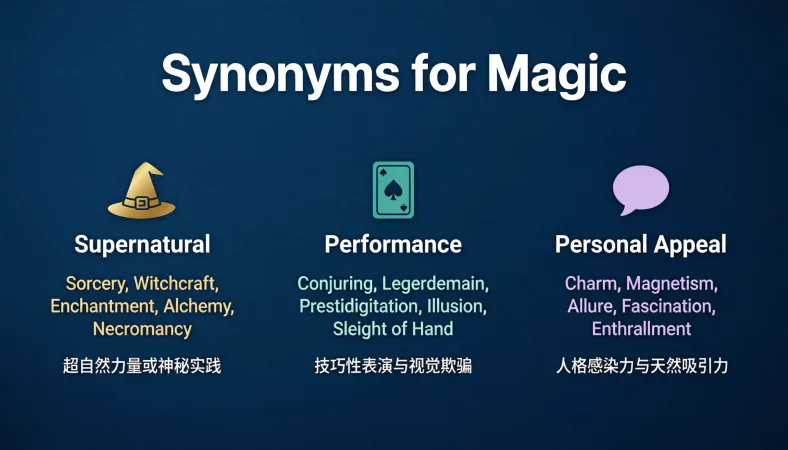
The best synonyms for magic are sorcery, witchcraft, conjuring, charm, and allure. For supernatural power, use “sorcery” or “wizardry”; for stage performance, use “conjuring” or “legerdemain”; for personal appeal, use “charisma” or “magnetism.” The right choice depends on tone, context, and intensity.
The word “magic” carries weight, whether you are describing a supernatural force, a captivating performance, or a person’s irresistible charm. The best synonyms for magic depend on what you want to say, the tone you want to set, and the context you are writing in.
Are you talking about pulling a rabbit from a hat, casting a spell, or describing a truly wonderful experience? This guide covers the best synonyms for magic in every situation.
What Does Magic Mean?
Magic is a noun and an adjective with several distinct but related meanings. Understanding these core meanings is the first step to choosing the right synonym.
Simple definition: Magic is the power to make things happen using supernatural forces, or the art of creating illusions through tricks. It can also describe a special, delightful quality that seems extraordinary.
Part of speech: Noun and adjective.
- Noun (supernatural): The old book contained spells of ancient magic.
- Noun (performance): The audience gasped at the magic on stage.
- Noun (quality): There is a certain magic about this old town.
- Adjective: It was a magic moment we will never forget.
Core Meaning of Magic
The core idea behind “magic” revolves around the extraordinary—things that defy normal explanation. This could be the supernatural, the theatrical, or the simply wonderful. Historically, magic referred to the practices of ancient priests and occultists who sought to influence events through supernatural means. Today, the word has broadened to include a sense of wonder, fascination, and delight in the ordinary.
Grammar and Usage Notes
Magic is a versatile word.
As a noun, it can be countable or uncountable. Often, it is used uncountably:
- “He believes in magic.”
- “She is studying the history of magic.”
As an adjective, it precedes the noun it modifies:
- “a magic trick”
- “a magic carpet”
The adjectival form “magical” is also common and sometimes preferred when the meaning is “wonderful” or “enchanting” rather than strictly supernatural. For example, “a magical evening” sounds slightly more natural than “a magic evening,” though both are acceptable.
Collocations (common phrases):
- “Black magic” (evil magic)
- “White magic” (good magic)
- “Magic trick”
- “Magic wand”
- “A touch of magic”
Best Synonyms for Magic
This table organizes the best synonyms for magic by their core meaning and best use case.
| Synonym | Meaning | Tone | Best Use Case | Example Sentence |
| Sorcery | Magic using evil spirits | Serious, often negative | Fantasy, historical, or occult contexts | The sorcerer was feared for his use of dark sorcery. |
| Witchcraft | Practice of magic, often with negative associations | Serious, can be negative | Describing traditional or folk magic practices | The villagers accused her of witchcraft. |
| Wizardry | Magic performed by a wizard; great skill | Neutral to positive | Fantasy literature or describing exceptional skill | His coding wizardry saved the project. |
| Conjuring | Stage magic; performing tricks | Neutral, descriptive | Entertainment, performance magic | His hobby is conjuring at children’s parties. |
| Legerdemain | Sleight of hand; skillful deception | Formal, sophisticated | Financial or legal trickery, stage magic | They accused him of financial legerdemain. |
| Charm | A pleasing quality that attracts people | Warm, positive | Describing a person’s personality or an object’s appeal | The cottage had a charm that was undeniable. |
| Allure | Powerful attraction or fascination | Elegant, sophisticated | Describing someone or something that is seductively attractive | The allure of the city lights was too strong. |
| Fascination | Power to captivate attention | Neutral, descriptive | Describing a subject or activity that is engrossing | Space has always held a fascination for him. |
| Magnetism | Strong personal charm that attracts others | Formal, powerful | Describing a charismatic leader or performer | He had an animal magnetism that drew people to him. |
Common Synonyms for Magic
These are everyday words used in normal writing and conversation.
Enchantment
- Short meaning: A feeling of being under a spell or great delight.
- Best context: Describing a place or experience that feels magical.
- Example: The garden had an old-world enchantment.
Glamour
- Short meaning: An attractive and exciting quality.
- Best context: Describing fashion, show business, or a seductive appeal.
- Example: The glamour of Hollywood was a powerful draw.
Spell
- Short meaning: A form of words used as a magical charm.
- Best context: Literal magic or a strong influence.
- Example: The witch put a spell on the prince.
Wonderful
- Short meaning: Inspiring delight or admiration.
- Best context: Describing an experience that feels magical.
- Example: The party was a wonderful evening.
Formal Synonyms for Magic
For academic writing, reports, or professional communication, these terms are more sophisticated.
Thaumaturgy
- Meaning: The working of miracles or wonders.
- Context: Religious or philosophical discussions about miracles.
- Example: The saint was known for his thaumaturgy.
Occultism
- Meaning: The study and practice of hidden, supernatural powers.
- Context: Historical, sociological, or religious studies.
- Example: Her research into 19th-century occultism was groundbreaking.
Prestidigitation
- Meaning: Magic tricks performed as entertainment, with emphasis on dexterity.
- Context: Formal descriptions of performance art.
- Example: The show featured impressive feats of prestidigitation.
Supernatural
- Meaning: Beyond what is natural or explainable by natural laws.
- Context: Academic writing on folklore, religion, or paranormal phenomena.
- Example: The village had many tales of supernatural occurrences.
Informal Synonyms for Magic
These casual alternatives are perfect for conversation, social media, and personal messages.
Hocus-pocus
- Meaning: Deception or trickery; words used in magic tricks.
- Context: Dismissively describing something confusing or deceptive.
- Example: Don’t pay attention to all that hocus-pocus.
Jiggery-pokery
- Meaning: Deceitful or dishonest behavior; trickery.
- Context: British informal, used to describe suspicious activities.
- Example: There’s been a bit of jiggery-pokery going on in the accounting department.
Mojo
- Meaning: A magical charm, spell, or personal power.
- Context: Describing someone’s personal charm, influence, or ability.
- Example: He’s lost his mojo since he stopped exercising.
Oomph
- Meaning: Enthusiasm, energy, or a compelling quality.
- Context: Describing something with exciting impact.
- Example: The performance lacked oomph.
Strong Synonyms for Magic
Use these words when you want to emphasize power, intensity, or a darker meaning.
Necromancy
- Meaning: The practice of communicating with the dead to predict the future.
- Context: Fantasy literature, historical accounts, or describing dark practices.
- Example: The forbidden text was a guide to necromancy.
Black Magic
- Meaning: Magic performed with the aid of evil spirits, for evil purposes.
- Context: Fantasy, horror, or describing malevolent practices.
- Example: The cult was rumored to practice black magic.
Devilry
- Meaning: Wicked or cruel behavior; black magic.
- Context: Informal, often used to describe mischievous or troubling acts.
- Example: The children were up to some sort of devilry again.
Mild Synonyms for Magic
For a softer, gentler, or more neutral tone, consider these alternatives.
Mystique
- Meaning: An aura of mystery and fascination.
- Context: Describing a person, place, or brand that has a powerful but subtle appeal.
- Example: The actress has retained her mystique.
Mystical
- Meaning: Of or relating to mysteries or spiritual powers.
- Context: Describing spiritual experiences or beliefs.
- Example: She had a mystical experience in the meditation retreat.
Radiant
- Meaning: Glowing with joy or beauty.
- Context: Describing a person’s appearance.
- Example: The bride looked radiant on her wedding day.
Synonyms for Magic by Context
Choosing the right synonym often depends on the specific situation. Here is how to choose the best word based on context.
Everyday Conversation
When chatting with friends, simple and clear words work best. Use charm, spell, wonderful, or enchanting. For example: “The way he tells stories is just enchanting.”
Professional Writing
In business or professional settings, precision is key. Words like influence, expertise, skill, or knack can replace “magic” when describing a talent or ability. For example: “The marketing director has a knack for branding.”
Academic Writing
For essays or research papers, formal terms like supernatural, occultism, or thaumaturgy are appropriate. For example, “The study examines the role of the supernatural in early modern plays.”
Creative Writing
As a writer, you have the freedom to be evocative. Use spellbinding, bewitching, luminous, or sublime to create a magical atmosphere. For example: “The forest was a spellbinding place under the moonlight.”
Emotional Expression
When describing a feeling, captivation, fascination, or glamour can be more precise than “magic.” For example, “The city held a certain fascination for her.”
Another Word for Magic in a Sentence
Here are realistic examples using different synonyms for magic.
- Sorcery: The ancient tome was filled with rituals for practicing sorcery.
- Witchcraft: The folklore of the region is steeped in stories of witchcraft.
- Wizardry: He used his wizardry with code to build the entire app in a weekend.
- Conjuring: The magician’s show was a masterclass in conjuring.
- Legerdemain: The lawyer’s legal legerdemain managed to get his client acquitted.
- Charm: It was the charm of the old cottage that made them buy it.
- Allure: The allure of the big city is hard to resist.
- Fascination: The natural world has a fascination that keeps scientists exploring.
- Magnetism: Her personal magnetism made her a natural leader.
- Enchantment: The forest at night held a strange and powerful enchantment.
- Glamour: The glamour of the film industry attracted her from a young age.
Magic Synonyms Compared
While synonyms are often used interchangeably, there are subtle differences.
Sorcery vs. Witchcraft: Both relate to supernatural practices. Sorcery often implies a learned practice, perhaps through studying forbidden texts. Witchcraft can suggest a more innate, folk-based tradition, often associated with nature and healing (or cursing). “The villagers were terrified of the old woman’s witchcraft.” “The sorcerer summoned a demon through his dark incantations.”
Charm vs. Allure: Both describe a pleasing quality. Charm is often warm, friendly, and disarming. Allure is more seductive, mysterious, and sophisticated. “He won over the audience with his boyish charm.” “The allure of the forbidden was too tempting.”
Conjuring vs. Legerdemain: Both are about stage magic. Conjuring is the general term for the act of performing illusions. Legerdemain focuses on the skill of hand movements and deception. “The show is an evening of conjuring and comedy.” “His impressive legerdemain made the card tricks seem impossible.”
Words Similar to Magic
These related words belong to the same semantic field but are not always direct synonyms.
Mystical: Related to a spiritual reality beyond normal understanding. While something mystical can be magical, it often implies a deep, spiritual experience rather than a performance or a simple attraction.
Mythical: Something from myth; not real. An event can be “mythical” because it only exists in legends, whereas a “magical” event could seem real and wondrous.
Alchemy: A medieval chemical science aiming to transform base metals into gold. Sometimes used metaphorically for a mysterious or extraordinary transformation.
Talented: Having natural aptitude or skill. A talented person may seem “magical” in their performance, but the word “talent” focuses on their ability, not a supernatural power.
Antonyms of Magic
The opposite of magic relates to the mundane, natural, or ordinary.
Antonym: Mundane
- Short meaning: Lacking interest or excitement; ordinary.
- Example: The weekdays were mundane, filled with the same routine tasks.
Antonym: Ordinary
- Short meaning: With no special or distinctive features.
- Example: It was an ordinary day, nothing like the magical evening before.
Antonym: Natural
- Short meaning: Existing in or caused by nature; not made or caused by humankind.
- Example: The crop growth was a natural occurrence, not the result of any spell.
How to Choose the Right Synonym for Magic
Follow this practical advice to select the most effective word.
- Match the context: Are you talking about the supernatural, a performance, or a personal quality? This will narrow down your options.
- Match the tone: Are you writing a formal report, a casual email, or a creative story? Choose a synonym that matches the formality of your writing.
- Check the intensity: Is “magic” a positive or negative force in your sentence? “Black magic” is malevolent, while “charm” is positive.
- Consider the reader: Will your reader understand the synonym? Avoid overly obscure words like “thaumaturgy” in everyday conversation.
- Check if it’s exact: “Mystical” is related but may not directly replace “magic” if you are describing a card trick.
- Keep it natural: Read the sentence aloud. Does the synonym sound right? If it feels forced, try another word.
Common Mistakes When Using Synonyms for Magic
Avoid these common errors when you’re looking for another word for magic.
- Using a word with the wrong tone: Don’t use “sorcery” to describe a pleasant, charming person.
- Using a synonym that is too strong: “Necromancy” is too specific and dark for a general “magical” experience.
- Using a formal word in casual writing: “Prestidigitation” might sound pretentious in a text to a friend.
- Using a casual word in professional writing: “Hocus-pocus” is too informal for a business report.
- Treating related words as exact synonyms: “Mystical” is not the same as “magical” in all contexts.
- Making the sentence sound unnatural: If the new word doesn’t flow, it’s the wrong choice.
Quick Synonym List for Magic
Common Synonyms: enchantment, charm, spell, wonder, fascination, glamour
Formal Synonyms: thaumaturgy, occultism, prestidigitation, supernatural
Informal Synonyms: mojo, hocus-pocus, jiggery-pokery, oomph
Strong Synonyms: sorcery, necromancy, black magic, devilry
Mild Synonyms: mystique, mystical, radiant
Related Words: mystical, mythical, alchemy, talented, charismatic
FAQs
What is the best synonym for magic?
The best synonym depends on your context. Use sorcery or witchcraft for supernatural power, conjuring for stage magic, and charm or allure for personal appeal. There is no single “best” synonym.
What is another word for magic in a person?
Words like charm, allure, charisma, and magnetism describe a person who has a magical or captivating quality.
What is a formal synonym for magic?
Thaumaturgy, occultism, and prestidigitation are formal synonyms for magic, each with a specific nuance.
What is an informal synonym for magic?
Mojo, oomph, and hocus-pocus are informal synonyms for magic.
What is a stronger word for magic?
Necromancy and sorcery are stronger, usually implying darker or more potent supernatural forces.
What is a milder word for magic?
Mystique or radiant are milder alternatives that suggest a soft, compelling quality without the weight of the supernatural.
What words are similar to magic?
Mystical, mythical, alchemy, and talented are related words but not always perfect synonyms.
What is the opposite of magic?
The opposite of magic is mundane, ordinary, or natural.
How do I choose the right synonym for magic?
Consider your context, the tone of your writing, and the intensity of the word. If it sounds natural in the sentence, you have found the right choice.
Conclusion
The word “magic” is wonderfully rich, with a synonym for every situation from the dark arts of necromancy to the warm charm of a friendly face. The best replacement for magic is the one that fits your meaning, tone, and context. By understanding the subtle differences between these words, you can be precise and colorful in your writing and conversation, bringing your own little bit of magic to every sentence.