Quick Answer:
The best synonyms for hurt are “injure” for physical damage, “wound” for emotional pain, “ache” for ongoing physical discomfort, and “damage” for causing harm to something. “Pain” works well as a noun for suffering, while “harm” is a neutral term for negative effects. The right choice depends on your tone and context.
The word “hurt” is commonly used to describe physical pain, emotional distress, or the feeling caused by an injury or unpleasant experience. However, using the same word repeatedly can make your writing or conversation feel less precise. Depending on the situation, words such as pain, ache, injure, wound, suffer, distress, upset, or offend may communicate the exact meaning more effectively.
Choosing the right synonym for hurt depends on context, intensity, and tone. A minor physical discomfort may be better described as an ache, while serious physical damage could be described as an injury or wound. When discussing emotions, words like upset, distress, disappoint, or offend can express different shades of meaning. Understanding these alternatives can help you communicate pain and emotional experiences more clearly in everyday speech, academic writing, professional communication, and creative work.
What Does Hurt Mean?
The word “hurt” has a simple definition with broad applications.
Simple definition: To cause physical pain, emotional distress, or damage to someone or something.
Core idea: At its heart, hurt describes a negative experience—something unpleasant that affects a person, animal, or object. This experience could be a sharp physical pain, a lingering emotional wound, or damage that reduces something’s value or function.
Part of speech: “Hurt” works as a verb (action word), a noun (thing), and an adjective (describing word).
- Verb: “You hurt my arm.”
- Noun: “The hurt was worse than I expected.”
- Adjective: “She looked hurt when I said that.”
Common usage examples:
- Physical: “My head hurts after that long day.”
- Emotional: “His comment really hurt my feelings.”
- Damage: “The company’s reputation was hurt by the scandal.”
Core Meaning of Hurt
The central concept behind hurt is a break from normal well-being. It suggests a state where something isn’t rightwhether it’s a body part, an emotional state, or even a business relationship.
When you use “hurt,” you’re indicating that someone or something has experienced a negative change. That negative change could be a sharp pain in your knee, the sadness of a broken relationship, or the financial loss from a bad investment. The word connects physical and emotional experiences, which is why it’s so flexible and widely used.
Grammar and Usage Notes
Understanding how “hurt” works in sentences helps you choose the right synonym.
Verb patterns:
- Transitive (with object): “She hurt him.” (action done to someone)
- Intransitive (without object): “His leg hurts.” (feeling or experience)
- Impersonal: “It hurts when I stand up.” (general statement of pain)
Common collocations (words that naturally go with hurt):
- Hurt feelings
- Hurt pride
- Badly hurt
- Deeply hurt
- Seriously hurt
- Physically hurt
When “hurt” sounds natural:
“hurt” works well in most situationsconversations, emails, even informal business writing. It’s straightforward and easy to understand. Because it’s simple and direct, you don’t need to overthink it for most everyday purposes.
When to consider a synonym:
You might want a synonym when the exact meaning, tone, or intensity matters. Formal writing often calls for more precise alternatives. Academic or professional contexts sometimes benefit from stronger or more specific words. And sometimes, you’ll want a word that sounds more sophisticated or more casual.
Best Synonyms for Hurt
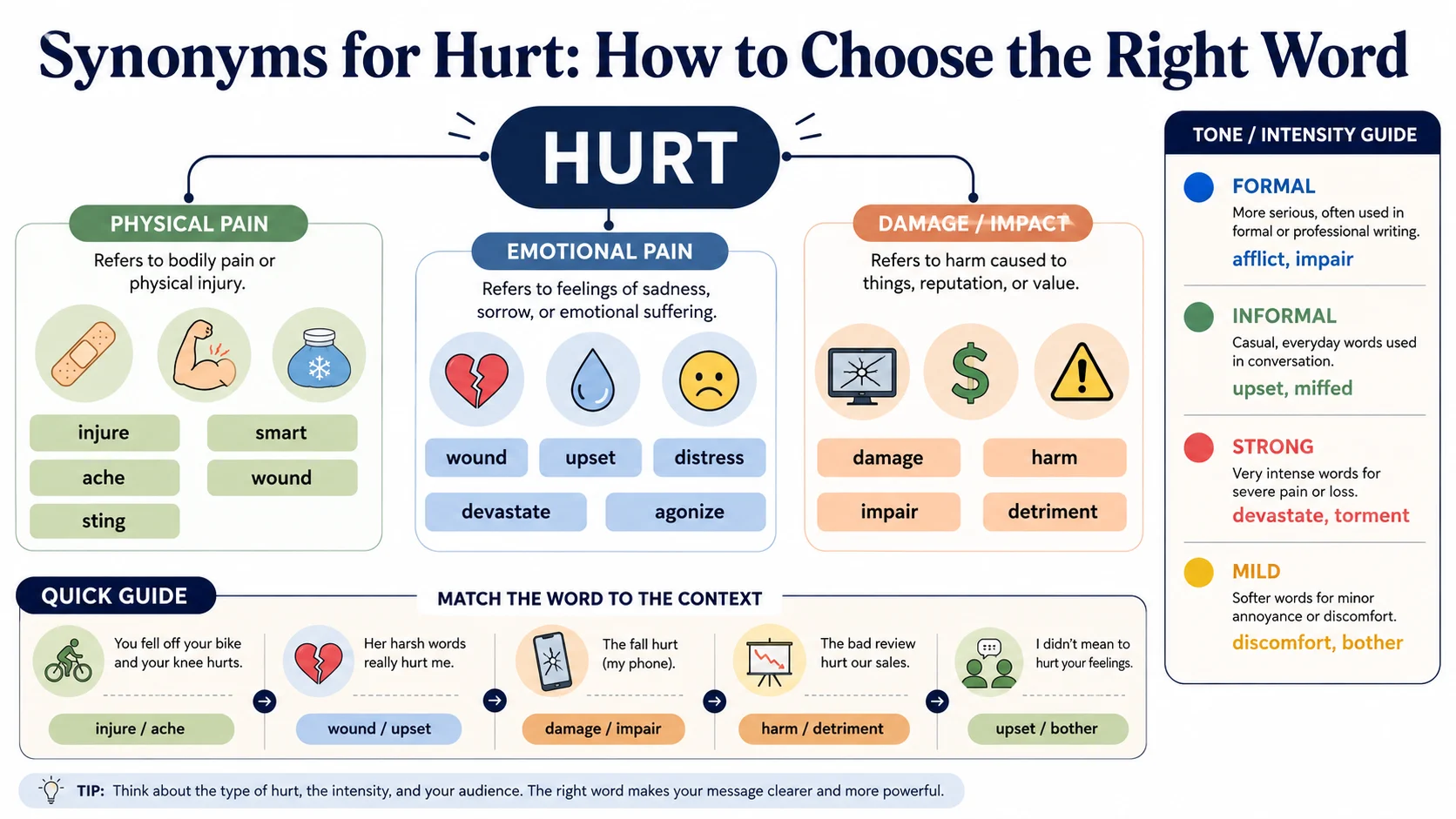
Here’s a quick reference table of the best synonyms for hurt, organized by what they mean and when to use them:
| Synonym | Meaning | Tone | Best Use Case | Example Sentence |
| Injure | Cause physical damage to a body | Formal/Neutral | Medical, legal, serious physical harm | “The athlete injured his knee during the game.” |
| Wound | Inflict emotional or physical injury | Formal/Literary | Emotional pain, deep betrayal, battle injuries | “His harsh words wounded her deeply.” |
| Ache | Dull, continuous pain | Neutral | Ongoing physical discomfort, longing | “My back aches after sitting all day.” |
| Damage | Harm the value or function of something | Neutral/Formal | Objects, reputation, systems, property | “The storm damaged the roof.” |
| Harm | Cause injury or negative effect | Neutral | Broad use, general negative impact | “The chemicals harm the environment.” |
| Pain | Physical or emotional suffering | Neutral | Both physical and emotional distress | “She felt a sharp pain in her side.” |
| Upset | Distress emotionally | Casual/Neutral | Everyday emotional hurt | “The news upset her.” |
| Sting | Sharp, sudden physical or emotional pain | Literary/Casual | Brief pain, harsh criticism | “The rejection stung more than he expected.” |
| Distress | Severe anxiety or suffering | Formal | Serious emotional or physical hardship | “The family was in distress after the fire.” |
| Mar | Spoil or impair quality or appearance | Formal/Literary | Appearance, experience, reputation | “The scratch marred the table’s surface.” |
Common Synonyms for Hurt
These everyday synonyms appear in normal writing and conversation. They’re simple, direct, and widely understood.
Injure
- Short meaning: To cause physical damage, often through accident or violence.
- Best context: Medical situations, sports, describing accidents.
- Example: “Five people were injured in the crash.”
Harm
- Short meaning: To cause damage or hurt, often in a general sense.
- Best context: Broad negative impact, safety warnings, casual and formal use.
- Example: “Smoking can seriously harm your health.”
Ache
- Short meaning: A dull, continuous physical pain.
- Best context: Describing ongoing bodily discomfort like headaches, muscle pain, or toothaches.
- Example: “After the hike, every muscle ached.”
Smart
- Short meaning: To feel a sharp stinging sensation.
- Best context: Fresh wounds, cuts, or eye irritation from smoke or chemicals.
- Example: “The antiseptic made the wound smart.”
Sting
- Short meaning: A sharp, brief physical or emotional pain.
- Best context: Insect bites, harsh criticism, emotional barbs.
- Example: “His words stung more than the slap.”
Formal Synonyms for Hurt
These formal synonyms are appropriate for academic writing, business reports, professional communication, and essays. They sound more sophisticated and precise.
Injure
- When it works best: Legal documents, medical reports, insurance claims. “Injure” sounds official and specific.
- Example: “The plaintiff claims the defective product injured him.”
Harm
- When it works best: Professional writing where a neutral tone matters. Often used in warnings, legal contexts, and policy statements.
- Example: “The new regulations are designed to prevent harm to the environment.”
Damage
- When it works best: Business writing, property descriptions, financial discussions. Focuses on negative effects to value or function.
- Example: “The data breach damaged customer trust.”
Impair
- When it works best: Formal contexts describing reduced function. Common in medical, legal, and technical writing.
- Example: “The injury will impair his ability to work.”
Distress
- When it works best: Serious emotional or physical suffering in formal writing like legal filings, medical records, or news reports.
- Example: “The victim experienced severe emotional distress.”
Afflict
- When it works best: Formal writing about suffering, often from disease, poverty, or other serious conditions.
- Example: “The region is afflicted by drought.”
Detriment
- When it works best: Formal writing where something causes disadvantage or loss, often in business or legal contexts.
- Example: “The policy change was to the detriment of small businesses.”
Informal Synonyms for Hurt
These casual alternatives work well in conversation, social media, friendly writing, and personal messages. They have a more relaxed, everyday feel.
Upset
- Tone: Casual, emotional.
- When to use: Describing emotional hurt in everyday situations.
- Example: “She was really upset about the argument.”
Bruised
- Tone: Casual, metaphorical.
- When to use: Describing emotional hurt in a gentle way, often about ego or pride.
- Example: “My ego was bruised after the rejection.”
Miffed
- Tone: Very casual, mild annoyance.
- When to use: Describing slight emotional hurt or offense.
- Example: “I was a bit miffed that she didn’t call.”
Burn
- Tone: Casual, vivid.
- When to use: Describing sharp physical or emotional pain in conversation.
- Example: “The criticism really burned.”
Get to
- Tone: Very casual, conversational.
- When to use: Describing someone who makes you feel upset or emotional.
- Example: “Don’t let him get to you.”
Strong Synonyms for Hurt
These stronger synonyms carry more emotional weight or intensity. They emphasize the seriousness of the pain, damage, or suffering.
Torture
- Intensity: Extreme. Used for severe physical or emotional suffering.
- When to use: Describing unbearable pain or deliberate cruelty.
- Example: “The uncertainty tortured him.”
Agonize
- Intensity: Very high. Suggests prolonged, intense suffering.
- When to use: Writing about deep emotional or physical struggle.
- Example: “She agonized over the decision for weeks.”
Devastate
- Intensity: Very high. Suggests overwhelming emotional destruction.
- When to use: Describing the worst emotional pain.
- Example: “The news devastated the family.”
Torment
- Intensity: High. Suggests ongoing mental or physical suffering.
- When to use: Describing prolonged emotional pain.
- Example: “Guilt tormented him for years.”
Gash
- Intensity: High (physical). Suggests a deep, serious cut.
- When to use: Describing serious physical wounds.
- Example: “He gashed his leg on the rocks.”
Mild Synonyms for Hurt
These softer, more neutral synonyms are less intense. They work well when you want to downplay or soften the impact of hurt.
Discomfort
- Intensity: Low. Suggests mild pain or unease.
- When to use: Describing minor physical or emotional issues.
- Example: “The patient reported some discomfort.”
Bother
- Intensity: Low. Suggests mild annoyance or hurt.
- When to use: Casual conversation about minor issues.
- Example: “His comment bothered me a little.”
Nettle
- Intensity: Low. Suggests mild irritation.
- When to use: Describing annoyance, not serious hurt.
- Example: “Her tone nettled him.”
Ruffled
- Intensity: Low. Suggests slight emotional disturbance.
- When to use: Casual writing about mild offense.
- Example: “He seemed a bit ruffled by the question.”
Sore
- Intensity: Low. Suggests mild physical or emotional tenderness.
- When to use: Describing sensitive or tender areas.
- Example: “My muscles are sore after the workout.”
Synonyms for Hurt by Context
The best synonym for hurt depends on where and how you’re using it. Here’s a breakdown by common contexts.
Everyday Conversation
In casual speech, simple words work best. “Ache,” “sting,” “smart,” and “upset” are natural choices for describing everyday physical and emotional hurt.
- Physical: “My head aches,” “The cut stings.”
- Emotional: “I’m upset about what happened.”
Professional Writing
In business or professional contexts, use neutral and precise alternatives. “Damage,” “harm,” “impair,” and “detriment” sound professional without being overly emotional.
- Example: “The incident could damage the company’s reputation.”
Academic Writing
Academic writing requires formal precision. “Injure,” “afflict,” “impair,” and “distress” work well in research, medical writing, and scholarly essays.
- Example: “The study examined how poverty afflicts urban communities.”
Creative Writing
Creative writing offers the most freedom. “Agonize,” “torment,” “wound,” and “smart” add emotional depth and vivid imagery.
- Example: “Her words wounded him like a blade.”
Emotional Expression
When emotions run high, choose words that match the intensity. “Devastate” and “torment” fit deep pain, while “bother” and “miffed” suit milder upsets.
Another Word for Hurt in a Sentence
Here are practical examples showing how different synonyms for hurt work in sentences.
- Injure: “He injured his shoulder during the workout.”
- Wound: “The officer was wounded in the line of duty.”
- Ache: “My legs ached after the long run.”
- Harm: “The chemicals harm local wildlife.”
- Damage: “The heavy rain damaged the crops.”
- Upset: “The cancellation upset everyone’s plans.”
- Distress: “The earthquake caused widespread distress among survivors.”
- Smart: “The ointment made my eyes smart.”
- Sting: “The bee sting hurt more than I expected.”
- Afflict: “The disease afflicts thousands each year.”
- Impair: “The injury impaired his vision.”
- Devastate: “The news devastated her entire family.”
Hurt Synonyms Compared
Some synonyms for hurt are nearly interchangeable, but small differences matter. Here’s how to tell them apart.
Injure vs. Wound
“Injure” typically refers to physical damage from accidents or violence. “Wound” can be physical (like a cut or gunshot) but often describes deep emotional hurt.
- Injure: “Five people were injured in the bus crash.”
- Wound: “His unfaithfulness wounded her in ways that never healed.”
Ache vs. Pain
“Ache” suggests a dull, continuous feeling. “Pain” is broader and can be sharp or dull, physical or emotional.
- Ache: “Her tooth ached all day.”
- Pain: “He felt a sharp pain in his chest.”
Harm vs. Damage
“Harm” is more general and can apply to people, animals, or things. “Damage” often implies affecting the value or function of an object or system.
- Harm: “The medication didn’t harm the patient.”
- Damage: “The flood damaged the basement.”
Words Similar to Hurt
These words are related to hurt and belong to the same semantic field, but they might not always be exact replacements. Understanding the distinction is useful for accurate word choice.
Suffer
- Why it’s related: Describes the experience of pain, hurt, or hardship.
- When it’s not a direct replacement: “Suffer” is about the person’s experience, not the action causing it.
- Example: “She suffered from chronic back pain.”
Grieve
- Why it’s related: Describes emotional hurt from loss.
- When it’s not a direct replacement: “Grieve” is specifically about sadness from death or loss, not general hurt.
- Example: “The family grieved for months.”
Trauma
- Why it’s related: Describes serious emotional or physical hurt.
- When it’s not a direct replacement: “Trauma” implies severe, lasting effects.
- Example: “The accident caused significant trauma.”
Misery
- Why it’s related: Describes a state of great unhappiness or suffering.
- When it’s not a direct replacement: “Misery” is more intense and prolonged than everyday hurt.
- Example: “Poverty brought them years of misery.”
Antonyms of Hurt
Opposites of “hurt” include words that describe healing, comfort, and benefit. These antonyms work for physical and emotional contexts.
| Antonym | Short Meaning | Example Sentence |
| Heal | To recover from injury or hurt | “Time helped heal the wound.” |
| Comfort | To ease someone’s distress | “She comforted her crying friend.” |
| Benefit | To have a positive effect | “The new policy will benefit everyone.” |
| Help | To make better or easier | “The medicine helped his back pain.” |
| Improve | To make better | “Her mood improved after the good news.” |
| Soothe | To calm or relieve pain | “The ointment soothed the burn.” |
How to Choose the Right Synonym for Hurt
Picking the best synonym requires considering a few key factors. Here’s a practical approach.
Match the context. The situation determines your word choice. A medical report needs “injure.” A personal conversation might call for “ache.” Creative writing often allows more flexibility.
Match the tone. Think about how formal or casual your writing should be. “Distress” works in formal settings. “Upset” sounds more natural in conversation.
Check the intensity. Use stronger words like “devastate” only when you mean serious hurt. Use milder words like “bother” for minor issues.
Think about your reader. Consider their expectations. For example, a business audience might expect “damage” or “harm.”
Check if the synonym is exact or only related. “Grieve” is related to hurt but doesn’t mean the same thing. Make sure you’re using words correctly.
Keep the sentence natural. Your synonym should fit smoothly into the sentence without sounding forced.
When in doubt, choose simple words. “Hurt” is clear and works in most situations.
Common Mistakes When Using Synonyms for Hurt
Using synonyms incorrectly can confuse your readers. Here are common mistakes to avoid.
Choosing a word with the wrong tone. “Miffed” sounds out of place in a formal business report. Conversely, “distress” sounds overly serious in a casual conversation.
Using a synonym that is too strong. “Torture” shouldn’t describe a mildly frustrating day.
Using a formal word in casual writing. “Impair” might sound stiff in personal messages. Save it for academic or professional contexts.
Using a casual word in professional writing. “Bruised” might not convey the seriousness needed in formal writing.
Replacing hurt without checking meaning. “Grieve” means a specific type of sadness, not general hurt. It’s important to avoid using related words as direct replacements.
Treating related words as exact synonyms. Words in the “similar to” section above aren’t always interchangeable.
Making the sentence sound unnatural. Forcing a thesaurus word into a sentence often leads to stilted writing. If it doesn’t sound like you, reconsider.
Quick Synonym List for Hurt
Common Synonyms
- Injure
- Harm
- Damage
- Ache
- Pain
- Wound
Formal Synonyms
- Injure
- Harm
- Damage
- Impair
- Distress
- Afflict
- Detriment
Informal Synonyms
- Upset
- Bruised
- Miffed
- Burn
- Get to
Strong Synonyms
- Torture
- Agonize
- Devastate
- Torment
- Gash
Mild Synonyms
- Discomfort
- Bother
- Nettle
- Ruffled
- Sore
Related Words
- Suffer
- Grieve
- Trauma
- Misery
- Anguish
FAQs
What is the best synonym for hurt?
The best synonym depends on what you’re trying to say. “Injure” is great for physical damage, “wound” works well for emotional pain, and “damage” fits objects or reputation. “Ache” describes ongoing physical discomfort, while “harm” is a general alternative.
What is another word for hurt?
Common alternatives include: injure, wound, ache, harm, damage, pain, upset, sting, smart, and distress. The right choice depends on the context.
What is a formal synonym for hurt?
Formal alternatives include: injure, harm, damage, impair, distress, afflict, and detriment. These words work well in academic, legal, and professional contexts.
What is an informal synonym for hurt?
Informal alternatives include: upset, bruised, miffed, burn, and get to. These are best for conversation and casual writing.
What is a stronger word for hurt?
Stronger words include: torture, agonize, devastate, torment, and gash. These convey more intense physical or emotional suffering.
What is a milder word for hurt?
Milder alternatives include: discomfort, bother, nettle, ruffled, and sore. These are softer and less intense.
What words are similar to hurt?
Similar words include: suffer, grieve, trauma, misery, and anguish. These are related but aren’t always direct replacements.
What is the opposite of hurt?
Antonyms include: heal, comfort, benefit, help, improve, and soothe. These describe recovery, positive effects, and relief.
How do I choose the right synonym for hurt?
Consider the context, tone, intensity, and your reader. Match the word to the situation. Formal writing needs formal words like “injure” or “impair.” Casual conversation calls for simpler words like “ache” or “upset.”
Conclusion
“Hurt” is a useful, flexible word that describes many types of negative experiences. Whether you’re describing a broken bone, a broken heart, or a broken reputation, you have a wide range of synonyms to choose from.
The right word makes your writing clearer and more precise. For physical injury, consider “injure” or “harm.” For emotional pain, “wound” or “upset” often hit the mark. For damage to things, “damage” or “impair” work well. Formal writing benefits from words like “distress” and “afflict,” while casual conversation calls for simpler options like “ache” or “sting.”
Always remember to match your synonym to the context, tone, and intensity of your message. When in doubt, “hurt” remains a clear, simple choice that works for most situations.
Read More Articles
Synonyms for Tension| Words for Emotional, Physical & Social Strain For 2026
Synonyms for Travel: Meaning, Examples, and Better Word Choices In 2026
Synonyms for Evidence: Meaning, Examples and Better Word Choices In 2026