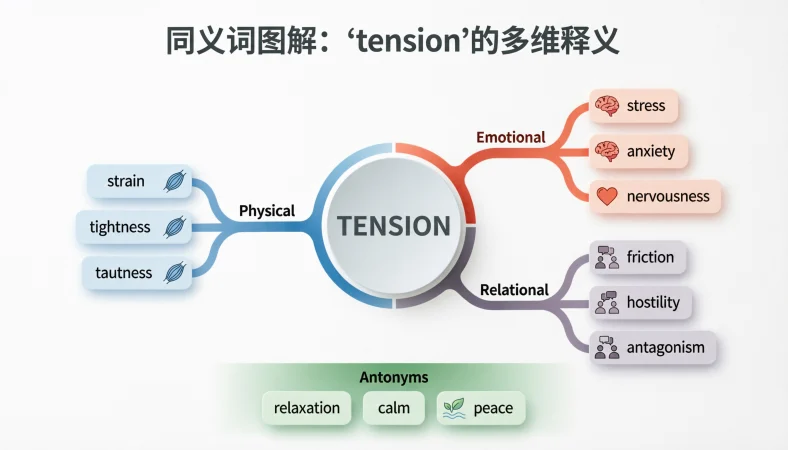
The best synonyms for tension depend on the context. Common alternatives include stress, strain, pressure, anxiety, unease, nervousness, conflict, friction, suspense, and hostility. For example, stress works well for emotional pressure, while friction or conflict is better when describing disagreements between people.
Tension can describe many different feelings and situations, from emotional stress and nervousness to conflict between people or suspense in a story. Choosing the right synonym makes your writing more precise and natural.
In this guide, we’ll explore useful synonyms for tension, explain how their meanings differ, and show you which alternatives work best in formal writing, everyday conversation, relationships, storytelling, and professional contexts. Whether you need a stronger word for stress, a softer way to describe unease, or a precise term for conflict, you’ll find practical options with clear examples.
What Does Tension Mean?
Tension is a state of being stretched, strained, or pulled tight whether physically, mentally, or emotionally. The word comes from the Latin tendere, meaning “to stretch.”
Part of speech: noun
Core meaning: The condition of being held in a state between opposing forces, resulting in tightness, stress, or unease.
Simple example sentences:
- The tension in the rope made it hum when plucked.
- She felt tension in her neck after hours at the computer.
- There was clear tension between the two managers during the meeting.
Core Meaning of Tension
At its heart, tension describes a state of opposition or imbalance. Something is being pulled, stretched, or strained whether that’s a physical object, a person’s nerves, or a relationship between people.
In physics, tension is a force transmitted through a string, rope, or cable when pulled tight by opposing forces. In everyday language, it usually refers to emotional or mental strain the feeling of being wound up, worried, or under pressure. And in social contexts, tension describes unease or hostility between individuals or groups.
Grammar and Usage Notes
Tension functions primarily as a noun. It can be countable or uncountable:
- Uncountable: “There was too much tension in the room.”
- Countable: “The tensions between the two nations finally eased.”
Common collocations:
- relieve tension (e.g., yoga relieves tension)
- create tension (e.g., the plot twist created tension)
- ease tension (e.g., a joke eased the tension)
- tension builds (e.g., tension builds throughout the film)
- tension mounts (e.g., as the deadline approaches, tension mounts)
The word works naturally in most contexts. But when you need more specificity whether about physical tightness, emotional strain, or social conflict a synonym often says more.
Best Synonyms for Tension
| Synonym | Meaning | Tone | Best Use Case | Example Sentence |
| Stress | Pressure or strain affecting mental or physical state | Neutral | General mental or physical strain | Job stress can affect sleep quality. |
| Strain | Excessive pressure causing wear or tension | Neutral | Physical or mental overexertion | The extra workload put a strain on the team. |
| Pressure | Force or demands that create stress | Neutral | External demands or expectations | She works well under pressure. |
| Anxiety | Uneasy feeling of worry or fear | Mild to moderate | Emotional worry about future events | Anxiety over the exam kept him awake. |
| Friction | Conflict or disagreement causing tension | Neutral | Relationship or social conflict | Friction between the two departments slowed the project. |
| Nervousness | Feeling of worry, often before an event | Mild | Pre-event jitters or anticipation | His nervousness before the speech was obvious. |
| Unease | Feeling of discomfort or worry | Mild | Subtle emotional discomfort | She felt a growing unease about the plan. |
| Apprehension | Fear or anxiety about something coming | Moderate | Worry about future events | Apprehension about the journey was understandable. |
| Suspense | Excited or anxious uncertainty | Moderate | Narrative or event-driven anticipation | The movie kept the audience in suspense. |
| Tautness | State of being pulled tight | Neutral | Physical tightness | The tautness of the canvas made it perfect for painting. |
| Hostility | Deep-seated ill will or antagonism | Strong | Extreme relational conflict | Hostility between the rivals was obvious. |
| Tightness | Feeling of pressure or constriction | Neutral | Physical or emotional constriction | Tightness in her chest made breathing hard. |
Common Synonyms for Tension
These are the synonyms you’ll hear most often in everyday speech and writing.
Stress
Meaning: Mental or physical strain caused by demands or pressure.
Best context: Work, school, health, or general life pressure.
Example: “Managing stress is essential for good health.”
Strain
Meaning: Excessive effort or pressure that causes wear or tension.
Best context: Physical overexertion or mental overload.
Example: “The strain of caring for two young children was exhausting.”
Pressure
Meaning: Force exerted by external demands or circumstances.
Best context: Work deadlines, performance expectations, or social demands.
Example: “The pressure to succeed at work can be overwhelming.”
Tightness
Meaning: A feeling of constriction or being pulled close.
Best context: Physical sensations, muscles, or emotional constriction.
Example: “Tightness in his jaw told her he was angry.”
Formal Synonyms for Tension
Use these words in academic, business, or professional communication.
Strain
Works well in formal writing about physical or mental overexertion. It appears in medical and psychological contexts.
Example: “The strain on the infrastructure became apparent after the population surge.”
Apprehension
Describes a formal kind of worry or unease about future events. Common in legal, academic, and professional writing.
Example: “The team expressed apprehension about the proposed changes.”
Antagonism
Denotes active hostility or opposition between people or groups. Suitable for political, diplomatic, or organizational contexts.
Example: “Antagonism between the two departments hindered progress.”
Unease
A professional way to describe discomfort or worry without being overly emotional.
Example: “Some unease about the new policy was apparent during the meeting.”
Hostility
Indicates strong opposition or ill will. Often used in formal descriptions of conflict.
Example: “Hostility toward the new regulations was widespread.”
Informal Synonyms for Tension
These casual alternatives work well in conversation, texts, and personal writing.
Nerves
Meaning: Anxiety or nervousness, often before an event.
Best context: Personal conversations about feeling anxious.
Example: “I had a bad case of nerves before the interview.”
Jitters
Meaning: Feelings of nervousness or anxiety.
Best context: Pre-event butterflies, anticipation anxiety.
Example: “She always gets the jitters before flying.”
Worry
Meaning: Anxiety or concern about potential problems.
Best context: General concern about everyday matters.
Example: “Money worry kept him up at night.”
Bad blood
Meaning: Lingering hostility or ill feeling between people.
Best context: Relationship conflict, ongoing feuds.
Example: “There’s still bad blood between the two families.”
Strong Synonyms for Tension
When you need to emphasize intensity, these words pack more punch.
Turmoil
A state of great disturbance, confusion, or uncertainty. Use it when tension reaches a boiling point.
Example: “Emotional turmoil left her unable to focus.”
Strife
Bitter conflict or struggle, often between groups. Stronger than friction and suggests active opposition.
Example: “The country was torn apart by internal strife.”
Hostility
Deep, active ill will. Stronger than antagonism and suggests aggression.
Example: “Open hostility between the coworkers made the office unbearable.”
Enmity
A very strong feeling of hatred between enemies. One of the strongest relational tension words.
Example: “Years of enmity prevented any compromise.”
Agitation
A state of nervous excitement or disturbance. Describes visible or intense emotional tension.
Example: “He paced the room in agitation, unable to sit still.”
Mild Synonyms for Tension
Sometimes tension is subtle, and a softer word fits better.
Unease
A gentle word for mild discomfort or worry. It suggests something is off but not alarming.
Example: “She felt a flicker of unease but dismissed it.”
Discomfort
A feeling of slight pain or awkwardness. Use it for low-level tension that’s more bothersome than distressing.
Example: “The discomfort between them was noticeable.”
Restlessness
The inability to relax or stay still, often from mild anxiety.
Example: “Restlessness set in after two hours of waiting.”
Concern
Mild worry or interest about something. Less intense than anxiety.
Example: “There was growing concern about the project’s progress.”
Synonyms for Tension by Context
Everyday Conversation
In casual conversation, you’ll usually hear stress, pressure, or anxiety. These words are familiar and don’t sound forced. For physical tension, tightness works well.
- “The stress of moving is getting to me.”
- “There’s so much pressure at work lately.”
- “I feel this tightness in my neck.”
Professional Writing
In business settings, choose words that sound measured and objective: strain, pressure, or friction. Avoid overly emotional words like turmoil or nervousness unless the context warrants them.
- “The strain on resources is becoming apparent.”
- “We need to reduce friction between sales and marketing.”
- “Employees report high pressure during quarterly reviews.”
Academic Writing
Scholarly writing calls for precision. Strain, apprehension, hostility, and antagonism are common in psychology, sociology, and political science.
- “The study measured anxiety and apprehension in participants.”
- “Antagonism between social groups increased significantly.”
Creative Writing
Writers can choose from many synonyms depending on the mood. Suspense creates anticipation, turmoil conveys chaos, and unease builds dread.
- “The suspense before the reveal was agonizing.”
- “Emotional turmoil consumed her thoughts.”
Emotional Expression
For personal feelings, anxiety, worry, and nervousness are direct and relatable. Agitation describes visible distress.
- “Anxiety overwhelmed her before the test.”
- “He couldn’t hide his agitation.”
Another Word for Tension in a Sentence
Here are twelve real-world examples showing different synonyms in action.
- Workplace stress has become a major health concern in the modern economy.
- The strain on her relationship with her parents grew after she moved away.
- He felt pressure to accept the job offer even though it wasn’t right.
- Her anxiety about the doctor’s visit was visible in her restless hands.
- Friction between the departments delayed the product launch by weeks.
- The nervousness in his voice betrayed his calm exterior.
- She felt a growing unease about the stranger following her home.
- Apprehension filled the room as the results were about to be announced.
- The suspense in the novel kept readers turning pages into the night.
- The tautness of the bowstring made archery feel precise and controlled.
- Open hostility between the rival groups made compromise impossible.
- Tightness in her chest made each breath feel shallower than the last.
Tension Synonyms Compared
Close synonyms have subtle differences that affect which one you should choose.
Stress vs. Strain
Both describe pressure, but stress is usually external (work stress, financial stress), while strain often describes the internal or physical effect (eye strain, relationship strain). You experience stress from demands; you feel strain as a result.
Anxiety vs. Unease
Anxiety is a more active, noticeable feeling of worry. Unease is subtler you sense something is wrong but can’t always name it. Anxiety keeps you awake; unease makes you glance over your shoulder.
Friction vs. Hostility
Friction describes mild to moderate disagreement or tension between people. Hostility implies active ill will or aggression. Friction can be resolved with a conversation; hostility may require intervention.
Tightness vs. Tautness
Tightness describes a feeling of constriction, often with a sense of discomfort. Tautness is more neutral or technical—something is pulled tight without the emotional weight.
Words Similar to Tension
These words relate to tension but don’t always work as direct replacements.
Pressure
Relationship: Very close, often interchangeable in emotional contexts.
Key difference: Emphasizes external force rather than internal state.
When to use: When outside forces create tension.
Suspense
Relationship: Close for narrative or anticipatory tension.
Key difference: Specifically describes excited uncertainty about an outcome.
When to use: In storytelling or waiting for news.
Conflict
Relationship: Covers relational tension but broader.
Key difference: Often implies active opposition or disagreement, not just strain.
When to use: When tension leads to or stems from disagreement.
Tautness
Relationship: Close for physical tension only.
Key difference: Describes the state of being physically tight.
When to use: Physics, engineering, or precise physical descriptions.
Antonyms of Tension
| Antonym | Meaning | Example Sentence |
| Relaxation | The state of being free from tension or stress | Yoga brought her a deep sense of relaxation. |
| Calm | A peaceful, tranquil state | The calm after the storm was a relief. |
| Ease | Freedom from difficulty or worry | He lived a life of ease without pressure. |
| Peace | Harmony without conflict or stress | There is peace between the two families now. |
| Serenity | A state of being calm and untroubled | Serenity washed over her as she sat by the lake. |
| Tranquility | A state of peace and quiet | The tranquility of the countryside helped her unwind. |
How to Choose the Right Synonym for Tension
Finding the right word comes down to asking a few simple questions.
Match the context. Physical tension calls for tightness, tautness, or strain. Emotional tension fits anxiety, stress, or nervousness. Relational tension pairs with friction, hostility, or antagonism.
Match the tone. Formal writing suits apprehension, antagonism, or strain. Casual conversation prefers stress, nerves, or jitters.
Check the intensity. Is the tension mild, moderate, or extreme? Unease and restlessness are mild. Hostility and turmoil are strong. Choose the word that matches the feeling.
Think about your reader. Use familiar words for a general audience. Choose precise terms when writing for experts or in professional contexts.
Test the replacement. Swap the word into your sentence and read it aloud. Does it sound natural? Does it carry the right meaning? If not, try another.
Common Mistakes When Using Synonyms for Tension
Using a Word With the Wrong Tone
Hostility sounds aggressive if you mean mild disagreement. Nervousness sounds casual in a formal report. Always check the tone.
Choosing a Word That’s Too Strong
Turmoil is dramatic it fits a crisis but not everyday stress. A mild situation calls for a mild word.
Using a Formal Word in Casual Writing
Apprehension sounds stiff in a text message. Worry or nerves feels more natural.
Treating Related Words as Exact Synonyms
Suspense is not the same as anxiety. Tautness isn’t the right word for emotional tension. Know the difference.
Making the Sentence Sound Unnatural
Don’t force a synonym where tension works better. The goal is clarity, not variety at any cost.
Quick Synonym List for Tension
Common synonyms: stress, strain, pressure, tightness, worry
Formal synonyms: apprehension, antagonism, hostility, strain, unease
Informal synonyms: nerves, jitters, stress, bad blood
Strong synonyms: turmoil, strife, hostility, enmity, agitation
Mild synonyms: unease, discomfort, restlessness, concern
Related words: pressure, suspense, conflict, tautness, tightness
FAQs About Synonyms for Tension
What is the best synonym for tension?
The best synonym depends on context. For emotional strain, stress or anxiety works well. For physical tightness, strain or tightness is better. For relationship conflict, friction fits.
What is another word for tension?
You can use stress, strain, pressure, or anxiety in most contexts. For tension between people, try friction or antagonism.
What is a formal synonym for tension?
Formal options include apprehension, antagonism, hostility, unease, and strain. These are common in business, academic, and professional writing.
What is an informal synonym for tension?
Informal words include nerves, jitters, and bad blood. These feel natural in conversation and casual writing.
What is a stronger word for tension?
Stronger options include turmoil, strife, hostility, and enmity. These carry more intensity and suit situations with serious conflict or distress.
What is a milder word for tension?
Milder alternatives are unease, discomfort, restlessness, and concern. These work for subtle, low-level tension.
What words are similar to tension?
Similar words include pressure, suspense, conflict, and tautness. Each shares part of tension’s meaning but has its own specific use.
What is the opposite of tension?
The opposites include relaxation, calm, ease, peace, serenity, and tranquility.
Conclusion
Tension is a versatile word with many useful synonyms. Whether you’re describing physical strain, mental stress, or relationship friction, the right word depends on context, tone, and intensity.
For everyday writing, stress and pressure are reliable choices. For professional or academic work, strain and apprehension add precision. And when you need to make a stronger statement, turmoil or hostility pack a punch.
The best synonym is the one that fits your sentence, your audience, and your meaning. Choose carefully, and your writing will feel clearer, sharper, and more natural.