Quick Answer:
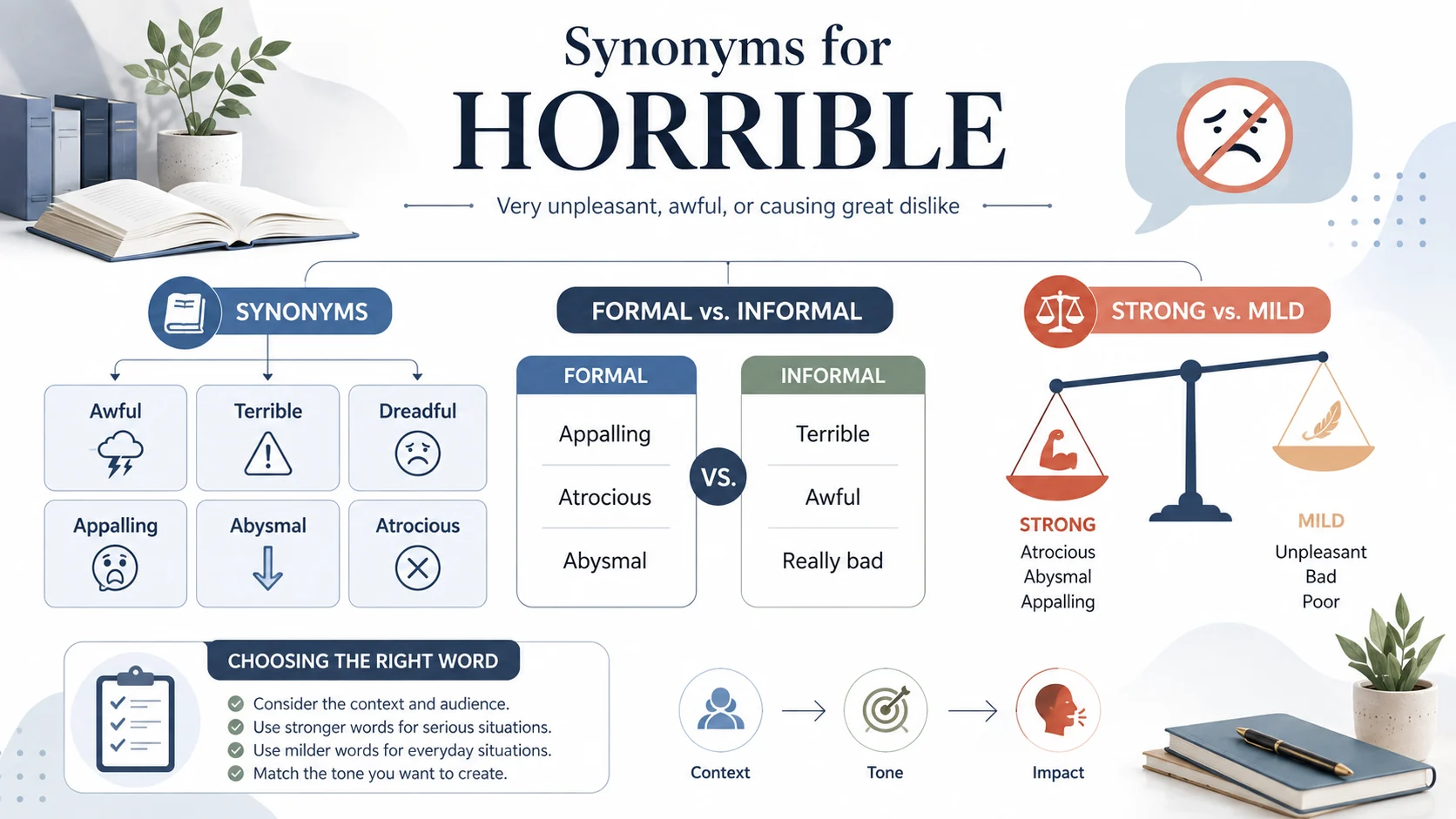
The best synonyms for horrible are terrible, dreadful, awful, and appalling. The right choice depends on tone, context, and intensity “terrible” works almost anywhere, while “appalling” suits stronger, more formal criticism.
Finding the right synonym for horrible can make your writing clearer, more vivid, and more precise. While “horrible” is a common word for describing something extremely unpleasant, frightening, bad, or distressing, it does not always express the exact feeling or level of intensity you mean. Depending on the context, words such as terrible, awful, dreadful, unpleasant, appalling, atrocious, ghastly, or disturbing may communicate your idea more effectively. Choosing the right alternative also helps you avoid repetition and gives your writing a more natural, polished tone.
In this guide, you’ll discover a useful range of synonyms for horrible, organized by meaning, tone, and intensity. Whether you need a formal word for professional writing, a casual option for everyday conversation, or a stronger term to describe something truly shocking or disturbing, you’ll find suitable choices with clear examples. Understanding the subtle differences between these words can help you select the most accurate synonym and communicate your thoughts with greater confidence.
What Does Horrible Mean?
At its core, “horrible” describes something extremely unpleasant, shocking, or bad in quality. It’s an adjective, and people use it for almost anything negative a smell, a movie, a mistake, or even a person’s behavior.
Native speakers use it loosely in everyday conversation, and that flexibility is exactly why it can sound repetitive in writing. A sentence like “The food was horrible” tells the reader something was bad, but it doesn’t say how bad or why.
- The weather turned horrible halfway through the hike.
- He felt horrible about missing her birthday.
Core Meaning of Horrible
Underneath all its casual uses, “horrible” carries one consistent idea: something causes strong displeasure, distress, or disgust. It can describe a physical experience (a horrible smell), an emotional state (a horrible feeling), or a moral judgment (a horrible decision).
Because the word covers so much ground, its exact meaning shifts with context. “Horrible traffic” is annoying but mild in comparison to “horrible news,” which might involve grief or shock. That range is part of why picking a more precise synonym often improves clarity.
Grammar and Usage Notes
“Horrible” functions only as an adjective, and it typically appears before a noun (“a horrible mess”) or after a linking verb (“that sounds horrible”).
Common patterns include:
- horrible + noun (horrible smell, horrible accident)
- feel/look/sound + horrible
- horrible at (something) meaning bad at a skill
“Horrible” sounds natural in casual speech and informal writing. In academic or professional writing, though, a more specific or formal synonym usually reads better, since “horrible” can come across as vague or overly emotional.
Best Synonyms for Horrible
| Synonym | Meaning | Tone | Best Use Case | Example Sentence |
| Terrible | Very bad or unpleasant | Neutral-to-strong | General use, everyday writing | The service at that restaurant was terrible. |
| Dreadful | Causing dread or great discomfort | Slightly formal | Describing weather, news, or experiences | We had a dreadful flight delay. |
| Awful | Extremely bad or unpleasant | Casual-to-neutral | Conversation, informal writing | That movie was awful from start to finish. |
| Appalling | Shocking in a bad way | Formal, strong | Criticism, reports, journalism | The living conditions were appalling. |
| Atrocious | Extremely poor in quality or morally shocking | Formal, strong | Behavior, performance, quality issues | His handwriting is atrocious. |
| Horrendous | Extremely unpleasant or shocking | Strong | Emphasizing severity | The traffic this morning was horrendous. |
| Ghastly | Frightening or extremely unpleasant | Formal, dramatic | Descriptive or literary writing | The scene was ghastly to witness. |
| Unpleasant | Not enjoyable or pleasant | Mild | Neutral, professional contexts | It was an unpleasant conversation. |
Common Synonyms for Horrible
These are the everyday words people reach for most often in speech and casual writing.
Terrible Means very bad, and it works in almost any situation. “The traffic was terrible this morning.”
Awful Slightly more casual than terrible, often used for disappointment. “The coffee here tastes awful.”
Bad The simplest option, useful when you don’t need emotional emphasis. “That was a bad decision.”
Nasty Adds a sense of unpleasantness or unkindness. “There’s a nasty smell coming from the fridge.”
Horrid An older-sounding, slightly informal cousin of horrible. “What a horrid mess this kitchen is.”
Formal Synonyms for Horrible
Formal writing benefits from words that sound measured rather than emotional. These work well in reports, essays, and professional communication.
Appalling Signals shock at something’s severity. “The report described appalling safety violations.”
Deplorable Implies something deserves strong disapproval. “The building’s conditions were deplorable.”
Egregious Best for describing a mistake or violation that stands out as unusually bad. “The audit revealed egregious accounting errors.”
Atrocious Works for both quality and moral judgments in formal contexts. “The company’s customer service record is atrocious.”
Informal Synonyms for Horrible
These fit casual conversation, texting, and social media, where a more relaxed tone feels natural.
Gross Common for anything physically unpleasant. “That leftover pizza smells gross.”
Nasty Works for both taste and behavior in casual speech. “He said something really nasty to her.”
Yucky Playful and mild, often used with kids or lighthearted complaints. “This soup tastes yucky.”
The worst A phrase rather than a single word, but extremely common in informal speech. “That commute is the worst.”
Strong Synonyms for Horrible
When “horrible” doesn’t feel intense enough, these words push the emotion further.
Horrific Suggests something so bad it borders on traumatic. “The accident scene was horrific.”
Atrocious Carries a sense of moral outrage alongside poor quality. “The treatment of the workers was atrocious.”
Monstrous Implies something is disturbingly wrong or unjust. “The penalty felt monstrous compared to the crime.”
Vile Focuses on disgust, often used for behavior or smells. “He made a vile comment during the meeting.”
Use these carefully they can sound overly dramatic if the situation doesn’t match the intensity.
Mild Synonyms for Horrible
Sometimes a softer word communicates the point without sounding exaggerated.
Unpleasant Understated and professional. “It was an unpleasant surprise.”
Poor Works well for quality-related complaints. “The visibility was poor during the storm.”
Disappointing Focuses on unmet expectations rather than outright badness. “The turnout was disappointing.”
Unfortunate Softens the blame while still expressing regret. “It was an unfortunate outcome.”
Synonyms for Horrible by Context
Everyday Conversation
Stick with simple, familiar words like terrible, awful, or nasty. They sound natural without overexplaining.
Professional Writing
Choose measured terms such as unsatisfactory, unacceptable, or deplorable to keep the tone objective.
Academic Writing
Favor precise, formal choices like egregious or atrocious when describing data, behavior, or historical events.
Creative Writing
Lean toward vivid, sensory words such as ghastly, horrific, or monstrous to build atmosphere.
Marketing Copy
Avoid overly negative synonyms altogether unless describing a “before” scenario; if needed, frustrating or disappointing reads better than horrible.
Emotional Expression
Words like devastating or heartbreaking capture emotional weight better than a generic “horrible.”
Another Word for Horrible in a Sentence
- The hotel room smelled terrible when we opened the door.
- Reviewers called the film’s ending dreadful.
- Her cooking skills are honestly awful.
- Investigators uncovered appalling neglect at the facility.
- His attitude toward coworkers has always been atrocious.
- The storm caused horrendous damage along the coast.
- Witnesses described the crash scene as ghastly.
- It was an unpleasant reminder of how things used to be.
- The soup tasted gross after sitting out overnight.
- She made a nasty remark during the debate.
- This soup tastes yucky, said the toddler.
- The company’s safety record remains deplorable.
- That was the worst customer service I’ve ever experienced.
- The images from the disaster zone were horrific.
- It’s disappointing that the project fell apart so quickly.
Horrible Synonyms Compared
| Word | Intensity | Formality | Best Fit |
| Terrible | Medium-high | Neutral | All-purpose replacement |
| Dreadful | Medium | Slightly formal | Weather, experiences, news |
| Awful | Medium | Casual | Everyday disappointment |
| Appalling | High | Formal | Shocking situations, reports |
| Atrocious | Very high | Formal | Quality or moral criticism |
| Horrific | Very high | Neutral-formal | Trauma, disasters |
| Unpleasant | Low | Neutral | Mild, professional complaints |
Terrible and awful sit close together, but terrible tends to carry slightly more weight and reads a bit less casual. Dreadful leans British in flavor and fits well in descriptive writing. Appalling and atrocious both suggest moral judgment, while horrific focuses more on shock and trauma than on quality.
Words Similar to Horrible
These words overlap with “horrible” in feeling but don’t always work as direct replacements.
Sad Describes an emotional reaction rather than the quality of something itself. “It’s sad that the store closed,” not “It’s horrible that the store closed” in every case, since sad implies grief more than disgust or shock.
Uncomfortable Describes physical or social unease, not necessarily something bad in quality. A meeting can be uncomfortable without being horrible.
Chaotic Refers to disorder, which may or may not be unpleasant. A chaotic kitchen isn’t automatically horrible.
Boring Describes a lack of interest, which is a different problem from being bad. Something boring isn’t necessarily horrible, just uneventful.
These words can add nuance, but swapping them in for “horrible” without checking the meaning can distort your sentence.
Antonyms of Horrible
| Antonym | Meaning | Example Sentence |
| Wonderful | Extremely good or pleasing | The vacation turned out wonderful. |
| Delightful | Charming and enjoyable | Her speech was delightful to listen to. |
| Pleasant | Agreeable and enjoyable | We had a pleasant afternoon at the park. |
| Excellent | Outstanding in quality | The service was excellent from start to finish. |
| Lovely | Attractive and pleasing | The garden looked lovely in spring. |
How to Choose the Right Synonym for Horrible
Start by matching the context a business email needs a different word than a text to a friend. Next, check the tone you want to set; a word like “atrocious” sounds far more serious than “awful.”
Pay attention to intensity, too. If the situation is mildly annoying rather than genuinely upsetting, a milder synonym like “unpleasant” keeps your writing accurate instead of exaggerated. Consider your reader as well, since formal audiences respond better to measured language than emotional word choices.
Before finalizing your choice, double-check whether the synonym is an exact match or only a related concept words like “sad” or “boring” shouldn’t stand in for “horrible” without adjusting the sentence. Finally, read the sentence aloud; if it sounds forced or unnatural, a simpler word is usually the better call.
Common Mistakes When Using Synonyms for Horrible
Writers often reach for a stronger synonym like “atrocious” or “horrific” when a milder word would fit better, which can make ordinary complaints sound overblown. Others swing the opposite direction, using a soft word like “unpleasant” for something genuinely severe, which weakens the message.
Mixing formality is another common slip dropping “appalling” into a casual text message feels stiff, just as “yucky” feels out of place in a formal report. Some writers also treat loosely related words, such as “boring” or “sad,” as direct substitutes for “horrible,” even though they describe different feelings entirely.
Finally, replacing “horrible” without rereading the full sentence can create awkward phrasing, especially when the new word doesn’t fit the same grammatical pattern.
Quick Synonym List for Horrible
Common synonyms: terrible, awful, bad, nasty, horrid
Formal synonyms: appalling, deplorable, egregious, atrocious
Informal synonyms: gross, nasty, yucky, the worst
Strong synonyms: horrific, monstrous, vile, atrocious
Mild synonyms: unpleasant, poor, disappointing, unfortunate
Related words: sad, uncomfortable, chaotic, boring
FAQs
What is the best synonym for horrible?
Terrible is the most versatile synonym for horrible. It fits almost any context, from casual conversation to general writing, without sounding too formal or too extreme.
What is another word for horrible?
Dreadful, awful, and appalling are all common alternatives. Each carries a slightly different tone, so the best pick depends on how formal or intense you want your sentence to sound.
What is a formal synonym for horrible?
Appalling and deplorable work well in formal writing. Both suggest strong disapproval while keeping the tone professional rather than emotional.
What is an informal synonym for horrible?
Gross and the worst are common in casual speech. They convey strong disapproval in a relaxed, everyday tone.
What is a stronger word for horrible?
Horrific and atrocious both intensify the meaning. Use them when the situation involves real shock, harm, or moral outrage rather than everyday annoyance.
What is a milder word for horrible?
Unpleasant and disappointing soften the tone. They work well when the situation is negative but not extreme.
What words are similar to horrible?
Sad, uncomfortable, chaotic, and boring share some emotional territory with horrible but describe different experiences, so they aren’t always direct substitutes.
What is the opposite of horrible?
Wonderful, delightful, and pleasant are common antonyms. They describe experiences or qualities that are enjoyable rather than distressing.
Conclusion
“Horrible” is useful, but it’s also a catch-all word that can flatten your writing if you rely on it too often. Swapping it for a more precise synonym whether that’s the everyday punch of “terrible,” the formal weight of “appalling,” or the gentler tone of “unpleasant” makes your sentences clearer and more engaging. The right word always comes down to meaning, tone, context, and intensity, so let the situation guide your choice rather than defaulting to the same word every time.