Quick Answer:
The best synonyms for reflect are consider, contemplate, ponder, and mull over. Each one works when you mean “to think carefully,” though the right choice depends on tone, context, and how deep or casual the thinking is.If you mean the other sense of reflect to show or represent something the closest words are mirror, show, and indicate.
If you find yourself using the word “reflect” too often, choosing the right synonym can make your writing more precise, natural, and engaging. The best alternative depends on what you mean. For example, mirror or display can describe something that shows an image or quality, while consider, contemplate, or ponder work better when talking about thoughtful consideration. In other contexts, words such as represent, express, reveal, and indicate can communicate the idea of showing or conveying something. Understanding these differences helps you avoid repetition while keeping your original meaning clear.
In this guide, you’ll discover a useful collection of synonyms for reflect, organized by meaning, tone, and context. Each word comes with simple explanations and examples so you can see how it works in real sentences. Whether you’re writing an essay, professional document, article, story, or everyday message, you’ll learn how to choose a synonym that fits naturally. From common alternatives to more formal and sophisticated choices, this guide will help you expand your vocabulary and express ideas with greater accuracy and confidence.
What Does Reflect Mean?
At its core, reflect means to think seriously and carefully about something, often turning it over in your mind before reaching a conclusion. It’s a verb, and you’ll usually see it paired with “on” or “upon,” as in “reflect on your choices.”
Reflect also carries a second meaning: to show, represent, or mirror something accurately. A glass surface reflects light, and a report can reflect a company’s actual performance.
Here are two quick examples showing both senses:
- She sat quietly to reflect on the year that had just ended.
- The survey results reflect a genuine shift in customer opinion.
Core Meaning of Reflect
The thinking-related sense of reflect describes a slower, more deliberate kind of mental activity than a word like “think” usually implies. When someone reflects, they’re not just having a quick thought they’re stepping back, reviewing something from the past or a decision they need to make, and weighing it with some care.
The mirroring sense works differently. It’s about accuracy and correspondence: one thing reflecting the true nature or state of another, whether that’s a mirror bouncing back light or a document reflecting real facts.
Both senses share a common thread a kind of return or echo. Thoughts return to an experience; light or truth bounces back and shows itself clearly.
Grammar and Usage Notes
Reflect functions as a verb in both its intransitive form (“I need time to reflect”) and its transitive form (“The numbers reflect strong growth”).
Common patterns include:
- Reflect on / reflect upon (something) for the thinking sense
- Reflect (something) in (something else) for the mirroring sense
- Take time to reflect
- Stop and reflect
- Reflect deeply, reflect carefully, reflect honestly
Reflect sounds natural in both spoken and written English, but it leans slightly more formal or introspective than everyday words like “think about.” A sentence such as “I reflected on my mistakes” reads a bit more thoughtful than “I thought about my mistakes,” even though both are correct.
A synonym may work better when you need a lighter, more conversational tone, or when you want to emphasize a specific kind of thinking deep, brief, worried, or careful.
Best Synonyms for Reflect
| Synonym | Meaning | Tone | Best Use Case | Example Sentence |
| Consider | To think about something before deciding | Neutral | General writing and speech | Please consider the offer before you respond. |
| Contemplate | To think about something deeply and steadily | Formal | Academic or serious writing | He sat by the window to contemplate his next move. |
| Ponder | To think carefully, often slowly | Neutral to literary | Creative or reflective writing | She pondered the letter for several minutes. |
| Mull over | To think about something for a while before deciding | Informal | Casual conversation | I need to mull it over before I give you an answer. |
| Meditate on | To think deeply and calmly, often with focus | Formal | Spiritual or philosophical writing | The monk meditated on the meaning of loss. |
| Deliberate | To think carefully about a decision, weighing options | Formal | Business or legal contexts | The jury deliberated for three hours. |
Common Synonyms for Reflect
These are everyday words people use in place of reflect when talking or writing about thinking something through.
Think about A simple, direct way to describe considering something. It fits almost any context. Example: I need to think about what you just told me.
Consider Slightly more formal than “think about,” and it often implies weighing options. Example: We should consider both sides before making a decision.
Look back on Focuses on reviewing the past specifically. Example: She likes to look back on her college years fondly.
Weigh Suggests comparing options carefully before deciding. Example: He weighed the pros and cons before quitting his job.
Review Implies going over something in an organized way. Example: Take a moment to review what happened this week.
Formal Synonyms for Reflect
These words fit academic papers, professional reports, essays, and formal speech.
Contemplate works well in essays and reflective writing where the tone calls for depth. Example: The philosopher contemplated the nature of free will.
Deliberate suits business and legal writing, especially when a decision is at stake. Example: The board will deliberate on the merger proposal tomorrow.
Meditate upon fits philosophical, spiritual, or highly formal writing. Example: Readers are encouraged to meditate upon the poem’s central image.
Introspect works in academic or psychological contexts focused on self-examination. Example: The exercise asks students to introspect on their own biases.
Ruminate appears in formal or literary writing and often implies dwelling on something, sometimes repeatedly. Example: She continued to ruminate over the missed opportunity long after the meeting ended.
Informal Synonyms for Reflect
These casual alternatives suit conversation, texting, and everyday personal writing.
Mull over feels relaxed and is common in spoken English. Example: Give me a day to mull it over.
Chew on is a friendly, figurative way of saying “think about.” Example: Chew on that idea for a bit and let me know what you think.
Sleep on it describes putting off a decision until after some thought, usually overnight. Example: Don’t answer now sleep on it and tell me tomorrow.
Think it through suggests a casual but complete review of a situation. Example: I want to think it through before I say yes.
Mull it around is a looser, spoken variant used in casual conversation. Example: I’ve been mulling it around in my head all week.
Strong Synonyms for Reflect
These words carry more intensity, suggesting deep, prolonged, or even heavy thinking.
Brood implies dwelling on something in a serious, often unhappy way. Example: He brooded over the argument for days. Use this word carefully it usually carries a negative or troubled undertone, and it can sound too heavy for a simple, everyday decision.
Ruminate suggests returning to a thought again and again, almost obsessively. Example: She ruminated on the criticism long after the meeting ended.
Agonize over points to painful, stressful deliberation. Example: They agonized over whether to sell the family home.
Dwell on implies staying stuck on a thought, sometimes longer than is healthy. Example: Try not to dwell on what you can’t change.
These stronger words fit situations involving real emotional weight or difficult decisions. In a light, everyday context, they can sound dramatic or out of place.
Mild Synonyms for Reflect
Softer alternatives work well when the thinking involved is casual, brief, or low-stakes.
Think about is neutral and mild enough for almost any everyday sentence. Example: I’ll think about it and let you know.
Consider stays gentle while still sounding thoughtful. Example: Would you consider joining us this weekend?
Glance back at suggests a brief, light review rather than deep analysis. Example: Let’s glance back at last quarter’s numbers before we continue.
Look over implies a quick, surface-level check rather than deep thought. Example: Look over the notes before the meeting starts.
Mild wording works best when you don’t want to overstate how much thought something actually required, or when the moment calls for a lighter tone.
Synonyms for Reflect by Context
Everyday Conversation
In daily speech, words like think about, mull over, and sleep on it sound the most natural. They keep the tone relaxed and familiar.
Professional Writing
Business writing benefits from consider, deliberate, and review, since these words sound organized and decision-focused without feeling overly emotional.
Academic Writing
Essays and research papers often call for contemplate, introspect, or meditate upon, all of which suggest a more disciplined, in-depth thought process.
Creative Writing
Fiction and poetry lean toward ponder, brood, and ruminate, since these words carry more mood and can shape a character’s inner world.
Emotional Expression
When writing about grief, regret, or personal struggle, dwell on, agonize over, and brood capture heavier emotional weight more accurately than neutral options.
Another Word for Reflect in a Sentence
- Take a few minutes to consider what you really want from this job.
- He paused on the porch to contemplate the quiet evening.
- I’ve been mulling over the idea of moving to a new city.
- She likes to look back on her childhood summers by the lake.
- The committee will deliberate before announcing a final decision.
- He tends to brood whenever a plan falls through.
- Give yourself time to think it through before signing anything.
- The old monk would meditate upon each verse for hours.
- I ruminated on her words long after the phone call ended.
- Let’s review what went wrong before we try again.
- She sat by the window to ponder her next chapter in life.
- Don’t agonize over a decision that can still be changed later.
- He chose to sleep on it rather than answer right away.
- The numbers mirror the growth we expected this quarter.
- Her essay reflects, in a broader sense, on how memory shapes identity.
Reflect Synonyms Compared
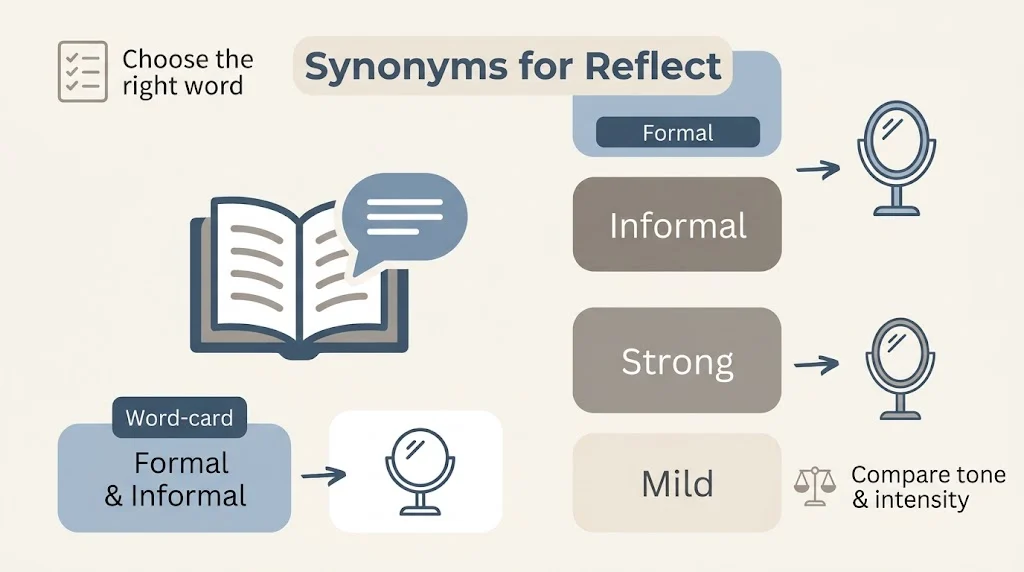
| Word | Meaning | Tone | Intensity | Formality | Best Use Case |
| Consider | Think before deciding | Neutral | Mild | Neutral | Everyday and business decisions |
| Contemplate | Think deeply and steadily | Serious | Moderate | Formal | Essays, personal reflection |
| Ponder | Think slowly and carefully | Thoughtful | Moderate | Neutral-literary | Creative or reflective writing |
| Brood | Dwell on something troubling | Heavy | Strong | Neutral-literary | Emotional or difficult situations |
| Mull over | Think for a while before deciding | Relaxed | Mild-moderate | Informal | Casual decisions |
| Ruminate | Return to a thought repeatedly | Serious | Strong | Formal-literary | Deep or lingering concerns |
The main differences come down to how long and how heavily someone is thinking, plus how formal the surrounding sentence needs to sound. “Consider” and “mull over” describe roughly the same action but at opposite ends of the formality scale, while “brood” and “ruminate” add emotional weight that “ponder” and “contemplate” don’t carry.
Words Similar to Reflect
These words share ground with reflect but don’t always work as direct replacements.
Mirror relates to reflect’s “show or represent” sense rather than its “think about” sense. It works when something visually or figuratively matches another thing, as in “her writing style mirrors her mentor’s.” It doesn’t fit in a sentence about personal thinking.
Introspect is closely related but more specific it always refers to examining your own thoughts or feelings, never external events or other people’s actions.
Analyze overlaps with reflect in the sense of examining something carefully, but it implies a more structured, step-by-step process rather than open ended thought. “Analyze the data” suggests method; “reflect on the data” suggests personal interpretation.
Recall is related because it often happens alongside reflection, but recall specifically means remembering something, not thinking about its meaning or implications.
Antonyms of Reflect
| Antonym | Meaning | Example Sentence |
| Ignore | To pay no attention to something | He chose to ignore the warning signs entirely. |
| Dismiss | To decide something isn’t worth considering | She dismissed the idea without a second thought. |
| Overlook | To fail to notice or consider something | They overlooked an important detail in the contract. |
| Act impulsively | To act without any thought or planning | He acted impulsively and regretted it later. |
How to Choose the Right Synonym for Reflect
Start by checking which sense of reflect you actually mean thinking deeply, or showing/representing something. From there:
- Match the context. Business writing calls for different words than a personal journal entry.
- Match the tone. A word like “brood” fits a heavy topic; it feels out of place in a cheerful sentence.
- Check the intensity. “Consider” is light; “agonize over” is heavy. Don’t reach for a stronger word than the situation actually needs.
- Think about the reader. Academic readers expect words like “contemplate”; casual readers respond better to “think about” or “mull over.”
- Confirm whether the word is an exact synonym or only related. “Mirror” and “reflect” overlap in meaning, but they aren’t interchangeable in every sentence.
- Read the sentence out loud. If a synonym sounds forced or unnatural, it probably needs a simpler word instead.
- When in doubt, choose clarity over complexity. A plain word that fits is always better than an impressive one that doesn’t.
Common Mistakes When Using Synonyms for Reflect
- Choosing a word with the wrong tone. Swapping “think about” for “meditate upon” in a text message will sound odd and overly formal.
- Using a synonym that’s too strong. Saying you “agonized” over picking a restaurant makes a small decision sound like a crisis.
- Using a formal word in casual writing. “Contemplate” can feel stiff in a friendly conversation.
- Using a casual word in professional writing. “Sleep on it” might sound unprofessional in a formal business email.
- Replacing reflect without checking meaning. Not every synonym fits both senses of the word “mirror” won’t work in a sentence about personal thought.
- Treating related words as exact synonyms. Words like “analyze” and “recall” are connected to reflect but aren’t always safe substitutes.
- Forcing an unnatural sentence. If a synonym doesn’t flow naturally, it’s usually better to keep the original word or pick a simpler option.
Quick Synonym List for Reflect
Common synonyms: think about, consider, look back on, weigh, review
Formal synonyms: contemplate, deliberate, meditate upon, introspect, ruminate
Informal synonyms: mull over, chew on, sleep on it, think it through, mull around
Strong synonyms: brood, ruminate, agonize over, dwell on
Mild synonyms: think about, consider, glance back at, look over
Related words: mirror, introspect, analyze, recall
FAQs
What is the best synonym for reflect?
The best general synonym for reflect is consider, since it fits nearly any context and clearly conveys careful thought without sounding too formal or too casual.
What is another word for reflect?
Common alternatives include think about, contemplate, ponder, and mull over, each suited to slightly different tones and settings.
What is a formal synonym for reflect?
Contemplate and deliberate work well in formal writing, since both suggest a serious, structured thought process appropriate for essays, reports, and professional communication.
What is an informal synonym for reflect?
Mull over and sleep on it are natural informal choices, commonly used in everyday conversation and casual writing.
What is a stronger word for reflect?
Brood and ruminate carry more intensity than reflect, often implying repeated or emotionally heavy thinking rather than a single, calm review.
What is a milder word for reflect?
Consider and think about are milder options, suitable when the thinking involved is quick or low-stakes.
What words are similar to reflect?
Mirror, introspect, and analyze are closely related to reflect but carry their own specific meanings, so they don’t always work as direct substitutes.
What is the opposite of reflect?
Common opposites include ignore, dismiss, and overlook, all of which describe giving something no real thought or attention.
Conclusion
Reflect is a flexible word, but its best replacement always comes down to meaning, tone, context, and intensity. Whether you need something formal like “contemplate,” something casual like “mull over,” or something related but distinct like “mirror,” matching the word to the moment is what makes writing feel natural instead of forced.