Quick Answer:
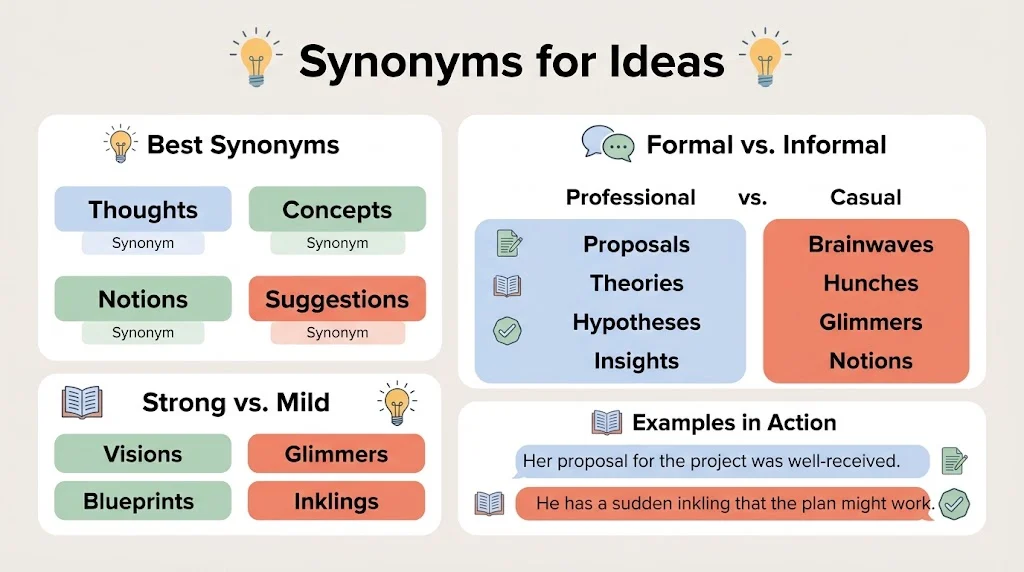
The best synonyms for ideas are thoughts, concepts, notions, and suggestions. If you need a more formal alternative, use proposals or recommendations. For casual conversations, try brainwaves or inklings. The right choice depends on your tone, context, and what exactly you want to express.
Finding the right synonym for “ideas” can make your writing clearer, more precise, and more engaging. Although “ideas” is a common and useful word, it does not always express exactly what you mean. Depending on the context, you may be talking about thoughts, concepts, suggestions, opinions, plans, insights, proposals, or creative notions. Choosing a more specific alternative helps readers understand your meaning without relying on vague or repetitive language. Whether you are writing an essay, business proposal, article, email, or everyday conversation, knowing several alternatives to “ideas” gives you greater flexibility and control over your word choice.
The best synonym depends on the meaning and tone you want to convey. For example, “concepts” works well in academic or professional writing, “suggestions” is useful when offering possible solutions, and “thoughts” sounds natural in casual conversation. Words such as “insights,” “notions,” “proposals,” and “strategies” can add more specific meaning when the situation calls for it. In this guide, you’ll discover useful synonyms for “ideas,” along with their meanings and examples, so you can choose the most natural word for every context.
What Does Ideas Mean?
In simple terms, ideas are thoughts, suggestions, or mental representations of something that could exist or happen. They can be plans, opinions, beliefs, or even vague impressions.
The word “idea” has several common meanings:
- A thought or suggestion about a possible course of action: “I have an idea for a new business.”
- A concept or mental image: “The idea of freedom is powerful.”
- An opinion or belief: “She has some interesting ideas about education.”
- An intention or purpose: “The idea of the game is to score points.”
Common examples:
- “Let me share some ideas for the project.”
- “His ideas about leadership are inspiring.”
- “I have no idea what you mean.”
- “That gives me a rough idea of the costs.”
Core Meaning of Ideas
At its heart, ideas represent mental activity. They are what happens when your mind creates, connects, or processes information. Ideas can be concrete and practical, such as a plan to fix a leaky roof, or abstract and philosophical, such as a theory about human nature.
Ideas form the foundation of creativity, problem solving, communication, and progress. Without ideas, there would be no inventions, no art, no strategies, and no meaningful conversations. They help people make decisions, solve problems, and understand the world around them.
Grammar and Usage Notes
Part of Speech: Noun (plural of idea). Singular forms include idea, thought, concept, etc.
Common Sentence Patterns:
- Have + idea: “Do you have any ideas?”
- Share + ideas: “Let’s share ideas.”
- Come up with + ideas: “She came up with a great idea.”
- Get + idea: “I got the idea from a book.”
- Give + idea: “The diagram gives you an idea of how it works.”
Common Collocations:
- Good ideas, creative ideas, new ideas, bright ideas, wild ideas
- Generate ideas, discuss ideas, exchange ideas, develop ideas
- Brainstorm ideas, bounce ideas off someone, toy with an idea
Tone and Natural Usage:
Ideas works in nearly all contexts, from casual chats to academic papers. However, in professional writing, more specific synonyms often sound more polished. For example, “proposal” sounds stronger than “idea” in a business report.
Best Synonyms for Ideas
| Synonym | Meaning | Tone | Best Use Case | Example Sentence |
| Thoughts | Mental processes or reflections | Neutral | General conversation | “I need to organize my thoughts before the meeting.” |
| Concepts | Abstract or general ideas | Formal | Academic writing | “The course covers key concepts in economics.” |
| Notions | Vague or general ideas | Neutral | Descriptive writing | “She has some old-fashioned notions about marriage.” |
| Suggestions | Ideas offered for consideration | Neutral | Giving advice | “Do you have any suggestions for dinner?” |
| Plans | Detailed ideas for achieving something | Practical | Project planning | “We have plans to expand next year.” |
| Proposals | Formal suggestions or plans | Formal | Business, reports | “The committee reviewed several proposals.” |
| Theories | Ideas intended to explain something | Academic | Scientific writing | “Einstein’s theory changed physics forever.” |
| Brainwaves | Sudden, clever ideas | Informal | Creative moments | “I had a brainwave and solved the puzzle instantly.” |
| Viewpoints | Personal opinions or perspectives | Professional | Discussing opinions | “Everyone shared their viewpoints on the issue.” |
| Perceptions | How something is understood | Formal | Psychology, analysis | “Public perception of the brand is positive.” |
Common Synonyms for Ideas
These everyday synonyms work well in normal conversation and general writing.
Thoughts
Meaning: Mental processes or the contents of your mind.
Best Context: General discussions, personal reflection, or brainstorming.
Example: “Let me gather my thoughts before I respond.”
Notions
Meaning: General or vague ideas, often not fully developed.
Best Context: Describing beliefs, impressions, or opinions that are not deeply analyzed.
Example: “He has some strange notions about healthy eating.”
Suggestions
Meaning: Ideas offered for someone else to consider.
Best Context: Giving advice, making recommendations, or problem-solving.
Example: “I appreciate your suggestions for improving the report.”
Plans
Meaning: Detailed ideas for achieving a specific goal.
Best Context: Project management, goal setting, and practical tasks.
Example: “We have plans to renovate the kitchen next summer.”
Opinions
Meaning: Personal views or judgments about a subject.
Best Context: Discussions, debates, or expressing personal beliefs.
Example: “Everyone has different opinions on this topic.”
Formal Synonyms for Ideas
Use these alternatives in academic writing, business reports, professional communication, or essays. They carry more weight and sophistication than casual synonyms.
Concepts
Meaning: Abstract or general ideas derived from specific instances.
When to Use: Academic papers, theoretical discussions, and professional presentations.
Example: “The training program introduces core marketing concepts.”
Proposals
Meaning: Formal suggestions or plans put forward for consideration or acceptance.
When to Use: Business meetings, project pitches, policy documents, and grant applications.
Example: “The board will vote on the budget proposal tomorrow.”
Recommendations
Meaning: Formal suggestions made by someone with authority or expertise.
When to Use: Reports, advisory documents, performance reviews.
Example: “The consultant gave several recommendations for cutting costs.”
Perceptions
Meaning: How something is understood, interpreted, or regarded.
When to Use: Psychology, sociology, market research, and analysis.
Example: “Consumer perception of the brand shifted after the campaign.”
Theories
Meaning: Systems of ideas intended to explain something, often based on general principles.
When to Use: Scientific writing, academic research, or intellectual discussions.
Example: “The research supports the theory that exercise improves memory.”
Viewpoints
Meaning: Particular attitudes or ways of regarding something.
When to Use: Professional discussions, debates, and analytical writing.
Example: “The article presents several viewpoints on climate policy.”
Informal Synonyms for Ideas
For casual chats, friendly writing, social media posts, and personal messages, these alternatives feel more natural and approachable.
Brainwaves
Meaning: Sudden, brilliant ideas that come unexpectedly.
Tone: Playful and enthusiastic.
Example: “I had a brainwavelet’s take the scenic route home!”
Hunches
Meaning: Intuitive feelings or guesses based on instinct rather than evidence.
Tone: Casual, intuitive.
Example: “I have a hunch we picked the right candidate.”
Inklings
Meaning: Slight suspicions or vague ideas about something.
Tone: Soft, tentative.
Example: “I had an inkling he might be late, so I brought a book.”
Gut Feelings
Meaning: Instinctive emotional reactions, often without rational basis.
Tone: Very informal, emotional.
Example: “My gut feeling says we should go with the first option.”
Whims
Meaning: Sudden, often unusual ideas or desires, especially impulsive ones.
Tone: Light, playful.
Example: “On a whim, she booked a trip to Japan.”
Strong Synonyms for Ideas
These synonyms carry more intensity, force, or conviction. Use them when you want to emphasize the power, creativity, or boldness of an idea.
Visions
Meaning: Vivid, imaginative ideas about the future or possibilities.
Intensity: Highsuggests creativity and foresight.
Example: “The founder had a vision for a sustainable future.”
Breakthroughs
Meaning: Major, innovative ideas that overcome significant obstacles.
Intensity: Very highimplies game-changing impact.
Example: “The new drug is a breakthrough in cancer treatment.”
Concepts (when used with conviction)
Meaning: Foundational ideas that structure thinking.
Intensity: Moderate to highimplies substance.
Example: “The architect’s concepts transformed urban design.”
Blueprints
Meaning: Detailed plans or strategies that serve as guides.
Intensity: Highsuggests thoroughness and practicality.
Example: “We have a blueprint for scaling the business.”
Strategies
Meaning: Careful plans for achieving success in complex situations.
Intensity: Highimplies thoughtfulness and purpose.
Example: “Their marketing strategy doubled their sales.”
Mild Synonyms for Ideas
When your idea is tentative, vague, or still forming, these softer words fit better.
Inklings
Meaning: Faint or slight ideas, barely formed.
Tone: Soft, uncertain.
Example: “I have an inkling of what’s going on, but not the full picture.”
Whispers
Meaning: Very faint or subtle suggestions of an idea.
Tone: Poetic, gentle.
Example: “There are whispers of a new policy, but nothing confirmed.”
Traces
Meaning: Very small amounts or signs of an idea.
Tone: Minimal, cautious.
Example: “There’s a trace of a pattern here, but I need more data.”
Seeds
Meaning: Beginning stages of an idea before it develops.
Tone: Gentle, hopeful.
Example: “Her speech planted seeds of change in the community.”
Glimmers
Meaning: Faint signs of an idea beginning to form.
Tone: Optimistic, tentative.
Example: “We have a glimmer of a solution, but it needs work.”
Synonyms for Ideas by Context
Everyday Conversation
- Thoughts: “I’ve been having some thoughts about that.”
- Notions: “Where did you get that notion?”
- Brainwaves: “I just had a brainwave!”
- Hunches: “I have a hunch about this.”
Professional Writing
- Concepts: “This section explains the core concepts.”
- Proposals: “We will submit a proposal next week.”
- Strategies: “Our strategy focuses on long-term growth.”
- Viewpoints: “Several viewpoints were expressed.”
Academic Writing
- Theories: “Several theories explain this phenomenon.”
- Concepts: “The concept of democracy is central to the discussion.”
- Hypotheses: “The researchers tested their hypothesis.”
- Paradigms: “This represents a paradigm shift in the field.”
Creative Writing
- Visions: “She had visions of a different world.”
- Notions: “He clung to notions of romantic love.”
- Whims: “Her whims led her on unexpected adventures.”
- Imagination: “His imagination produced endless possibilities.”
Marketing Copy
- Concepts: “Our concept combines style with function.”
- Visions: “We share a vision for a better future.”
- Strategies: “Our strategy focuses on customer satisfaction.”
- Themes: “The campaign’s theme resonates with audiences.”
Emotional Expression
- Feelings: “I have mixed feelings about this.”
- Convictions: “She held strong convictions about justice.”
- Beliefs: “His beliefs shaped every decision.”
- Sentiments: “The sentiment was unanimous.”
Another Word for Ideas in a Sentence
Here are 15 examples showing how to use synonyms for ideas naturally.
- After hours of brainstorming, we finally produced some concepts for the project.
- Please share your suggestions with the team during the meeting.
- The professor introduced several new theories in the lecture.
- Her visions for the company were ambitious but practical.
- I have a hunch that the answer lies in the data.
- The marketing team’s blueprint won the client’s trust.
- He has some unusual notions about raising children.
- The committee reviewed our proposals and approved them.
- She had a sudden brainwave and solved the problem instantly.
- We need to hear all viewpoints before deciding.
- The organization’s strategy doubled its membership.
- Her convictions never wavered, even under pressure.
- I want to get your opinions on the new design.
- The artist’s visions were expressed in vivid colors.
- There’s a whisper of a new initiative, but nothing official.
Ideas Synonyms Compared
These words are close in meaning but differ in nuance. Understanding the differences helps you choose the right one.
| Synonym | Meaning | Tone | Key Difference |
| Thoughts | Mental content, reflections | Neutral | Broadest term, includes all mental activity |
| Notions | Vague, general ideas | Neutral | Less concrete than thoughts, often unproven |
| Concepts | Abstract, generalized ideas | Formal | More theoretical, often complex |
| Suggestions | Ideas offered to others | Neutral | Implies giving advice or options |
| Plans | Action-oriented ideas | Practical | More structured and detailed |
| Proposals | Formal suggestions | Formal | Usually written, for approval |
| Theories | Ideas that explain | Academic | Requires testing or evidence |
| Brainwaves | Sudden, creative ideas | Informal | Spontaneous and clever |
Words Similar to Ideas
These terms belong to the same semantic field but are not exact synonyms. They are related and can sometimes replace “ideas” depending on context.
Creativity
Related because ideas often arise from creative thinking. However, creativity is a skill or trait, not a specific thought.
- Best Use: Discussing innovation or artistic production.
- Why Not Exact: Creativity is an ability; ideas are products of that ability.
Inspiration
Related because ideas often come from moments of inspiration. Inspiration is the trigger, not the idea itself.
- Best Use: Discussing motivation or where ideas originate.
- Why Not Exact: Inspiration is a feeling or influence; ideas are mental constructs.
Imagination
Related because imagination helps generate ideas. However, imagination is the mental faculty, not the thought.
- Best Use: Creative contexts.
- Why Not Exact: Imagination is the capacity; ideas are the results.
Perspective
Related because ideas often reflect personal perspectives.
- Best Use: Discussions of opinion or interpretation.
- Why Not Exact: Perspective is a viewpoint; ideas can be broader.
Antonyms of Ideas
Understanding opposites clarifies the meaning.
| Antonym | Meaning | Example Sentence |
| Fact | Something known to be true; not just a thought. | “We need facts, not just ideas.” |
| Reality | The actual state of things. | “Let’s focus on reality, not abstract ideas.” |
| Evidence | Proof or data supporting a claim. | “We need evidence, not vague ideas.” |
| Certainty | Complete confidence or knowledge. | “He wants certainty, not mere ideas.” |
| Ignorance | Lack of knowledge or awareness. | “Her ignorance prevented her from forming useful ideas.” |
How to Choose the Right Synonym for Ideas
Selecting the best synonym depends on several factors.
- Match the Context: Formal writing needs formal synonyms like proposals or concepts. Casual conversations welcome brainwaves or notions.
- Match the Tone: Consider your overall tone. A serious report needs serious words; a friendly email should stay light.
- Check the Intensity: Does your idea feel bold and visionary? Use vision or breakthrough. Is it tentative? Choose inkling or seed.
- Think About Your Reader: What would they understand best? Simple words often work better than fancy ones.
- Check If the Synonym Is Exact: Not every related word is a perfect replacement. Creativity is not the same as idea. Make sure the synonym fits the specific meaning you intend.
- Keep the Sentence Natural: If the synonym sounds awkward or forced, try a different option. Natural flow always beats technical precision.
Common Mistakes When Using Synonyms for Ideas
Avoid these pitfalls when swapping synonyms.
Choosing the Wrong Tone
Mixing formal and informal can confuse readers. Don’t use concepts in casual texts or brainwaves in business reports unless the tone fits.
Using a Synonym That Is Too Strong
Breakthrough and vision carry heavy meaning. If your idea is small or simple, these words sound exaggerated. Use suggestion or plan instead.
Using a Synonym That Is Too Mild
Conversely, don’t downplay a significant idea with weak words. A major strategic decision deserves strategy or blueprint, not notion.
Treating Related Words as Exact Synonyms
Creativity and imagination are related to ideas but are not direct synonyms. Use them only when they accurately convey your meaning.
Making the Sentence Sound Unnatural
If a synonym feels forced, it probably is. Native speakers trust their ear. If the word sounds off, choose a more natural alternative.
Quick Synonym List for Ideas
Common:
- Thoughts
- Notions
- Suggestions
- Plans
- Opinions
Formal:
- Concepts
- Proposals
- Recommendations
- Theories
- Viewpoints
Informal:
- Brainwaves
- Hunches
- Inklings
- Gut feelings
- Whims
Strong:
- Visions
- Breakthroughs
- Blueprints
- Strategies
Mild:
- Whispers
- Traces
- Seeds
- Glimmers
Related Words:
- Creativity
- Imagination
- Inspiration
- Perspective
- Belief
FAQs
What is the best synonym for ideas?
The best synonym depends on the context. For general use, thoughts, concepts, and notions work well. For formal writing, proposals and recommendations are excellent.
What is another word for ideas in a professional context?
In a professional setting, try concepts, proposals, strategies, or recommendations. These sound polished and clear.
What is a formal synonym for ideas?
The most common formal synonyms include concepts, theories, proposals, and viewpoints. These work in academic, business, and government contexts.
What is an informal synonym for ideas?
Informal alternatives include brainwaves, hunches, inklings, and whims. These are great for casual conversations and friendly writing.
What are stronger alternatives for ideas?
Use visions, breakthroughs, blueprints, or strategies to convey power and impact. These words suggest the idea is significant or game-changing.
What is a milder or softer word for ideas?
Inklings, seeds, glimmers, and whispers are softer and suit tentative or vague thoughts.
What words are similar to ideas?
Related terms include creativity, inspiration, imagination, and perspective. These belong to the same semantic field but are not exact synonyms.
What is the opposite of ideas?
Antonyms include facts, reality, evidence, certainty, and ignorance. These represent the opposite of mental concepts or proposals.
How do I choose the right synonym for ideas?
Consider context, tone, intensity, and your reader. Match the synonym to the situation. Formal writing calls for formal synonyms; casual conversations suit informal alternatives.
Conclusion
The English language offers many alternatives for “ideas.” The best choice depends on what you want to say, who you are saying it to, and how you want to say it. Use this guide to find the perfect word for any situation. Whether you need something formal, informal, strong, mild, or context-specific, there is a synonym ready for the job. Choose wisely, and your writing will become clearer, stronger, and more engaging.