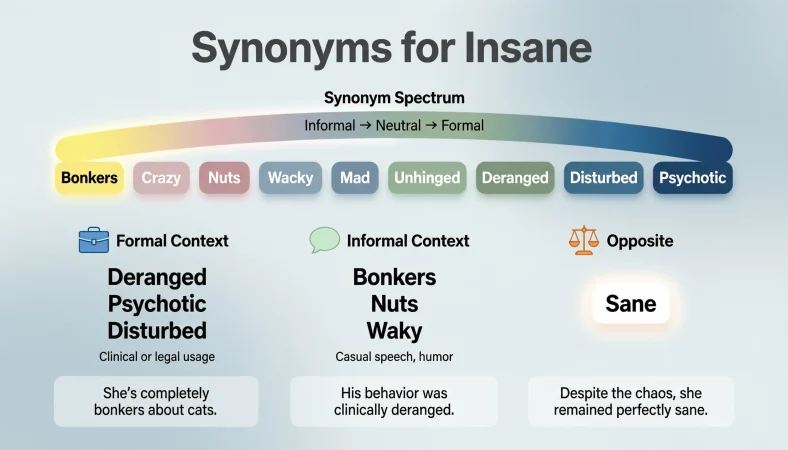
The best synonyms for “insane” are mentally ill (formal/clinical), crazy (informal/general), absurd (for foolish ideas), deranged (for disturbed behavior), and bonkers (playful/casual). The right choice depends on tone, context, and intensity.
The best synonyms for “insane” depend heavily on what you are trying to say and who your audience is. If you mean mentally unwell, appropriate terms include “mentally ill,” “psychotic,” or “deranged.” For describing foolish actions, words like “absurd,” “reckless,” or “harebrained” work well.
In casual conversation, you might use “crazy,” “bonkers,” or “nuts” to describe something extreme or surprising. This guide breaks down all of these synonyms for insane by meaning, tone, context, and intensity, helping you choose the right word every time.
What Does Insane Mean?
“Insane” is an adjective with several distinct meanings, each carrying different connotations and levels of formality.
In its most formal sense, the word means suffering from a severe mental illness that prevents normal thinking or behavior . However, this usage is now often considered offensive, with “mentally ill” preferred in modern contexts . The term still appears in legal phrases like “criminally insane” or “temporarily insane” .
In informal use, “insane” describes something very foolish, unreasonable, or dangerous. “I must have been insane to agree to that idea” . It can also mean extremely annoying (“This noise is driving me insane”) or shockingly impressive (“The prices are insane”) .
Examples:
- The court declared him criminally insane and unfit to stand trial.
- That was an insane risk to take on the highway.
Core Meaning of Insane
At its core, the word “insane” expresses a departure from soundness—whether of mind, judgment, or reason. The word comes from the Latin insanus, a combination of *in-* (not) and sanus (healthy or sane) . This origin captures the two primary uses: a medical/legal condition and a more general lack of good sense.
Modern usage has expanded. People often use “insane” informally to express disbelief, excitement, or frustration. Describing a sale as “insane” means it was remarkably good or extreme, not that it was mentally ill. This flexibility makes it a common word, but also a loaded one that requires careful selection of alternatives.
Grammar and Usage Notes
Part of speech: Adjective (insane, more insane, most insane).
Common phrases:
- “Go insane” (become mentally ill or extremely annoyed)
- “Drive someone insane” (annoy someone greatly)
- “Criminally insane” (legal term)
- “Insane asylum” (now outdated and offensive; use “mental hospital” or “psychiatric facility”)
- “Insane amount of…” (very large amount)
When “insane” sounds natural:
The word works well in informal conversation, creative writing dialogue, or when expressing strong emotion. It also fits in legal contexts when used correctly .
When a synonym may work better:
Avoid using “insane” to describe a person with a mental illness in everyday conversation. It is considered offensive, and “mentally ill” or “experiencing mental health issues” are more respectful . Choose a synonym based on the level of formality and the specific nuance you need—whether you mean mentally unwell, foolish, reckless, or extreme.
Best Synonyms for Insane
| Synonym | Meaning | Tone | Best Use Case | Example Sentence |
| Mentally ill | Having a mental health condition | Formal/Clinical | Medical or respectful contexts | She has been diagnosed as mentally ill and receives treatment. |
| Crazy | Mentally unstable or very foolish | Informal | Everyday conversation, casual writing | That’s a crazy idea, but it just might work. |
| Deranged | Disturbed, behaving in a chaotic way | Formal/Serious | Describing dangerous or severe behavior | The deranged man was shouting threats on the street corner. |
| Absurd | Wildly unreasonable or illogical | Formal/Neutral | Critiquing ideas or plans | It’s absurd to think we can finish this project in one day. |
| Reckless | Acting without caution or thought | Formal/Neutral | Describing dangerous actions | His reckless driving endangered everyone on the road. |
| Bonkers | Crazy or silly | Very Informal/Playful | Friendly or humorous contexts | I must be bonkers for agreeing to run a marathon with no training. |
| Nuts | Crazy, foolish, or enthusiastic | Slang/Informal | Casual speech with friends | My friends thought I was nuts to quit my job and travel. |
| Psychotic | Suffering from psychosis | Formal/Clinical | Medical or psychological descriptions | He was diagnosed with a psychotic disorder. |
Common Synonyms for Insane
These everyday synonyms fit well in normal writing and conversation. Each has a slightly different shade of meaning, so choose based on your specific context.
Crazy
A versatile and common word for someone acting irrationally or an idea that seems foolish . It can be playful or serious depending on tone.
Example: “My schedule this week is absolutely crazy.”
Mad
Similar to “crazy,” this word can mean mentally ill, angry, or very enthusiastic. It is more common in British English for “crazy” and American English for “angry” .
Example: “He must be mad to spend that much money on a car.”
Loco
An informal, often playful term derived from Spanish slang meaning “crazy” .
Example: “You’re loco if you think I’m going to jump off that cliff.”
Formal Synonyms for Insane
For academic papers, professional communication, business reports, or any formal setting, these synonyms are more appropriate. They avoid the casual or potentially offensive connotations of “insane.”
Mentally ill
This is the respectful and medically accurate term for someone living with a mental health condition . Use this when discussing mental health in a serious or professional context.
Example: “The policy aims to improve care for people with mental illness.”
Deranged
Describes someone whose mind is in a state of extreme disturbance or disorder, often implying dangerous or irrational behavior .
Example: “The deranged attacker was quickly apprehended by police.”
Unhinged
This word suggests someone has become unstable or mentally unbalanced, often due to shock or stress .
Example: “The shocking news left him temporarily unhinged.”
Psychotic
A clinical term for someone suffering from psychosis, a severe mental disorder where thoughts and emotions are impaired . Use this only when speaking medically.
Example: “The patient was exhibiting psychotic symptoms.”
Irrational
This describes a lack of reason or logic, rather than mental illness. It is a neutral word suitable for critiques of ideas or behavior .
Example: “Her fear of flying is completely irrational, but very real to her.”
Informal Synonyms for Insane
These alternatives are great for conversations, personal messages, social media, and friendly writing. They are not suitable for formal or professional contexts.
Bonkers
A playful, fun word meaning “crazy” or “silly.” It has a lighthearted tone and often implies something is absurdly funny or unbelievable .
Example: “The fans went absolutely bonkers when the band came on stage.”
Nuts
A common slang word meaning crazy, foolish, or extremely enthusiastic .
Example: “He’s nuts about that new video game.”
Batty
A slightly dated but still understandable slang term for someone who is crazy or eccentric .
Example: “Stop that batty talk; you’re making no sense.”
Loco
As mentioned, this playful slang word is often used affectionately or in jest .
Example: “We all went a little loco during the final exam week.”
Strong Synonyms for Insane
These synonyms carry more intensity, power, and emotion. They often describe severe states of mind or extreme actions and should be used sparingly to avoid exaggeration.
Maniacal
Suggests a wild, frenzied, and often dangerous state of mind. It evokes images of uncontrolled behavior or obsession .
Example: “A maniacal laugh echoed through the empty room.”
Demented
Refers to a severe state of mental deterioration, such as that caused by dementia. It can also describe extremely foolish or wicked ideas .
Example: “That was a demented plan that could have gotten us all arrested.”
Frenzied
This word doesn’t imply mental illness but describes a state of wild or uncontrolled activity, emotion, or excitement.
Example: “The stock market saw frenzied trading as the news broke.”
Berserk
To go berserk means to become violently out of control or enraged .
Example: “My boss went berserk when he saw the sales figures.”
Mild Synonyms for Insane
When you need a softer, more neutral, or less aggressive alternative, consider these words.
Foolish
This is a mild, straightforward way to describe a lack of good judgment without the dramatic connotation of “insane” .
Example: “It was a foolish mistake, but we all make them.”
Unreasonable
This neutral word simply means not based on or consistent with reason. It is a polite way to critique a plan or a person’s expectations .
Example: “His demands are completely unreasonable.”
Senseless
Describes something that lacks meaning, purpose, or good judgment .
Example: “The violence was a senseless act.”
Absurd
As mentioned, this describes something wildly illogical or ridiculous. It is formal and feels intellectual .
Example: “The idea that the earth is flat is absurd.”
Unsound
This means not healthy or firm, often used to describe a person’s mental state or an idea’s logic .
Example: “His theory is fundamentally unsound.”
Synonyms for Insane by Context
The perfect word for “insane” depends heavily on the context. Here is how to choose the right synonym for your specific situation.
Everyday Conversation
In casual chats with friends or family, you want words that feel natural and expressive. “Crazy” is the go-to choice, but “bonkers,” “nuts,” and “loco” add color and humor. Use these for everyday exaggerations and playful banter.
Professional Writing
For business reports, emails, or professional memos, “insane” is almost never appropriate. Instead, choose neutral terms like “unreasonable,” “foolish,” or “unsound” to critique a decision. For mental health in a workplace context, always use “mental health” or “psychological” terminology professionally.
Academic Writing
This is where precision matters most. In psychology, medicine, or law, use formal and clinical terms like “psychotic,” “deranged,” or “mentally ill.” In a philosophy paper, you might argue an “irrational” or “absurd” point. Avoid slang or informal words entirely.
Creative Writing
Synonyms become tools for characterization and tone. A “deranged” villain creates terror, a “maniacal” laugh suggests madness, and a “bonkers” scheme fits a comedy. The best creative choice depends on the atmosphere you are building.
Emotional Expression
When describing how you feel, choose words that match your intensity. “Frenzied” works for a stressful period, “frustrated” for mild annoyance, and “crazy” for feeling overwhelmed. For serious emotional distress, terms like “unhinged” or “going insane” are appropriate, but consider using more descriptive mental health language when discussing real issues.
Another Word for Insane in a Sentence
- His crazy plan to build a treehouse in a week actually succeeded.
- The new film features a deranged villain with a tragic backstory.
- After a 16-hour shift, my tired mind felt completely unhinged.
- My daughter is absolutely bonkers about that new pop star.
- The claim that the company was bankrupt was utterly absurd.
- Witnesses described the frenzied crowd trying to escape the building.
- It seems foolish to invest all your savings in one risky stock.
- The dictator ruled with a maniacal desire for absolute power.
- My friends thought I was nuts for choosing to hike the mountain in winter.
- The lawyer argued his client was temporarily insane during the incident.
- She holds the irrational belief that the number 13 is pure evil.
- We couldn’t believe the insane amount of food at the buffet.
- The demented criminal showed no remorse for his actions.
- Cutting the education budget now seems senseless.
Insane Synonyms Compared
Crazy vs. Mad
“Crazy” is the standard American English word, while “mad” is more common in British English for meaning “crazy” . In American English, “mad” usually means “angry.” Both can express foolishness or mental instability.
Deranged vs. Unhinged
“Deranged” implies a chronic or severe disturbance, while “unhinged” suggests a more temporary state caused by shock or stress. Both are serious, but “unhinged” feels more immediate.
Maniacal vs. Frenzied
“Maniacal” focuses on a crazed state of mind, while “frenzied” describes a state of frantic activity. You can be in a “frenzied” rush without being “maniacal.”
Bonkers vs. Nuts
These are both playful slang terms, but “bonkers” has a slightly more ridiculous and fun connotation. “Nuts” can also mean very enthusiastic about something, while “bonkers” is usually reserved for silly or extreme behavior .
Words Similar to Insane
These words belong to the same semantic field but are not always exact synonyms. They are related through meaning, context, or association.
Eccentric
Describes someone who is unconventional or odd, but not mentally ill. It’s a gentler word often used to describe creative or quirky people. An “eccentric” person is not “insane”; they just march to a different beat.
Delusional
This means holding false beliefs despite clear evidence. It is a symptom of psychosis but can also describe everyday stubbornness (“He is delusional if he thinks he can win”). It is related but more specific.
Criminally Insane
A specific legal term for a defendant who was insane at the time of a crime and therefore not legally responsible for their actions . This is a legal status, not a general descriptive word.
Mentally Unstable
A broad term meaning a person’s mental state is not stable or consistent. It is less clinical than “mentally ill” and can describe temporary states. It is a common phrase in media but should be used carefully.
Antonyms of Insane
| Antonym | Short Meaning | Example Sentence |
| Sane | Having a sound, healthy mind | He was the only sane person in the chaotic office. |
| Rational | Based on reason or logic | Her decision to leave was calm and rational. |
| Reasonable | Fair and sensible | A reasonable person would not make that demand. |
| Lucid | Having a clear mind | Despite his age, he remains completely lucid. |
| Sound | Healthy and free from defect | She has a sound mind and a strong body. |
How to Choose the Right Synonym for Insane
Selecting the best synonym is a simple process of asking yourself a few questions.
Match the Context
Will you be speaking to a friend or writing to your boss? A formal setting calls for “irrational” or “unreasonable,” while a casual one allows “crazy” or “bonkers.
Match the Tone
Do you want to sound playful, serious, or neutral? “Bonkers” is lighthearted, while “deranged” is grim. Choose the word that fits the mood.
Check the Intensity
Are you describing a mild foolishness or a state of severe distress? “Foolish” is mild, “maniacal” is strong. Using a strong word for a mild situation is melodramatic.
Think About Your Reader
Will your audience find certain words offensive? Using “insane” or “crazy” to describe a person with a mental illness is inappropriate. Choose respectful language.
Check the Meaning
Is the word an exact fit, or is it just related? “Eccentric” is not a synonym for “insane.” It’s important to use precise language.
Keep the Sentence Natural
If the synonym makes the sentence awkward, try a different one. Good writing sounds effortless.
Clarity Comes First
Simple, clear words are often more powerful than fancy ones. When in doubt, choose the word your reader will instantly understand.
Common Mistakes When Using Synonyms for Insane
Using the Wrong Tone
Saying a corporate business plan is “bonkers” sounds unprofessional. Calling your friend’s new haircut “deranged” is far too extreme and might hurt their feelings.
Using a Synonym that is Too Strong
Don’t call your friend’s nervousness “psychotic.” That word describes a severe mental condition. Use “nervous” or “anxious.”
Using a Formal Word in Casual Writing
Telling your friend their outfit is “irrational” is weird. Say it is “crazy” or “wild” in a good way.
Using a Casual Word in Professional Writing
Calling a colleague’s idea “nuts” in a meeting can sound disrespectful. Say it is “unreasonable” or “unviable.”
Treating Related Words as Exact Synonyms
“Eccentric” is related to “insane” but is not a synonym. Using them interchangeably is incorrect.
Making the Sentence Sound Unnatural
Don’t force a big word into a simple sentence. It’s better to sound clear than to try to sound smart.
Quick Synonym List for Insane
- Common synonyms: crazy, mad, loco, nuts
- Formal synonyms: mentally ill, deranged, unhinged, psychotic, irrational
- Informal synonyms: bonkers, batty, loony
- Strong synonyms: maniacal, demented, frenzied, berserk
- Mild synonyms: foolish, unreasonable, senseless, absurd, unsound
- Related words: eccentric, delusional, mentally unstable
FAQs
What is the best synonym for insane?
The best synonym depends on your context. For informal use, “crazy” works well. For formal writing, use “irrational” or “unreasonable.” For mental health contexts, use “mentally ill.” There is no single perfect synonym.
What is another word for insane?
Many words can replace “insane.” Some common ones are “crazy,” “mad,” “deranged,” and “bonkers.” The right choice depends on tone and context.
What is a formal synonym for insane?
Formal alternatives include “mentally ill,” “deranged,” “unhinged,” “psychotic,” and “irrational.” These words are suitable for academic, business, or professional writing.
What is an informal synonym for insane?
“Crazy,” “bonkers,” “nuts,” “loco,” and “batty” are informal synonyms. They are perfect for casual conversation and social media .
What is a stronger word for insane?
“Deranged,” “maniacal,” “demented,” and “frenzied” are stronger synonyms. They carry more intensity and are often used to describe severe, extreme, or dangerous behavior.
What is a milder word for insane?
“Foolish,” “unreasonable,” “absurd,” and “senseless” are milder alternatives. They are better for polite or neutral critiques of ideas or actions.
What words are similar to insane?
“Eccentric,” “delusional,” and “mentally unstable” are related words. They belong to the same semantic field but are not always exact synonyms.
What is the opposite of insane?
The main antonyms are “sane,” “rational,” “reasonable,” and “lucid.” These words describe a sound and healthy state of mind.
How do I choose the right synonym for insane?
First, think about the formality of the situation. Then, consider the intensity you want to convey and the reaction you want from the reader. Finally, choose the word that makes your sentence sound natural.
Conclusion
“Insane” is a word with many layers of meaning, from a clinical mental health diagnosis to an informal expression of excitement. This flexibility means it has many synonyms, each suited to different contexts, tones, and levels of intensity. The best way to choose is to consider your audience and your message.
For professional and serious writing, “irrational,” “unreasonable,” or “deranged” are precise and respectful. For casual conversation, “crazy,” “bonkers,” or “nuts” work perfectly. Using precise language is key to effective communication, and now you have the tools to pick the perfect synonym for “insane” every time.