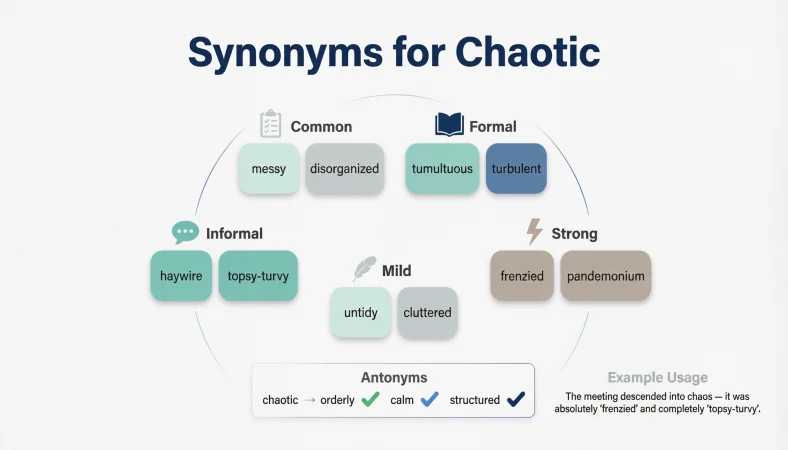
The best synonyms for chaotic are disorganized, tumultuous, frenetic, and haphazard. Disorganized works for messy spaces or unplanned events. Tumultuous fits emotional or noisy situations. Frenetic describes fast-paced, frantic energy. Haphazard works for things that lack planning or pattern. The right choice depends on tone, context, and intensity.
The word “chaotic” gets used a lot maybe too much. When everything feels out of control, messy, or unpredictable, chaotic is often the first word that comes to mind. But it’s not always the best choice. Finding the right synonyms for chaotic can help you describe situations more precisely, match your tone to your audience, and avoid repetitive language.
The best synonym depends on what you’re describing, how strong you want to sound, and whether you’re writing for a formal report or a casual conversation.
What Does Chaotic Mean?
At its core, chaotic describes a state of complete disorder and confusion. It refers to situations, spaces, or systems that lack structure, predictability, or control.
Part of speech: adjective
Common usage:
- Describing physical spaces: “Her desk was chaotic.”
- Describing events or situations: “The meeting turned chaotic.”
- Describing systems or processes: “The old filing system was chaotic.”
- In science: describing systems sensitive to initial conditions (chaos theory)
- “The scene at the train station during the strike was completely chaotic.”
- “His schedule is so chaotic that he never knows where he’ll be from one hour to the next.”
Core Meaning of Chaotic
Chaotic isn’t just about being messy—it implies a lack of order that makes things hard to understand, manage, or predict. When something is chaotic, there’s no clear pattern, no obvious structure, and often no one in control. The chaos can be physical (a messy room), emotional (a chaotic mind), social (a chaotic protest), or even scientific (a chaotic weather system).
Think of the difference between a busy office and a chaotic one. A busy office has lots of activity, but there’s still a system—people know where things are, meetings happen on schedule, work gets done. A chaotic office is the opposite: papers everywhere, missed appointments, no one knows who’s doing what. That’s the extra layer of meaning chaotic carries: not just activity, but a breakdown of order.
Grammar and Usage Notes
Chaotic functions as an adjective, so it modifies nouns: a chaotic scene, chaotic energy, a chaotic process. It can also appear in predicate position: “The situation became chaotic.”
Common collocations:
- Chaotic scene
- Chaotic environment
- Chaotic situation
- Chaotic system (especially in science)
- Descend into chaos (noun form)
When chaotic sounds natural:
- Describing events that feel overwhelming, confusing, or out of control
- Talking about physical spaces that are extremely disorganized
- Referencing systems that lack predictability
When a synonym may work better:
- When you need a more formal or academic word
- When you want to emphasize speed rather than confusion
- When you need a milder word for a less intense situation
- When you want to describe a specific type of disorder (noisy, messy, unpredictable, etc.)
Best Synonyms for Chaotic
| Synonym | Meaning | Tone | Best Use Case | Example Sentence |
| Disorganized | Lacking order or planning | Neutral, common | Describing messy spaces, unplanned events, or poor systems | “The files were so disorganized that no one could find anything.” |
| Tumultuous | Noisy, excited, and disorderly | Formal, dramatic | Describing emotional events, protests, or intense situations | “The country experienced a tumultuous period of political change.” |
| Frenetic | Fast-paced, frantic, and disordered | Energetic, vivid | Describing busy, high-energy situations | “The office was frenetic as everyone rushed to meet the deadline.” |
| Haphazard | Lacking plan or order; random | Neutral, descriptive | Describing things done without planning or care | “The books were arranged in a haphazard way across the shelves.” |
| Anarchic | Without rules or control | Strong, political | Describing situations with no authority or structure | “The classroom became anarchic when the teacher left the room.” |
| Pandemonium-like | Wild and noisy disorder | Vivid, descriptive | Describing scenes of loud, chaotic confusion | “The stadium erupted into pandemonium-like chaos when the team scored.” |
Common Synonyms for Chaotic
These are everyday words you can use in normal writing and conversation.
Messy
Meaning: Untidy or dirty; lacking neatness.
Best context: Describing physical spaces, appearances, or situations that are visibly cluttered.
Example: “Her apartment was messy, with clothes and books covering every surface.”
Disordered
Meaning: Lacking order or organization; confused.
Best context: Formal or clinical descriptions of spaces, systems, or mental states.
Example: “The patient’s disordered thinking made it hard for her to hold a conversation.”
Confused
Meaning: Mixed up and unclear; lacking clarity.
Best context: Describing situations, communication, or mental states that lack clear structure.
Example: “After the power went out, the evacuation plans were confused and ineffective.”
Uncontrolled
Meaning: Not restrained or managed; out of hand.
Best context: Describing situations or emotions that have escalated beyond management.
Example: “Uncontrolled spending had pushed the company to the brink of bankruptcy.”
Wild
Meaning: Unrestrained, excited, or disorderly.
Best context: Casual descriptions of parties, crowds, or behavior.
Example: “The party got wild after midnight, with people dancing on tables.”
Formal Synonyms for Chaotic
For academic writing, business reports, essays, and professional communication, these formal alternatives work well.
Tumultuous
Meaning: Marked by disturbance, uproar, or violent disorder.
When it works best: Describing historical periods, political situations, or emotional events in formal writing.
Example: “The company’s tumultuous first year saw three CEOs come and go.”
Turbulent
Meaning: In a state of agitation or tumult; disturbed.
When it works best: Describing unstable markets, political climates, or emotional periods in professional contexts.
Example: “Investors were wary during the turbulent economic quarter.”
Disorganized (Formal Context)
Meaning: Functioning without adequate order or systemization.
When it works best: Describing poorly managed operations, systems, or structures in reports or analyses.
Example: “The disorganized approach to data management created significant inefficiencies.”
Unsystematic
Meaning: Lacking a system, method, or plan.
When it works best: Academic or technical writing about processes or methods.
Example: “The unsystematic collection of evidence undermined the study’s findings.”
Informal Synonyms for Chaotic
For conversations, social media, friendly writing, and personal messages, these casual alternatives work well.
All Over the Place
Meaning: Very disorganized or confused; lacking focus.
Tone: Casual, conversational.
Example: “My thoughts are all over the place this morning—I can’t focus on anything.”
Haywire
Meaning: Out of control or order; malfunctioning.
Tone: Playful or frustrated.
Example: “Our weekend plans went haywire after the car broke down.”
Topsy-Turvy
Meaning: Upside down; in complete disorder.
Tone: Lighthearted, slightly old-fashioned.
Example: “The kids turned the living room topsy-turvy while we were out.”
Helter-Skelter
Meaning: In headlong and disorderly haste; rushed confusion.
Tone: Vivid, somewhat dramatic.
Example: “We packed our bags helter-skelter and barely caught the train.”
At Sixes and Sevens
Meaning: In confusion and disorder.
Tone: Idiomatic, conversational.
Example: “The office has been at sixes and sevens since the renovation started.”
Strong Synonyms for Chaotic
These carry more emotional weight, intensity, or emphasis. Use them when you need to describe truly extreme disorder. Be careful—they can sound exaggerated if used too casually.
Frenzied
Meaning: Wildly excited or uncontrolled; frantic.
When to use: Describing extreme emotional states, panic, or intense activity.
Example: “The frenzied shoppers pushed through the doors the moment they opened.”
Pandemonium
Meaning: Wild and noisy disorder or confusion; uproar.
When to use: Describing scenes of total chaos, especially in crowds or public events.
Note: Though a noun, it’s often used to describe a scene: “It was pandemonium.”
Example: “Pandemonium broke out when the concert was cancelled.”
Riotous
Meaning: Characterized by rioting or disturbance; wildly disorderly.
When to use: Describing events that are out of control, often involving groups.
Example: “The celebration turned riotous, with fireworks exploding everywhere.”
Deranged
Meaning: Wildly disordered or irrational.
When to use: Describing extreme mental or behavioral disorder (use with care).
Example: “His deranged schedule left him sleeping only three hours a night.”
Mild Synonyms for Chaotic
These are softer, more neutral alternatives for when chaotic sounds too dramatic or strong.
Untidy
Meaning: Not tidy or neat; slovenly; disordered.
When mild wording works better: Describing a messy space without the drama.
Example: “The guest room was untidy, but nothing a quick clean couldn’t fix.”
Cluttered
Meaning: Crowded with disorderly things.
When mild wording works better: Describing spaces that are crowded but not necessarily chaotic.
Example: “Her desk was cluttered with papers, mugs, and sticky notes.”
Mixed-Up
Meaning: Confused and disordered.
When mild wording works better: Describing thoughts, schedules, or minor disorganization.
Example: “I got the appointment times mixed-up and showed up an hour late.”
Irregular
Meaning: Not following a pattern; lacking regularity.
When mild wording works better: Describing schedules, patterns, or processes with inconsistency.
Example: “His irregular sleep schedule made mornings difficult.”
Synonyms for Chaotic by Context
Everyday Conversation
- Messy for physical spaces
- All over the place for disorganized thoughts or plans
- Crazy for overwhelming situations (informal)
Professional Writing
- Tumultuous for periods of change or disruption
- Disorganized for processes or systems
- Erratic for unpredictable behavior or patterns
Academic Writing
- Unsystematic for research methods or approaches
- Disordered for structural descriptions
- Turbulent for social or political analysis
Creative Writing
- Frenetic for high-energy scenes
- Pandemonium-like for dramatic moments
- Helter-skelter for vivid, chaotic action
Emotional Expression
- Frenzied for panic or extreme emotion
- Tumultuous for emotional upheaval
- Uncontrolled for feelings that feel overwhelming
Another Word for Chaotic in a Sentence
- The office was disorganized, with files stacked on every surface.
- After the earthquake, the scene was tumultuous as rescue workers rushed in.
- Her schedule was so frenetic that she barely had time to eat lunch.
- The books were arranged in a haphazard way, with no apparent system.
- The protest descended into chaos when the police arrived.
- His erratic behavior made it hard for anyone to work with him.
- The children’s room was messy, with toys scattered everywhere.
- The market remained turbulent throughout the year.
- The party turned wild after midnight, with music blasting.
- She felt confused and overwhelmed by the contradictory instructions.
- The backstage area before the show was organized chaos—messy but functional.
- His unsystematic approach to studying meant he never knew what to expect on tests.
Chaotic Synonyms Compared
Tumultuous vs. Turbulent
Both suggest disturbance and disorder. Tumultuous often emphasizes noise, emotion, or excitement, while turbulent tends to emphasize instability and agitation.
Frenetic vs. Frantic
Frenetic describes fast, busy activity that may or may not be out of control. Frantic suggests panic and desperation. Frenetic is often more neutral; frantic implies distress.
Haphazard vs. Random
Haphazard suggests a lack of planning or care, while random implies a lack of pattern. Something haphazard is often messy because no one tried to organize it; something random is unpredictable by design.
Disorganized vs. Disorderly
Disorganized refers to a lack of structure or planning. Disorderly often refers to behavior that violates rules or creates disturbance.
Words Similar to Chaotic
These words belong to the same semantic field but are not always exact synonyms.
Anarchic — Means without rules or authority. Related to chaotic, but specifically implies a lack of governance or control rather than just disorder.
Entropic — A scientific term related to chaos theory. Describes systems trending toward disorder. Useful in technical writing but too specialized for everyday use.
Cacophonous — Means harshly noisy and disordered. Focuses on the auditory aspect of chaos rather than general disorder.
Fragmented — Means broken into disconnected parts. Related to chaotic in the sense of lacking coherence, but emphasizes separation rather than confusion.
Antonyms of Chaotic
| Antonym | Meaning | Example Sentence |
| Orderly | Neat and well-organized | “The orderly arrangement of tools made the workshop efficient.” |
| Calm | Not showing or feeling nervousness or strong emotion | “The library remained calm despite the noise outside.” |
| Structured | Having a clear and organized pattern or framework | “The structured program left no room for confusion.” |
| Organized | Arranged in a systematic way | “Her organized desk made it easy to find anything.” |
| Controlled | Restrained and managed | “The controlled experiment produced reliable results.” |
| Systematic | Done according to a fixed plan or system | “The systematic review covered every relevant study.” |
How to Choose the Right Synonym for Chaotic
Match the context. A messy room calls for a different word than a chaotic political situation. Use “untidy” for small-scale disorder and “tumultuous” for large-scale disruption.
Match the tone. Formal writing needs words like “turbulent” or “unsystematic.” Informal writing works better with “all over the place” or “haywire.”
Check the intensity. If the situation is mildly disorganized, “cluttered” works. If it’s completely out of control, “frenzied” or “pandemonium” are stronger choices.
Think about the reader. Will they understand the word? Will it sound natural in your sentence? If the synonym feels forced, it probably is.
Check whether the synonym is exact or only related. Some words, like “cacophonous,” only cover part of what chaotic means. Make sure the word you choose covers the meaning you need.
Keep the sentence natural. The best synonym is the one that flows naturally. Read the sentence out loud—does it sound like something you’d actually say?
Common Mistakes When Using Synonyms for Chaotic
Choosing a word with the wrong tone. Using “frenzied” in a business report can sound dramatic and unprofessional.
Using a synonym that is too strong. Calling a slightly messy desk “pandemonium” sounds exaggerated.
Using a formal word in casual writing. “The party was tumultuous” sounds stiff when you could say “wild.”
Using a casual word in professional writing. “The company’s finances went haywire” undermines your credibility.
Replacing chaotic without checking meaning. “Cacophonous” only describes noise, not general disorder.
Treating related words as exact synonyms. Words like “anarchic” or “fragmented” have specific meanings that chaotic doesn’t always cover.
Making the sentence sound unnatural. If the word doesn’t fit the rhythm of your sentence, it will pull the reader out of your writing.
Quick Synonym List for Chaotic
Common Synonyms:
Messy, disorganized, confused, uncontrolled, wild, jumbled
Formal Synonyms:
Tumultuous, turbulent, unsystematic, disordered, erratic
Informal Synonyms:
All over the place, haywire, topsy-turvy, helter-skelter, at sixes and sevens
Strong Synonyms:
Frenzied, pandemonium-like, riotous, deranged
Mild Synonyms:
Untidy, cluttered, mixed-up, irregular
Related Words:
Anarchic, fragmented, cacophonous, chaotic-neutral (gaming context)
FAQs
What is the best synonym for chaotic?
The best synonym depends on context. For everyday use, “disorganized” works well. For more intense situations, “tumultuous” or “frenetic” are excellent choices. “Haphazard” works when emphasizing lack of planning.
What is another word for chaotic?
Common alternatives include disorganized, turbulent, frenetic, haphazard, messy, and tumultuous. Each has a slightly different shade of meaning.
What is a formal synonym for chaotic?
“Tumultuous” and “turbulent” are the most formal synonyms. “Unsystematic” works for academic or technical writing. “Disordered” is also acceptable in formal contexts.
What is an informal synonym for chaotic?
All over the place,” “haywire,” “topsy-turvy,” and “helter-skelter” are all informal alternatives. These work well for conversations, social media, and friendly writing.
What is a stronger word for chaotic?
“Frenzied,” “pandemonium-like,” and “riotous” are stronger synonyms. Use these when describing extreme disorder or chaos. “Deranged” is the strongest but should be used with care.
What is a milder word for chaotic?
“Untidy,” “cluttered,” “mixed-up,” and “irregular” are milder alternatives. These work when you want to describe disorder without sounding dramatic.
What words are similar to chaotic?
Words in the same semantic field include “anarchic,” “fragmented,” “cacophonous,” and “entropic.” These share some meaning with chaotic but are not always direct substitutes.
What is the opposite of chaotic?
The main antonyms are “orderly,” “calm,” “structured,” “organized,” “controlled,” and “systematic.”
How do I choose the right synonym for chaotic?
Match the context and tone of your writing. Consider how intense the disorder is. Think about your reader and what will sound natural. Avoid forcing a word that doesn’t fit.
Conclusion
“Chaotic” describes disorder, confusion, and unpredictability but it’s not the only word for the job. The best synonym depends on the situation, your audience, and the tone you want to strike. Formal writing benefits from words like “tumultuous” and “turbulent”; casual conversation calls for “haywire” and “all over the place.”
Strong situations need stronger words like “frenzied” or “pandemonium-like,” while mild situations work better with “untidy” or “cluttered.” Choose carefully, and your writing will be clearer, more precise, and more engaging.