Quick Answer:
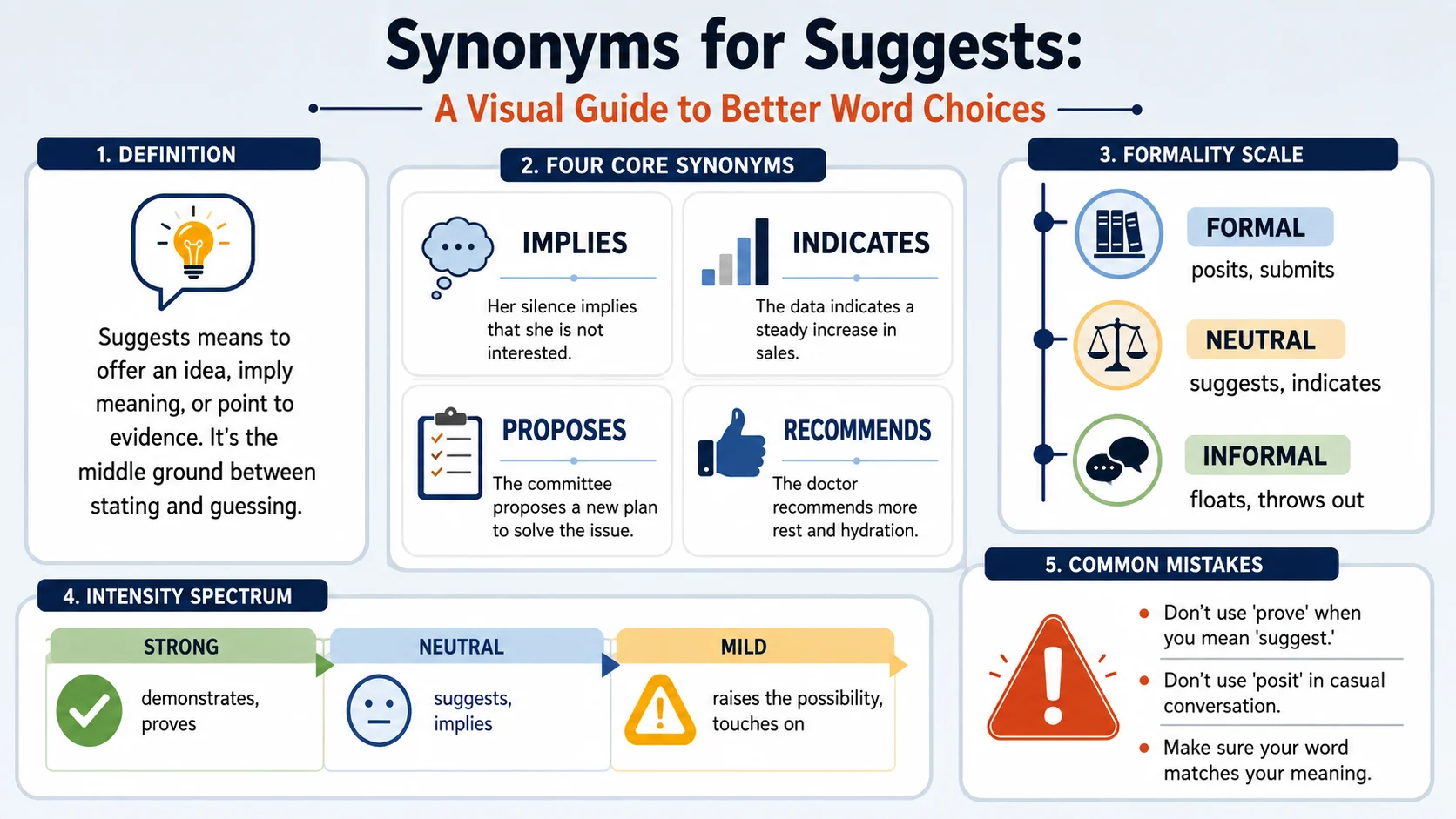
The best synonyms for suggests are implies, indicates, proposes, recommends, hints, advises, offers, and points to. Your choice depends on whether you’re stating evidence, giving advice, making a proposal, or hinting at something indirectly.
The word suggests is commonly used when something points to an idea, possibility, recommendation, or conclusion without stating it directly. Depending on the context, however, you may need a more precise word to express the exact meaning. For example, implies can describe an indirect meaning, recommends works well for advice, while indicates is often better when evidence points toward a particular conclusion. Choosing the right synonym can make your writing clearer, more natural, and more accurate.
In this guide, you’ll discover useful synonyms for suggests for different situations, including formal writing, everyday conversation, academic contexts, and professional communication. You’ll also see example sentences that show how words such as implies, indicates, proposes, recommends, hints, reveals, and signals differ in meaning and tone. Whether you are improving an essay, report, article, email, or everyday vocabulary, understanding these alternatives will help you choose the word that best fits your intended message.
What Does Suggests Mean?
At its core, suggests means to mention or introduce an idea, possibility, or course of action for someone to consider. The word carries a sense of tentativeness it is softer than states, less forceful than insists, and less direct than declares.
Part of speech: Verb (transitive)
Simple definition: To put forward an idea or possibility; to imply or indicate something indirectly.
Example sentences:
- The data suggests that exercise improves cognitive function.
- She suggested we try the new Italian restaurant downtown.
Core Meaning of Suggests
The central concept behind suggests involves offering something for consideration without demanding acceptance. It lives in the middle ground between certainty and doubt. When you use suggests, you are putting forward an idea, evidence, or interpretation while leaving room for other possibilities.
The word operates on two main levels:
- Proposing or recommending – when you offer advice or a plan
- Implying or indicating – when evidence, data, or behavior points to a conclusion
This dual nature makes suggests remarkably flexible, but it also means you need to choose synonyms carefully to preserve the precise meaning you intend.
Grammar and Usage Notes
Part of speech: Verb
Common patterns:
- Suggest + noun: “He suggested a new approach.”
- Suggest + that + clause: “The evidence suggests that the policy works.”
- Suggest + gerund (ing form): “She suggested waiting until next week.”
- Suggest + whclause: “Can you suggest where we should go?”
Important grammar rule: Suggest is never followed directly by an infinitive (to + verb). Incorrect: “He suggested to go.” Correct: “He suggested going.” or “He suggested that we go.”
Common collocations:
- strongly suggests
- research suggests
- evidence suggests
- preliminary data suggests
- studies suggest
- I would suggest
- suggest otherwise
When to use suggests naturally:
- Presenting findings without absolute certainty
- Offering polite recommendations
- Introducing ideas diplomatically
- Interpreting ambiguous data or behavior
When a synonym may work better:
- Use proves or demonstrates when evidence is conclusive
- Use orders or demands when authority is required
- Use states when directness is needed
- Use whispers or mutters when speaking is literally happening
Best Synonyms for Suggests
The table below presents the strongest and most accurate synonyms for suggests, organized by their core meaning and best use case.
| Synonym | Meaning | Tone | Best Use Case | Example Sentence |
| Implies | To convey indirectly without stating openly | Neutral to formal | Interpreting meaning; reading between the lines | Her tone implied she wasn’t convinced. |
| Indicates | To point to as a sign or signal | Formal; neutral | Data, evidence, or signs pointing to a conclusion | The results indicate a clear trend. |
| Proposes | To put forward a plan or idea for consideration | Formal to neutral | Formal suggestions, business proposals, academic ideas | The committee proposes a new budget plan. |
| Recommends | To endorse or suggest as good or appropriate | Helpful; advisory | Advice, guidance, product reviews | The doctor recommends getting eight hours of sleep. |
| Hints | To suggest indirectly in a subtle way | Casual to neutral | Implying without being explicit | He hinted that he might resign. |
| Advises | To offer counsel or guidance | Professional; helpful | Professional advice, warnings, guidance | The lawyer advises caution before signing. |
| Offers | To present for acceptance or rejection | Neutral to helpful | Proposing options, providing alternatives | She offered a different interpretation. |
| Points to | To draw attention to as evidence | Neutral to formal | Evidence, clues, or facts that support a conclusion | All signs point to a positive outcome. |
| Submits | To present formally for consideration | Very formal | Legal contexts, formal proposals, official settings | The defense submits that the evidence is insufficient. |
| Alludes to | To mention indirectly or passingly | Formal; literary | Creative writing, indirect references | The author alludes to classical mythology. |
| Intimates | To make known subtly or indirectly | Very formal | Formal writing; making subtle points | The report intimates that changes are coming. |
| Posits | To assume as a fact for argument’s sake | Academic; formal | Hypotheses, theories, academic arguments | The theory posits a connection between stress and illness. |
| Opines | To express an opinion | Formal; somewhat dated | Giving personal judgment | The critic opines that the film lacks substance. |
| Touches on | To mention briefly | Casual to neutral | Brief mentions, passing references | He touched on the topic during his speech. |
Common Synonyms for Suggests
These everyday alternatives work well in regular conversation and general writing. They maintain the core meaning while offering variety in expression.
Suggests That
Meaning: To indicate or point to a conclusion. Used when evidence or signs point toward something.
Best context: General writing, discussing findings, casual inference.
Example: The dark clouds suggest that rain is coming.
Proposes
Meaning: To put forward an idea or plan for consideration. More deliberate than a casual suggestion.
Best context: Planning, formal discussions, work environments.
Example: She proposes we start the project next month.
Indicates
Meaning: To be a sign of; to point to. Often used with data, evidence, or research.
Best context: Academic writing, business reports, scientific discussions.
Example: The survey indicates strong customer satisfaction.
Implies
Meaning: To express indirectly. Used when meaning is conveyed without being stated explicitly.
Best context: Interpreting statements, reading between lines, discussing subtext.
Example: His silence implies disapproval.
Hints At
Meaning: To suggest in a subtle or indirect way.
Best context: Casual conversation, mystery, situations requiring tact.
Example: She hinted at a surprise for his birthday.
Offers
Meaning: To present something for consideration. More neutral than proposes or recommends.
Best context: Providing options, brainstorming, presenting alternatives.
Example: He offered a different solution to the problem.
Recommends
Meaning: To suggest as being good or suitable. Carries an element of approval or endorsement.
Best context: Advice, reviews, professional guidance.
Example: The expert recommends early intervention.
Formal Synonyms for Suggests
When writing for academic audiences, preparing business reports, or crafting professional correspondence, these formal alternatives elevate your language and add precision.
Posits
Meaning: To assume or suppose as a basis for argument or theory. Common in academic and philosophical writing.
When it works best: Research papers, theoretical discussions, presenting hypotheses.
Example: The researcher posits that social media usage correlates with decreased attention spans.
Submits
Meaning: To present formally for consideration, judgment, or approval. Common in legal and official contexts.
When it works best: Legal arguments, formal proposals, official reports.
Example: The defense submits that the evidence was improperly obtained.
Intimates
Meaning: To make known subtly or indirectly. Carries a formal tone and suggests careful, measured communication.
When it works best: Formal writing, diplomatic language, professional analysis.
Example: The spokesperson intimated that negotiations were progressing.
Alludes To
Meaning: To mention in an indirect or passing manner. Often used in literary analysis.
When it works best: Creative writing, academic essays, cultural criticism.
Example: The poem alludes to Greek mythology throughout.
Opines
Meaning: To express an opinion or judgment. Slightly formal and sometimes perceived as oldfashioned.
When it works best: Formal opinion pieces, legal judgments, academic commentary.
Example: The judge opined that the law was outdated.
Connotes
Meaning: To imply or suggest an additional meaning beyond the literal. Used in semantic and literary analysis.
When it works best: Writing about language, discussing symbolism, academic analysis.
Example: The word “home” connotes warmth and safety.
Informal Synonyms for Suggests
Casual conversations, friendly emails, social media posts, and creative dialogue call for more relaxed alternatives that sound natural and unforced.
Throws Out
Meaning: To mention an idea casually without expecting immediate acceptance.
Best context: Brainstorming, casual discussions, creative meetings.
Example: He threw out a few ideas for the weekend trip.
Puts Forward
Meaning: To offer an idea or suggestion for consideration. Falls between formal and informal.
Best context: Group discussions, casual workplace conversations.
Example: She put forward the idea of a potluck dinner.
Brings Up
Meaning: To introduce a topic for discussion.
Best context: Conversations, meetings, any situation where a topic is introduced.
Example: He brought up the possibility of rescheduling.
Floats
Meaning: To offer an idea tentatively to see how others react.
Best context: Business meetings, brainstorming sessions, casual proposals.
Example: We floated the idea of expanding the team.
Pipes Up With
Meaning: To speak suddenly and offer a suggestion or idea.
Best context: Casual conversations, humorous or animated discussions.
Example: She piped up with a brilliant suggestion.
Tosses Out
Meaning: To suggest something casually, often in brainstorming.
Best context: Creative sessions, informal meetings, family discussions.
Example: He tossed out a few names for the new puppy.
Mentions
Meaning: To speak about briefly. Simpler and more neutral than suggests.
Best context: Everyday conversation, brief references.
Example: She mentioned trying the new cafe downtown.
Strong Synonyms for Suggests
Some situations call for more force, confidence, or authority. These stronger alternatives carry greater weight and conviction.
Demonstrates
Meaning: To clearly show or prove through evidence. Far stronger than suggests.
When to use it: Evidence is conclusive; certainty is high; presenting proof.
Example: The experiment demonstrates that the compound is effective.
Proves
Meaning: To establish truth through evidence. The strongest alternative in this category.
When to use it: Absolute certainty; irrefutable evidence.
Example: The DNA test proves his innocence.
Establishes
Meaning: To set beyond doubt; to prove conclusively.
When to use it: Formal writing, legal contexts, scientific conclusions.
Example: The study establishes a clear link between diet and disease.
Confirms
Meaning: To verify or support with evidence.
When to use it: When previous beliefs or hypotheses are validated.
Example: The new data confirms our original hypothesis.
Dictates
Meaning: To command or prescribe authoritatively.
When to use it: Rules, policies, authority figures.
Example: Company policy dictates that all requests be submitted in writing.
Mandates
Meaning: To require by law or authority. Implies compulsion, not suggestion.
When to use it: Legal requirements, official rules, regulations.
Example: Federal law mandates paid sick leave.
Caution: When strong synonyms sound too forceful
Using a stronger synonym where a softer one is needed can make you sound arrogant, overconfident, or pushy. Consider these differences:
- “The data suggests a trend” (appropriate caution) vs. “The data proves a trend” (overclaiming)
- “I would suggest waiting” (polite) vs. “I mandate waiting” (authoritative, inappropriate in most peer relationships)
Mild Synonyms for Suggests
When you want to be especially careful, diplomatic, or uncertain, these softer alternatives help you communicate with caution and tact.
Raises the Possibility
Meaning: To bring up a potential option without endorsing it strongly.
When to use it: Discussing uncertain outcomes, exploring options diplomatically.
Example: The consultant raised the possibility of a merger.
Touches On
Meaning: To mention a topic briefly without developing it fully.
When to use it: Introductions, brief references, avoiding full discussion.
Example: He touched on the budget concerns in his presentation.
Signals
Meaning: To indicate something indirectly, often through action.
When to use it: Interpreting behavior, reading implications.
Example: Their behavior signals a desire for change.
Points Toward
Meaning: To give evidence that suggests a conclusion without proving it.
When to use it: Tentative conclusions, incomplete evidence.
Example: All signs point toward a peaceful resolution.
Is Indicative Of
Meaning: To serve as a sign or indicator. More formal and tentative.
When to use it: Academic writing, formal analysis.
Example: The current trend is indicative of broader changes.
Conjectures
Meaning: To form an opinion based on incomplete information.
When to use it: Academic speculation, uncertainty.
Example: The historian conjectures that the document was forged.
Synonyms for Suggests by Context
Everyday Conversation
Best choices: hints at, brings up, mentions, throws out, floats
Conversational English favors clear, direct language. These alternatives help you suggest something without being pushy or overly formal. “I’d like to float an idea” sounds approachable; “I propose” sounds like you’re at a board meeting.
Professional Writing
Best choices: proposes, recommends, indicates, offers, advises
Workplace communication requires balancing authority with respect. Recommends and advises show professional judgment without demanding compliance. Proposes works well for formal business plans. Indicates suits datadriven reports.
Academic Writing
Best choices: posits, suggests, indicates, implies, connotes, submits
Academics value precision and appropriate caution. Posits introduces theoretical frameworks. Indicates discusses evidence. Submits appears in legal or formal academic arguments. All maintain scholarly objectivity.
Creative Writing
Best choices: hints at, implies, alludes to, intimates, signals, touches on
Creative writers often avoid direct statements, preferring to suggest meaning through subtext. Alludes to creates literary depth. Hints at builds suspense. Implies adds layers of meaning for readers to interpret.
Marketing Copy
Best choices: recommends, suggests, indicates, shows, points to
Marketers often choose words that lead customers toward conclusions without making claims they can’t legally back. Suggests and indicates let you imply benefits without guaranteeing them. Recommends works for endorsements.
Emotional Expression
Best choices: hints at, implies, signals, betrays, indicates
When discussing emotions, softer alternatives help you navigate sensitive territory. “His tone implied frustration” is more diplomatic than “His tone said he was angry.” Signals helps interpret nonverbal cues. Betrays suggests someone is revealing emotions they’d rather hide.
Technical Writing
Best choices: indicates, suggests, points to, signals, demonstrates
Technical documents rely on precision and evidence. Indicates and suggests are your goto words for interpreting data. Reserve demonstrates for when evidence is strong, and avoid implies in technical contexts where clarity matters most.
Personal Communication
Best choices: proposes, offers, recommends, hints at, suggests
Personal communication varies widely based on relationship and context. Offers works for neutral suggestions among peers. Recommends shows care and consideration. Hints at helps with delicate topics. Proposes fits planning discussions.
Another Word for Suggests in a Sentence
These example sentences demonstrate how different synonyms for suggests work in real writing.
- The evidence implies that the policy has had unintended consequences.
- She proposed a completely different approach to the problem.
- His cautious tone indicates he isn’t convinced by the argument.
- The doctor recommends a lowsodium diet for better heart health.
- He hinted that there might be layoffs coming soon.
- The advisor counsels patience during the negotiation.
- He offered a creative solution that nobody else had considered.
- The data points to a significant shift in consumer behavior.
- The defense submits that the witness testimony is unreliable.
- The author alludes to ancient philosophies throughout the novel.
- The study posits a direct connection between sleep quality and productivity.
- The board advises shareholders to approve the merger.
- His expression betrayed his true feelings about the decision.
- The statistics demonstrate a clear pattern over the past decade.
- She touched on the subject briefly before moving to the next topic.
Suggests Synonyms Compared
Some synonyms for suggests are easily confused. Here’s how to tell them apart.
Suggests vs. Implies
Suggests is broader and can mean either proposing an idea or pointing to evidence. Implies always means conveying meaning indirectly, often through language or tone.
Use “suggests” for: Proposing options, interpreting data. “She suggests a new approach.”
Use “implies” for: Reading between lines, indirect meaning. “His tone implies disagreement.”
Suggests vs. Indicates
Suggests is more tentative and broader in scope. Indicates is more specific and often refers to signs or data pointing to a conclusion.
Use “suggests” for: Ideas, possibilities, recommendations. “I suggest we leave early.”
Use “indicates” for: Evidence, data, signs. “The forecast indicates rain.”
Suggests vs. Proposes
Suggests is more tentative; proposes implies a more formal, developed plan or idea. Proposes also conveys greater commitment to the idea.
Use “suggests” for: Casual or informal ideas. “He suggested a movie.”
Use “proposes” for: Formal or serious plans. “The committee proposes a new budget.”
Suggests vs. Recommends
Suggests is neutral; recommends implies endorsement or approval of the idea as a good one.
Use “suggests” for: Offering options neutrally. “She suggested three restaurants.”
Use “recommends” for: Endorsing a specific choice. “She recommends the Italian place.”
Suggests vs. Advises
Suggests is openended; advises carries authority and implies that the listener should follow the guidance.
Use “suggests” for: General ideas. “I suggest you check the hours.”
Use “advises” for: Professional guidance. “The lawyer advises you to sign nothing.”
| Synonym | Meaning | Tone | Best Use |
| Suggests | Offers an idea or points to evidence | Neutral | General use |
| Implies | Conveys meaning indirectly | Neutral | Interpreting subtext |
| Indicates | Points to through signs or data | Formal | Evidencebased conclusions |
| Proposes | Puts forward a plan | Formal | Formal planning |
| Recommends | Endorses as a good option | Helpful | Advice and reviews |
| Advises | Offers professional guidance | Professional | Expert opinion |
Words Similar to Suggests
These words belong to the same semantic family as suggests but may not always serve as direct replacements. Understanding them helps you choose the most precise word for your context.
Infers
Related because: Both deal with drawing conclusions.
Difference: Infers means to deduce or conclude from evidence, but it’s the listener or reader who infers, while the speaker or evidence suggests.
When it’s useful: Describing conclusions drawn by an observer.
Example: From his silence, I inferred he was unhappy.
Concludes
Related because: Both involve reaching an understanding.
Difference: Concludes implies a more definite decision or judgment reached after reasoning.
When it’s useful: When you’ve evaluated evidence and made a firm decision.
Example: The committee concluded that the proposal was feasible.
Assumes
Related because: Both involve taking something for granted.
Difference: Assumes implies taking something as true without proof, often more certain than suggests.
When it’s useful: When you’re operating on an unproven premise.
Example: We assume the project will be approved.
Hypothesizes
Related because: Both involve proposing ideas.
Difference: Hypothesizes is specifically for forming a hypothesis for testing, more scientific and formal.
When it’s useful: Scientific writing, research papers.
Example: The researcher hypothesizes a link between the two variables.
Insinuates
Related because: Both involve indirect communication.
Difference: Insinuates carries a negative connotation, suggesting something unpleasant or unwanted.
When it’s useful: Talking about negative or unwanted implications.
Example: Are you insinuating that I’m lying?
Signifies
Related because: Both involve conveying meaning.
Difference: Signifies is about representing meaning, often more symbolic.
When it’s useful: Discussing symbols, signs, deeper meanings.
Example: The color red signifies danger in many cultures.
Speculates
Related because: Both involve considering possibilities.
Difference: Speculates is about guessing or theorizing without strong evidence, more uncertain.
When it’s useful: When evidence is limited and you’re working with possibilities.
Example: Analysts speculate about the company’s future.
Antonyms of Suggests
Understanding opposites helps clarify meaning. These antonyms represent the opposite of suggesting—they involve directness, certainty, refusal, or outright denial.
States
Meaning: To express something definitely and clearly.
Example: The report clearly states the company’s position.
Declares
Meaning: To announce officially or formally.
Example: The government declared a state of emergency.
Denies
Meaning: To state that something is not true.
Example: She denies any involvement in the incident.
Refuses
Meaning: To indicate unwillingness to do something.
Example: He refused to comment on the situation.
Conceals
Meaning: To keep from being seen or known.
Example: He concealed his true intentions.
Withholds
Meaning: To keep something back.
Example: She withheld important information.
Disproves
Meaning: To show that something is false.
Example: The evidence disproves the theory.
Rejects
Meaning: To refuse to accept or consider.
Example: The board rejected the proposal outright.
Contradicts
Meaning: To deny the truth of a statement.
Example: The witness contradicted his earlier testimony.
How to Choose the Right Synonym for Suggests
Choosing the perfect alternative requires considering several factors:
1. Match the Context
Your choice should fit the situation. Proposes belongs in formal planning. Brings up works for casual conversations. Indicates suits datadriven reports. Let your writing situation guide you.
2. Match the Tone
Formal writing calls for posits or submits. Friendly writing welcomes throws out or floats. Professional settings prefer recommends or advises. Always consider your audience.
3. Check the Intensity
Indicates and implies offer balanced, neutral intensity. Demonstrates and proves are much stronger. Raises the possibility is deliberately cautious. Choose the intensity that matches your certainty.
4. Consider the Reader
Academic readers expect precision and appropriate caution. Business readers appreciate clarity and professionalism. Casual readers value naturalness. Always write with your audience’s expectations in mind.
5. Verify the Relationship
Exact synonyms (like proposes for formal suggestions) can replace suggests directly. Related words (like infers) may need rewording to work naturally. Always read your replacement in context.
6. Read It Aloud
Your choice might be grammatically correct but awkward in context. Reading aloud reveals unnatural patterns. If it sounds off, try a different synonym.
7. Use Simple Words When Clarity Matters
When precision is critical, choose the clearest, most direct word. Suggests itself often works best. Don’t choose a fancier word if it makes your meaning less clear.
Common Mistakes When Using Synonyms for Suggests
Mistake 1: Choosing a Word with the Wrong Tone
“Could you recommend what time we should meet?” sounds overly formal for friends. Use “suggest” or “think.” Conversely, “I propose we end the meeting” sounds pretentious in casual settings.
Mistake 2: Using a Synonym That is Too Strong
“The data proves a correlation” overstates what evidence typically shows. Use “suggests” or “indicates” to maintain academic honesty. Only use “proves” when evidence is irrefutable.
Mistake 3: Using a Formal Word in Casual Writing
“I would posit that we should order pizza” sounds comically formal. Save “posit” for academic papers. Use simpler alternatives for everyday communication.
Mistake 4: Using a Casual Word in Professional Writing
Let’s toss out some ideas for the quarterly report” might be too casual for formal business writing. “Let’s propose some ideas” or “Let’s offer some suggestions” sounds more professional.
Mistake 5: Replacing Suggests Without Checking Meaning
“His tone implies anger” and “His tone suggests anger” are similar but not identical. Implies is about indirect expression; suggests is broader. Always verify precise meaning.
Mistake 6: Treating Related Words as Exact Synonyms
“From the evidence, we can infer a pattern” is correct, but the evidence suggests; the researcher infers. Don’t write “The evidence infers” because evidence can’t infer.
Mistake 7: Making the Sentence Sound Unnatural
“He submitted we leave early” is grammatically awkward. Submits usually takes a clause: “He submitted that we leave early.” Or better: “He suggested we leave early.”
Mistake 8: Forgetting Grammar Rules
Remember that suggest is never followed directly by an infinitive. “He suggested to go” is incorrect. “He suggested going” or “He suggested that we go” are correct. Some synonyms follow different patterns, so check each one.
Quick Synonym List for Suggests
Common Synonyms
- proposes
- implies
- indicates
- hints at
- recommends
- offers
- points to
- advises
Formal Synonyms
- posits
- submits
- intimates
- alludes to
- opines
- connotes
Informal Synonyms
- throws out
- puts forward
- brings up
- floats
- pipes up with
- tosses out
- mentions
Strong Synonyms
- demonstrates
- proves
- establishes
- confirms
- dictates
- mandates
Mild Synonyms
- raises the possibility
- touches on
- signals
- points toward
- is indicative of
- conjectures
Related Words
- infers
- concludes
- assumes
- hypothesizes
- insinuates
- signifies
- speculates
FAQs
What is the best synonym for suggests?
The best synonym depends on your context. For evidencebased writing, indicates works well. For advice, recommends is excellent. For subtle meaning, implies is precise. For general use, proposes offers strong coverage of the recommending meaning.
What is another word for suggests in academic writing?
Posits and indicates are excellent choices. Posits introduces hypotheses or theoretical claims. Indicates discusses evidence and findings. Suggests itself remains appropriate for cautious academic writing.
What is a formal synonym for suggests?
Posits, submits, and intimates are strong formal alternatives. Posits works for theories and hypotheses. Submits fits legal and official contexts. Intimates suits diplomatic or carefully worded statements.
What is an informal synonym for suggests?
Floats, throws out, and brings up are casual alternatives. These work in conversations, brainstorming sessions, and informal writing where a formal tone would feel out of place.
What is a stronger word for suggests?
Demonstrates, proves, and establishes are stronger alternatives. They carry more certainty and authority. Use them only when evidence or logic supports a firm conclusion.
What is a milder word for suggests?
Raises the possibility, touches on, and signals are milder alternatives. These are appropriate when you want to be cautious, diplomatic, or when evidence is limited.
What words are similar to suggests?
Infers, concludes, assumes, hypothesizes, insinuates, and speculates share semantic territory with suggests. They are related but have distinct meanings and contexts.
What is the opposite of suggests?
Key antonyms include states, declares, denies, refuses, conceals, withholds, and rejects. These represent directness, refusal, or withholding rather than offering or implying.
How do I choose the right synonym for suggests?
Consider your context, tone, audience, and the degree of certainty you want to convey. Formal contexts call for formal synonyms. Casual situations welcome informal options. Always verify that your chosen word fits the grammar and meaning of your sentence.
Conclusion
Suggests is a versatile word, but its flexibility also makes it easy to overuse. The English language offers an abundance of alternatives that add precision, personality, and power to your writing.
The best synonym for suggests isn’t the one that’s most elegant or impressive it’s the one that fits. The right word depends on your meaning, tone, context, and audience. Implies works when you’re reading between lines. Indicates shines with evidence and data. Proposes fits formal planning. Floats suits casual brainstorming. Demonstrates commands certainty. Signals conveys caution.
When you choose carefully, your writing becomes clearer, more engaging, and more effective. Your readers understand exactly what you mean, and your message carries the precise weight and tone you intend.
So the next time you reach for suggests, pause. Consider your options. Pick the word that gives your reader the clearest understanding and the most satisfying reading experience. Your writing and your readers will appreciate the effort.