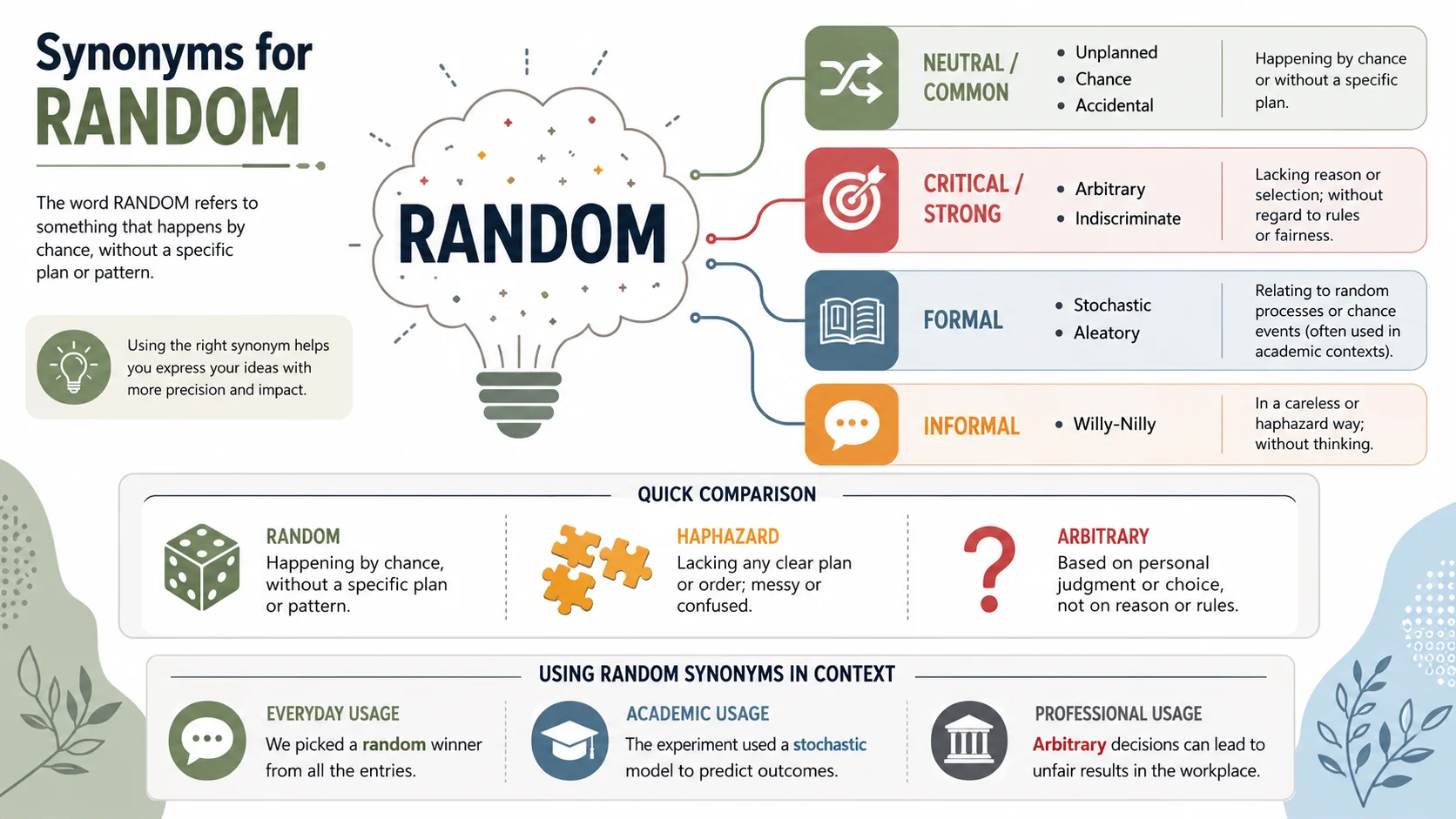
The best synonyms for random are haphazard, arbitrary, chance, and unplanned. Haphazard works best for describing a lack of order or organization, while arbitrary suggests a decision made without a clear reason or pattern. The right choice depends on your meaning, tone, and context .
The word random is useful when something happens without a clear pattern, plan, order, or predictable reason. However, using the same word repeatedly can make your writing feel less precise. Depending on what you mean, alternatives such as unpredictable, arbitrary, accidental, haphazard, spontaneous, chance, unplanned, or unstructured may communicate your idea more clearly. The best synonym depends on the situation and the tone you want to create.
In this guide, you’ll discover useful synonyms for random with their meanings, differences, and example sentences. Whether you’re writing an academic paper, professional email, creative story, casual conversation, or everyday message, you’ll learn how to choose a word that fits naturally. We’ll also explore formal and informal alternatives, stronger and milder options, and common contexts where each synonym works best. By understanding these subtle differences, you can expand your vocabulary and make your writing more accurate, natural, and engaging.wqaz
What Does Random Mean?
At its core, random describes something that happens, is chosen, or is made without a definite plan, aim, reason, or pattern . An event or choice that is random lacks predictability and is not governed by a specific system or design .
Part of Speech: Adjective
Example Sentences:
- The study used a random sample of 1,000 participants .
- He made a random decision without reviewing any of the data.
Core Meaning of Random
The central idea behind random is the absence of order or intention. When something is random, it is not the result of a deliberate plan or a logical sequence. Instead, it is governed by chance, whim, or an unpredictable process .
This can apply to many situations, from the scientific method a random sample to everyday life a random comment that seems out of place. Understanding this core idea is key to selecting the right synonym.
Grammar and Usage Notes
Random is primarily used as an adjective to modify a noun, as in “a random event,” “a random choice,” or “random thoughts.” It can also appear in the phrase “at random,” which functions as an adverbial phrase meaning “without a particular plan or pattern” .
Common Collocations:
- Random sample
- Random selection
- Random event
- Random comment
- Random thoughts
When to Use Random vs. a Synonym:
Use random when you want a neutral, widely understood term for something that is unplanned or occurs by chance. If you need to emphasize a lack of organization, haphazard might be better. To criticize a decision made without good reason, arbitrary is a stronger choice .
Best Synonyms for Random
| Synonym | Meaning | Tone | Best Use Case | Example Sentence |
| Haphazard | Lacking order or planning; determined by chance . | Neutral | Describing disorganization or a messy collection. | Their filing system was haphazard, with papers scattered everywhere. |
| Arbitrary | Based on personal whim or preference, not reason or pattern . | Slightly Critical | Describing a decision that seems unfair or illogical. | The school’s dress code felt arbitrary and unfair to the students. |
| Unplanned | Not intended or thought out in advance. | Neutral | Stating that something was not premeditated. | The trip to the beach was completely unplanned. |
| Chance | Happening without any cause that can be predicted or controlled . | Neutral | Describing an event that is a matter of luck. | Their meeting was pure chance. |
| Accidental | Happening by chance or as a result of an accident, not deliberately . | Neutral | Emphasizing a lack of intent. | Her discovery was accidental while she was looking for something else. |
| Indiscriminate | Done at random without making careful distinctions . | Slightly Critical | Describing actions that are careless or without judgment. | The bombing of the village was an indiscriminate act of violence. |
Common Synonyms for Random
These are the everyday synonyms you are most likely to encounter in standard writing and conversation.
Chance: This word highlights the role of luck or accident in an event. Something that happens by chance is not designed or predictable . Example: “I bumped into an old friend by chance at the grocery store.”
Unplanned: This is a simple, direct synonym for anything that was not thought about beforehand. It is neutral and describes events, trips, or decisions that happen spontaneously . Example: “The power outage turned into an unplanned evening of board games by candlelight.”
Casual: While often meaning “relaxed,” casual can also mean something done without much thought or intention, like a casual remark . Example: “He made a casual comment that upset everyone at the table.”
Accidental: This synonym emphasizes a lack of intent. It often describes events that happen by mistake or as a secondary result of another action . Example: “The invention was an accidental discovery in the lab.”
Odd: This word moves away from describing a process and instead describes the result of randomness something that is strange, unusual, or peculiar . Example: “She has a habit of making odd observations that no one quite understands.”
Unexpected: This describes a result that is surprising because it was not predicted. It focuses on the element of surprise . Example: “The visit from my uncle was completely unexpected.”
Formal Synonyms for Random
For academic essays, professional reports, or business communications, choose words with precision and gravitas.
Arbitrary (Formal): In formal writing, arbitrary precisely describes a decision or rule that is based on personal opinion or whim, rather than logic or a system. It often carries a negative connotation, suggesting unfairness or lack of a valid reason . Example: “The court found the judge’s sentencing guidelines to be arbitrary and unconstitutional.”
Stochastic (Very Formal): This term is almost exclusively used in technical fields like mathematics, statistics, and science. It means “involving a randomly determined sequence of observations” or a process that involves probability . Example: “The model uses stochastic processes to simulate the movement of particles.”
Aleatory (Formal): Aleatory refers to something dependent on chance, luck, or accident. It is sometimes used in legal contexts but also appears in formal writing about art or music (e.g., aleatory music, where chance plays a role in composition) . Example: “The contract’s obligations were subject to an aleatory event.”
Adventitious (Formal): This word means “coming from outside or by chance, rather than being an integral part” of something . It is often used in biology to describe roots or buds that grow in an unusual place. Example: “The plant had adventitious roots sprouting from its stem.”
Informal Synonyms for Random
When writing a message to a friend, posting on social media, or having a casual conversation, these are the words to use.
Rando: This is a slang noun for a stranger or an odd person. It can also be used as an adjective meaning “unusual or unpredictable” . Example: “Some rando just walked up to us and asked for directions.”
Willy-Nilly: This playful term means something is done in a disorganized, haphazard, or unplanned way, often without much care or consideration . Example: “He just threw his clothes willy-nilly into the suitcase.”
Hit-or-Miss: This describes something that is unreliable, unpredictable, or poorly organized. Its success or effectiveness is left to chance . Example: “The service at that restaurant is hit-or-miss.”
Oddball: This term is used for a person or thing that is unusual, unconventional, or strange. It is playful and informal. Example: “I know it sounds a bit oddball, but I decided to start a pet rock collection.”
Half-Assed: A vulgar but common informal phrase meaning poorly planned, not fully developed, or done without enough effort . Example: “He did a half-assed job cleaning his room.”
Strong Synonyms for Random
These synonyms carry a stronger emotional weight or imply a more negative judgment than the neutral word random.
Arbitrary (Strong): As mentioned, arbitrary often implies an unfair or unjust decision made without a good reason . Example: “The new policy is an arbitrary power grab.”
Indiscriminate (Strong): This word strongly implies a lack of care, judgment, or distinction. It is often used to describe harmful actions that affect everyone equally . Example: “The disease was indiscriminate, infecting both young and old.”
Desultory (Strong/Formal): This has a strongly negative connotation, describing something that lacks consistency, is disconnected, and is performed in a half-hearted, fitful way . Example: “His desultory attempts at studying were never going to result in a passing grade.”
Mild Synonyms for Random
When you want to soften the idea of randomness, these are gentler, more neutral alternatives.
Unplanned: This is a very mild, factual synonym. It simply states that something was not planned and carries no critical judgment . Example: “We had an unplanned picnic.”
Incidental: This describes something that happens as a minor or secondary part of something else. It is less about chance and more about being a “side effect” . Example: “The noise from the construction was merely an incidental problem.”
Casual: This word softens the idea of randomness by implying that it was a relaxed, thoughtless, or offhand action, like a casual remark . Example: “He made a casual observation.”
Irregular: This synonym focuses on the lack of a predictable pattern or rhythm, without the other negative connotations of words like arbitrary . Example: “He only makes irregular appearances at the gym.”
Synonyms for Random by Context
Everyday Conversation
For daily conversation, words like chance, unplanned, odd, and casual are the most natural and widely understood . You might say, “I had a random thought,” or “It was pure chance that we met.” If you want to be playful, you could use willy-nilly or hit-or-miss .
Professional Writing
In the workplace, clarity and precision are key. Use unplanned for schedule changes or casual for an informal remark. However, be careful with arbitrary, as it can be seen as a criticism of a decision-making process . For describing a process, haphazard can be a direct way to point out a lack of organization .
Academic Writing
Academia often requires specific terminology. Stochastic is the preferred term in statistics and mathematics . Arbitrary and aleatory are also appropriate in fields like law, philosophy, and the arts . Haphazard might be used to critique a methodology or a poorly organized argument.
Creative Writing
Creative writing offers the most freedom with synonyms. Desultory can paint a picture of a character’s aimless behavior. Aleatory can describe a plot driven by chance events. Whimsical is a great choice for a character whose actions are unpredictable but in a lighthearted way . Odd and unexpected are perfect for creating surprise or tension.
Another Word for Random in a Sentence
Here are 15 example sentences using different synonyms for random.
- The storm caused haphazard damage, destroying some houses while leaving their neighbors untouched .
- She felt the test questions were selected arbitrarily rather than based on the course material .
- Finding that $20 bill on the sidewalk was pure chance.
- The meeting was unplanned, so most people couldn’t attend.
- The paint job was so messy and haphazard that it looked intentional.
- His arbitrary decision to fire three employees backfired spectacularly.
- The hikers set out on a whimsical journey with no fixed destination .
- The explosion was an accidental result of an electrical fault.
- Her desultory research made it difficult to publish a comprehensive paper .
- The algorithm uses stochastic processes to simulate weather patterns .
- He just tossed his shoes willy-nilly in the closet without a second thought .
- They made an incidental discovery while testing a new drug.
- The general order to evacuate the city was indiscriminate and caused mass panic .
- Their casual conversation at the coffee shop turned into a serious business deal.
- I know it sounds like an odd question, but where did you get that hat?
Random Synonyms Compared
The most common synonyms for random haphazard, arbitrary, and chance are often used interchangeably, but they have distinct nuances.
| Synonym | Focus | Connotation | Use Example |
| Random | Lack of a definite aim, goal, or pattern . | Neutral | A random sample of participants. |
| Haphazard | Lack of order, planning, and concern for consequences . | Slightly negative (suggests carelessness or messiness). | A haphazard pile of paperwork. |
| Arbitrary | Based on personal whim, not a reason or system . | Often negative (suggests unfairness or illogical decisions). | An arbitrary and unjust law. |
| Chance | Happening by luck or accident, not design . | Neutral (suggests unpredictability). | It was a chance encounter. |
Words Similar to Random
These words belong to the same semantic field as random but are not direct synonyms. They are useful for expanding your vocabulary.
- Fortuitous: This means “happening by chance,” but specifically in a positive way, implying a lucky or fortunate accident . Example: “A fortuitous opportunity came my way.” This is not an exact synonym for random because it usually has a positive meaning.
- Whimsical: This describes something that is playful, fanciful, and unpredictable, often in a charming way . It suggests randomness that is driven by a person’s imagination. Example: “Her whimsical choice of decor.” It is more specific than random.
- Fickle: This describes something that changes frequently and without warning, often used for weather or people’s moods. It is related to randomness but focuses on unpredictability over time. Example: “The fickle weather spoiled our picnic.”
- Desultory: While a synonym for random, it is more specific, meaning disconnected, fitful, and lacking consistency, sometimes due to a lack of enthusiasm . It is a near-synonym but carries a stronger nuance of half-heartedness.
Antonyms of Random
- Planned: “The planned schedule was strictly followed.”
- Intentional: “My action was intentional, not an accident.”
- Deliberate: “The insult was a deliberate attempt to provoke him.”
- Organized: “Her desk is organized, while his is a mess.”
- Methodical: “She took a methodical approach to solving the problem.”
- Systematic: “The researchers conducted a systematic review of all the data.”
How to Choose the Right Synonym for Random
- Match the context: Are you writing a formal report, an academic paper, a professional email, or a text to a friend? Use stochastic for formal science, arbitrary for formal criticism, chance or unplanned for business, and willy-nilly for friends.
- Check the tone: Is the situation positive, neutral, or negative? Fortuitous is positive, haphazard is neutral/negative, and arbitrary is usually negative.
- Consider the intensity: Are you describing a slight deviation from a plan or a complete lack of order? Unplanned is mild; indiscriminate is very strong.
- Think about your reader: Use simple, common words like chance and unplanned for a general audience. Save more technical words like stochastic for a specialized audience.
Common Mistakes When Using Synonyms for Random
- Using arbitrary when you mean chance: Arbitrary implies a conscious choice based on whim, while chance implies no conscious choice at all. A “chance meeting” is not an “arbitrary meeting.”
- Using fortuitous to mean any random event: Fortuitous specifically means a positive, lucky chance event . Using it for a negative event is incorrect.
- Choosing a word that is too formal for the situation: Using aleatory in a casual conversation will sound out of place and confusing.
- Choosing a word that is too negative: Criticizing your boss’s decision as arbitrary is strong language, while calling it unplanned is a neutral observation.
- Using haphazard for something that is simply unpredictable: Haphazard often describes a messy or disorganized state, whereas unpredictable describes a future outcome.
Quick Synonym List for Random
Common Synonyms:
chance, unplanned, accidental, casual, odd, unexpected
Formal Synonyms:
arbitrary, stochastic, aleatory, adventitious
Informal Synonyms:
rando, willy-nilly, hit-or-miss, oddball, half-assed
Strong Synonyms:
arbitrary, indiscriminate, desultory
Mild Synonyms:
unplanned, incidental, casual, irregular
Related Words:
fortuitous, whimsical, fickle, unpredictable
FAQs
What is the best synonym for random?
The best synonym depends on context. For everyday use, unplanned and chance are excellent choices. For a more academic setting, arbitrary is precise, while stochastic is best for technical contexts .
What is another word for random?
Another word for random includes haphazard, which emphasizes a lack of order, and chance, which emphasizes luck or accident .
What is a formal synonym for random?
Formal synonyms include arbitrary, stochastic, and aleatory .
What is an informal synonym for random?
Willy-nilly is a playful and informal alternative . Rando is used as a noun.
What is a stronger word for random?
Indiscriminate or arbitrary are stronger words that often carry a negative tone .
What is a milder word for random?
Unplanned and incidental are softer, more neutral alternatives.
What words are similar to random?
Words like fortuitous (positive chance), whimsical (playful unpredictability), and fickle (changeable) are conceptually similar but not exact synonyms.
What is the opposite of random?
The opposite of random is planned, deliberate, organized, or methodical.
How do I choose the right synonym for random?
Think about the tone, context, and formality of your writing. Consider whether you are describing a process, an event, or a decision, and choose the word that best fits .
Conclusion
Finding the perfect synonym for random is about more than just swapping one word for another. It is about choosing a word that captures the exact nuance you want to convey whether it is the lack of a plan (unplanned), the role of luck (chance), a disorganized state (haphazard), or an unfair decision (arbitrary). By understanding these distinctions, you can make your writing more precise, engaging, and effective.