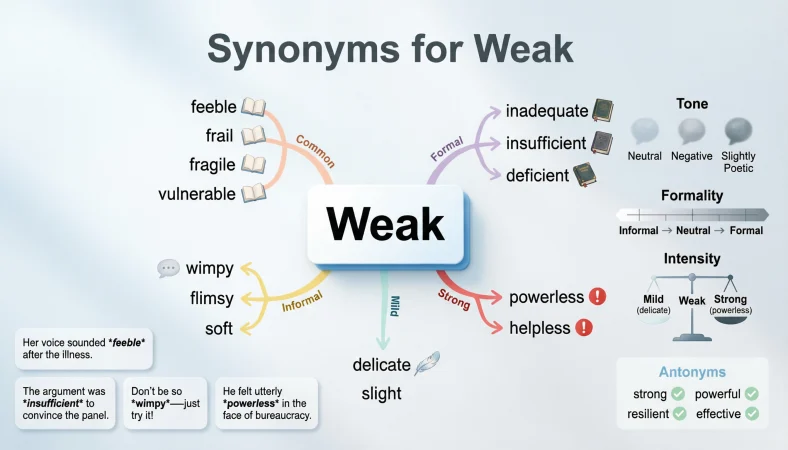
When looking for synonyms for weak, the best choice depends on what you mean by weak. The word can describe a lack of physical strength, emotional resilience, effectiveness, intensity, influence, or quality. Common alternatives include feeble, frail, fragile, powerless, ineffective, and vulnerable. Each carries a slightly different meaning and tone, so choosing the right synonym helps make your writing more accurate and natural.
Quick Answer:
The best synonyms for weak are feeble, frail, fragile, and powerless. The right choice depends on tone, context, and intensity.
Other useful alternatives include:
- Vulnerable
- Ineffective
- Inadequate
- Delicate
- Unconvincing
- Faint
- Inferior
- Lacking
What Does Weak Mean?
Weak is an adjective that generally means lacking strength, power, effectiveness, or intensity.
Simple Definition
Weak describes someone or something that is not strong enough physically, mentally, emotionally, or functionally.
Part of Speech
- Adjective
Common Usage
People use weak to describe:
- Physical strength
- Emotional resilience
- Arguments and ideas
- Signals and sounds
- Performance and results
- Leadership and influence
Example Sentences
- After the illness, she felt weak for several days.
- The proposal was weak and failed to convince the committee.
Core Meaning of Weak
At its core, weak suggests a shortage of strength, power, force, effectiveness, or stability.
The exact meaning changes depending on context:
- A weak person may lack physical strength.
- A weak argument may lack evidence.
- A weak signal may be difficult to detect.
- A weak economy may struggle to grow.
- A weak leader may have little influence.
This flexibility explains why no single synonym works in every situation.
Grammar and Usage Notes
Part of Speech
Weak functions primarily as an adjective.
Common Sentence Patterns
- weak + noun
- weak in + area
- become weak
- feel weak
- appear weak
Common Collocations
- weak argument
- weak signal
- weak economy
- weak leadership
- weak performance
- weak evidence
- weak response
- weak muscles
When Weak Sounds Natural
Use weak when you want a broad, neutral description.
When a Synonym Works Better
A more specific synonym may improve clarity:
- Use frail for physical delicacy.
- Use ineffective for poor results.
- Use powerless for lack of control.
- Use vulnerable for exposure to harm.
Best Synonyms for Weak
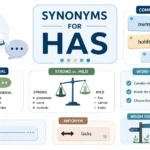
| Synonym | Meaning | Tone | Best Use Case | Example Sentence |
|---|---|---|---|---|
| Feeble | Lacking strength | Neutral | Physical weakness | He felt feeble after surgery. |
| Frail | Delicate and weak | Gentle | Elderly people or fragile conditions | The frail patient needed assistance. |
| Fragile | Easily damaged | Neutral | Objects or emotional states | Her confidence was fragile. |
| Powerless | Without control | Strong | Authority or influence | They felt powerless to change the outcome. |
| Vulnerable | Open to harm | Neutral | Risk situations | Small businesses were vulnerable during the downturn. |
| Ineffective | Not producing results | Professional | Performance evaluation | The strategy proved ineffective. |
| Inadequate | Not sufficient | Formal | Skills, resources, quality | The budget was inadequate. |
| Faint | Barely noticeable | Neutral | Sounds, signals, light | A faint signal reached the receiver. |
| Inferior | Lower quality | Formal | Comparisons | The product was inferior to competitors. |
| Unconvincing | Not persuasive | Neutral | Arguments and speeches | The explanation sounded unconvincing. |
Common Synonyms for Weak
Feeble
Meaning: Lacking physical strength.
Best context: Health and physical condition.
Example: The runner felt feeble after the marathon.
Frail
Meaning: Delicate and easily harmed.
Best context: Elderly people or fragile conditions.
Example: The frail woman moved carefully.
Vulnerable
Meaning: Open to danger or harm.
Best context: Risk and protection.
Example: Young plants are vulnerable to frost.
Ineffective
Meaning: Not achieving the desired result.
Best context: Strategies, plans, and actions.
Example: The campaign was ineffective.
Faint
Meaning: Slight or difficult to detect.
Best context: Sounds, signals, or sensations.
Example: We heard a faint knock at the door.
Formal Synonyms for Weak
Inadequate
Often used in reports and evaluations.
Example: The available resources were inadequate.
Ineffective
Useful in business and academic writing.
Example: The policy was ineffective in reducing costs.
Inferior
Suitable when comparing quality.
Example: The substitute material was inferior.
Deficient
Suggests a shortage or lack.
Example: The report was deficient in supporting evidence.
Insufficient
Means not enough.
Example: The funding was insufficient for the project.
Informal Synonyms for Weak
Wimpy
Casual and sometimes critical.
Example: That excuse sounds wimpy.
Soft
Can imply a lack of toughness.
Example: Some people thought the punishment was too soft.
Flimsy
Often used for poor quality or weak reasoning.
Example: That’s a flimsy argument.
Lame
Informal and commonly used for poor quality or effectiveness.
Example: The joke was pretty lame.
Strong Synonyms for Weak
Powerless
Suggests a complete lack of control.
Example: Citizens felt powerless during the crisis.
Helpless
Emphasizes inability to act.
Example: He felt helpless watching the situation unfold.
Pathetic
Very strong and often negative.
Example: The effort was described as pathetic.
Crippled
Suggests severe limitation or damage.
Example: The company was crippled by debt.
Note: These words carry stronger emotional weight and may sound harsh in some contexts.
Mild Synonyms for Weak
Delicate
Gentle and less critical.
Example: The fabric is delicate.
Modest
Useful when discussing limited strength or effect.
Example: The improvement was modest.
Slight
Describes low intensity.
Example: There was only a slight chance of success.
Limited
Neutral and professional.
Example: The system has limited capacity.
Synonyms for Weak by Context
Everyday Conversation
Best choices:
- Feeble
- Frail
- Vulnerable
- Soft
These sound natural in daily speech.
Professional Writing
Best choices:
- Ineffective
- Inadequate
- Insufficient
- Deficient
These sound objective and precise.
Academic Writing
Best choices:
- Insufficient
- Inadequate
- Deficient
- Unconvincing
These help evaluate evidence and arguments.
Creative Writing
Best choices:
- Fragile
- Frail
- Vulnerable
- Helpless
These create vivid imagery and emotion.
Marketing Copy
Best choices:
- Limited
- Ineffective
- Underperforming
These sound professional without being overly negative.
Personal Communication
Best choices:
- Tired
- Fragile
- Vulnerable
- Feeble
These often feel more compassionate than weak.
Another Word for Weak in a Sentence
- The patient seemed frail after the operation.
- His voice was faint but still understandable.
- The company remained vulnerable to market changes.
- Their strategy proved ineffective.
- The explanation was unconvincing.
- She felt feeble after skipping meals.
- The evidence was insufficient to support the claim.
- The organization appeared powerless against the crisis.
- The structure was fragile and required careful handling.
- The budget was inadequate for the project.
- The team delivered an inferior performance.
- The signal became faint as we moved away.
- His argument sounded flimsy.
- The economy showed limited growth.
- The defense was deficient in several areas.
Weak Synonyms Compared
| Word | Meaning | Tone | Intensity | Best Use |
|---|---|---|---|---|
| Weak | General lack of strength | Neutral | Medium | Broad use |
| Frail | Delicate and fragile | Gentle | Medium | Health and aging |
| Feeble | Physically weak | Neutral | Medium | Physical condition |
| Vulnerable | Open to harm | Neutral | Medium | Risk situations |
| Ineffective | Not successful | Professional | Medium | Performance |
| Powerless | No control | Strong | High | Authority and influence |
| Fragile | Easily damaged | Neutral | Medium | Objects and emotions |
Words Similar to Weak
These words are related but are not always exact synonyms.
Tired
Related because tired people may seem weak.
Difference: Tired refers to fatigue, not necessarily weakness.
Hesitant
Related because hesitation can be perceived as weakness.
Difference: It describes uncertainty, not lack of strength.
Passive
Related because passive behavior may appear weak.
Difference: Passive focuses on behavior rather than strength.
Sensitive
Related because sensitivity is sometimes mistaken for weakness.
Difference: Sensitive refers to emotional responsiveness.
Dependent
Related because dependence can involve limited self-sufficiency.
Difference: It does not automatically mean weak.
Antonyms of Weak
| Antonym | Meaning | Example Sentence |
|---|---|---|
| Strong | Having strength or power | She remained strong throughout the challenge. |
| Powerful | Having great influence | The company became a powerful competitor. |
| Robust | Healthy and durable | The system is robust and reliable. |
| Effective | Producing desired results | The new strategy was effective. |
| Capable | Able to perform well | He is a capable leader. |
| Resilient | Able to recover quickly | The community proved resilient. |
| Sturdy | Strongly built | The table is sturdy. |
How to Choose the Right Synonym for Weak
Match the Context
Think about whether you mean physical weakness, emotional weakness, poor performance, or lack of influence.
Match the Tone
Formal writing often requires words like ineffective or inadequate.
Check the Intensity
Use stronger words only when appropriate.
Think About the Reader
Professional audiences often prefer precise alternatives.
Check Whether the Synonym Is Exact
Some related words only partially overlap with weak.
Keep the Sentence Natural
Choose words that fit smoothly within the sentence.
Use Simplicity When Clarity Matters
Simple words are often the most effective.
Common Mistakes When Using Synonyms for Weak
Choosing the Wrong Tone
A casual word like wimpy rarely belongs in a business report.
Using a Synonym That Is Too Strong
Pathetic may sound unnecessarily harsh.
Using Formal Language Casually
Deficient can sound overly technical in conversation.
Using Casual Language Professionally
Lame often sounds unprofessional.
Replacing Weak Without Checking Meaning
Not every synonym fits every situation.
Treating Related Words as Exact Synonyms
Words like tired and hesitant are related but not identical.
Making Sentences Sound Unnatural
Always read the sentence aloud to ensure it sounds natural.
Quick Synonym List for Weak
Common Synonyms
- Feeble
- Frail
- Fragile
- Vulnerable
- Ineffective
Formal Synonyms
- Inadequate
- Insufficient
- Deficient
- Inferior
- Ineffective
Informal Synonyms
- Wimpy
- Soft
- Flimsy
- Lame
Strong Synonyms
- Powerless
- Helpless
- Pathetic
- Crippled
Mild Synonyms
- Delicate
- Slight
- Limited
- Modest
Related Words
- Tired
- Hesitant
- Passive
- Sensitive
- Dependent
FAQs
What is the best synonym for weak?
The best synonym depends on context. Feeble, frail, vulnerable, and ineffective are among the most useful alternatives.
What is another word for weak?
Another word for weak could be feeble, fragile, powerless, inadequate, or vulnerable, depending on the situation.
What is a formal synonym for weak?
Inadequate, insufficient, deficient, and ineffective are common formal alternatives.
What is an informal synonym for weak?
Informal options include wimpy, soft, flimsy, and lame.
What is a stronger word for weak?
Powerless, helpless, and pathetic express a stronger degree of weakness.
What is a milder word for weak?
Delicate, slight, modest, and limited often sound softer and less critical.
What words are similar to weak?
Related words include tired, passive, hesitant, dependent, and sensitive.
What is the opposite of weak?
Common opposites include strong, powerful, robust, effective, and resilient.
How do I choose the right synonym for weak?
Start by identifying the type of weakness involved, then match the tone, formality, and intensity to your audience and purpose.
Conclusion
Understanding the best synonyms for weak helps you communicate more accurately and naturally. While words like feeble, frail, vulnerable, ineffective, and powerless are all related to weakness, each carries its own nuance.
The most effective choice depends on the specific meaning, tone, context, and intensity you want to convey. By considering these factors, you can select vocabulary that sounds precise, clear, and appropriate for any situation.