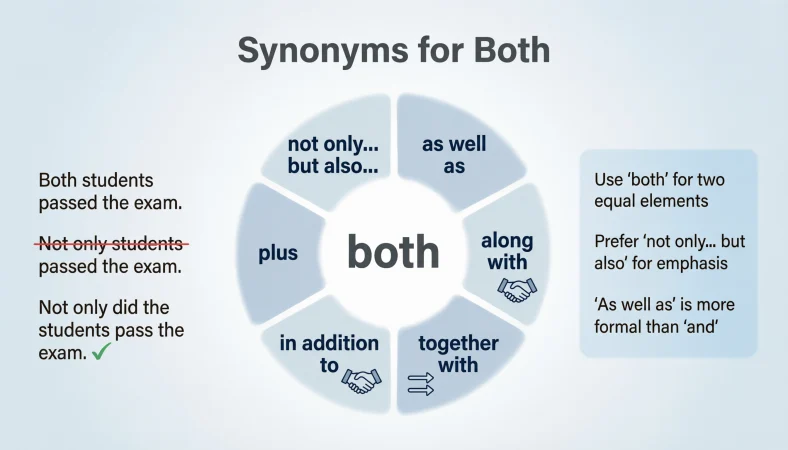
Quick Answer: The most useful synonyms for “both” are “the two,” “the pair,” “one and the other,” and “together.” Choose “the two” for neutral writing, “the pair” for slightly more descriptive tone, “one and the other” for clarity, and “together” when emphasizing joint action.
The word both is a simple but powerful term used to refer to two people, objects, ideas, or situations at the same time. However, using the same word repeatedly can make your writing feel less engaging. Exploring synonyms for both can help you create smoother sentences, improve vocabulary, and choose expressions that fit different contexts.
As an English language specialist and content writer, I understand how word choice affects clarity, tone, and reader experience. This guide explains useful alternatives to both, including formal, casual, academic, and creative options, so you can confidently select the right phrase for every situation.
What Does Both Mean?
“Both” is a word used to refer to two people, things, or ideas together. It always involves exactly two items.
- Part of speech: determiner, pronoun, or conjunction
- Simple definition: one and the other of two
Example sentences:
- Both of the books are on the shelf.
- She speaks both Spanish and Portuguese.
Core Meaning of Both
The core meaning of “both” is inclusion of two distinct items as a unit. When you say “both,” you are not talking about one or the other you are talking about the two together. This idea of “pair‑inclusion” is what makes “both” hard to replace with a single word in English. Many languages have a single word for this, but English relies on “both” or short phrases.
Grammar and Usage Notes
Part of speech:
- Determiner: Both children arrived late.
- Pronoun: I like both.
- Conjunction (paired with “and”): Both the manager and the assistant agreed.
Common sentence patterns:
- Both + noun → Both options work.
- Both + of + determiner + noun → Both of the cars are red.
- Both … and … → He is both smart and kind.
When “both” sounds natural:
- Listing two features, people, or objects
- Contrasting with “neither” or “either”
- Emphasizing that nothing is left out of a pair
When a synonym may work better:
- When you need a more formal or academic tone (use “the two” or “the pair”)
- When you want to avoid repetition in a sentence
- When “both” sounds too short or abrupt in creative writing
Best Synonyms for Both
This table shows the most accurate alternatives for “both,” organized by meaning and tone.
| Synonym / Phrase | Meaning | Tone | Best Use Case | Example Sentence |
|---|---|---|---|---|
| the two | exactly the two items | neutral | everyday writing | The two answers are correct. |
| the pair | the two as a unit | slightly descriptive | storytelling, conversation | The pair walked into the room. |
| one and the other | each of the two separately | clear, explanatory | instructions, definitions | One and the other need cleaning. |
| together | jointly | action‑focused | verbs of action | They worked together on the project. |
| equally | in the same way | formal, logical | comparisons, rules | The rules apply equally to both sides. |
| alike | in the same manner | neutral to slightly formal | describing similarity | The two proposals were treated alike. |
| each (of two) | individually within the pair | precise | lists, step‑by‑step | Each of the two files was corrupted. |
Common Synonyms for Both
These are everyday words and short phrases you can use in normal writing and conversation instead of “both.”
The two
Meaning: the specific two people or things already mentioned.
Best context: neutral, conversational, or instructional.
Example: The two restaurants are equally good.
The pair
Meaning: two items or people seen as a matched set.
Best context: informal to semi‑formal; common in sports, fashion, relationships.
Example: The pair have been friends for decades.
One and the other
Meaning: a way to name both items without using “both.”
Best context: when you need to be very clear or avoid pronoun confusion.
Example: One and the other are broken — we need new ones.
Together
Meaning: in combination; as a group of two.
Best context: action verbs (go, work, live, arrive).
Example: They arrived together at the same time.
Formal Synonyms for Both
In academic writing, business reports, or professional documents, you may want to avoid short words like “both” for stylistic variety. These formal alternatives work well.
The two (in formal contexts)
Even “the two” is acceptable in formal writing. It is plain but correct.
Example (academic): The two variables showed no significant correlation.
Both … and … (retained as a conjunction)
Sometimes the best formal choice is to keep “both” but use the paired conjunction structure. That is not a synonym, but it is the most professional phrasing.
Example: The policy affects both full‑time and part‑time employees.
Equally
Use “equally” when you want to emphasize that the same condition applies to two things.
Example (business): The new standards apply equally to domestic and international suppliers.
The pair (formal‑leaning)
In formal writing about people or objects studied as a dyad, “the pair” is fine.
Example (scientific): The pair of compounds were analyzed separately.
Respectively
This is not a direct synonym, but it often replaces “both” when listing two items in order.
Example: Samples A and B were heated to 80°C and 100°C, respectively. (Here “both” would be less precise.)
Informal Synonyms for Both
In conversation, text messages, or casual blog posts, you can use relaxed alternatives.
The two of them
Tone: conversational, friendly.
Example: The two of them are always late.
Both of ’em (contraction)
Tone: very casual, spoken English. Avoid in writing unless dialog.
Example: I’ll take both of ’em.
The whole pair
Tone: folksy, slightly emphatic.
Example: The whole pair of them are up to something.
Together as a pair
Tone: informal but descriptive.
Example: They work together as a pair better than alone.
Strong Synonyms for Both
Most synonyms for “both” are neutral in intensity. However, in certain contexts, you may want a word that adds emphasis or force.
The entire two
Intensity: strong, emphatic. Used when you want to stress that nothing is left out of the pair.
Example: The entire two volumes are required reading.
Both … without exception
This is a phrase, not a word, but it adds strength.
Example: Both candidates without exception agreed to the rules.
Alike (as an adverb)
When placed after a verb, “alike” can strengthen the idea of equal treatment.
Example: The new coach treated winners and losers alike.
Without distinction
Intensity: formal and strong.
Example: The rules apply to both groups without distinction.
Mild Synonyms for Both
Sometimes “both” feels too direct or too obvious. Use these softer, more indirect alternatives.
Each (of the two)
“Each” focuses on individuals within the pair, which softens the collective emphasis.
Example: Each of the two options has benefits.
Either (when used carefully)
“Either” usually means one or the other, but in some sentences with negative or “or” structures, it can replace “both.”
Mild example: You can choose either side. (Not exactly “both sides,” but softer.)
The two separately
This phrase avoids lumping the pair together, making the statement more neutral.
Example: The two separately require approval.
Synonyms for Both by Context
Different writing situations call for different replacements.
Everyday Conversation
Use “the two” or “the pair.”
- Can you hand me the two blue mugs?
- The pair are coming over later.
Professional Writing
Use “the two” or equally.
- The two departments will merge.
- The policy applies equally to both offices.
Academic Writing
Use “the two” or “respectively” (in lists). Avoid overly casual phrases.
- The two test groups showed no difference.
- Solutions A and B were heated to 60°C and 80°C, respectively.
Creative Writing
Use “the pair,” “together,” or “one and the other” for rhythm and variety.
- The pair stood in silence.
- One and the other had reasons to leave.
Instructional / Technical Writing
Use “each of the two” for precision.
- Each of the two cables must be connected securely.
Another Word for Both in a Sentence
Here are 12 realistic sentences using different synonyms for “both.”
- The two children finished their homework at the same time.
- The chef seasoned the pair of steaks perfectly.
- One and the other proposals were rejected by the committee.
- They worked together to lift the heavy box.
- The safety rules apply equally to new and old employees.
- All team members were treated alike regardless of rank.
- Each of the two laptops needs a software update.
- I read the two reports — neither was accurate.
- The rescue team saved the pair of hikers before dark.
- One and the other keys opened the same door.
- You must submit both (here, keeping “both” is fine) identification forms.
- The awards went to the two oldest members of the group.
Both Synonyms Compared
Some alternatives seem interchangeable but have small, important differences.
| Phrase | Difference from “both” | When to choose it |
|---|---|---|
| the two | More neutral, slightly colder | Factual lists, instructions |
| the pair | Adds a sense of relationship | Describing people, matching objects |
| one and the other | More explicit, avoids assumptions | Legal or safety instructions |
| together | Focuses on action, not the items | Verbs like go, work, live |
| equally | Focuses on fairness or sameness | Rules, policies, comparisons |
| each (of two) | Highlights individuality, not the group | Step‑by‑step processes |
Words Similar to Both
These words belong to the same semantic field (duality, pair, inclusion) but are not exact synonyms. Use them when you cannot directly replace “both” but want a related word.
Either
Refers to one or the other, not both together. Related because it also deals with two options.
Example: Either choice is fine. (Not the same as “both choices are fine.”)
Neither
The negative opposite of “both.” Related because it also references two items.
Example: Neither option works. (Opposite meaning.)
Each
Refers to every individual item in a group of two or more. When the group is exactly two, “each” is closely related.
Example: Each child received a gift. (Could be two children.)
Together
Already listed as a synonym, but worth noting: “together” is an adverb, while “both” is a determiner. They overlap in meaning but not grammar.
Jointly
Means “done by two or more together.” Formal and related.
Example: They jointly own the property.
Antonyms of Both
Antonyms are words with the opposite meaning. For “both,” the opposite is neither (not one nor the other) or either…or (only one, not both).
| Antonym | Meaning | Example Sentence |
|---|---|---|
| neither | not one and not the other | Neither answer was correct. |
| either (alone) | one or the other, but not both | You can choose either side, not both. |
| one | only a single item | One of the two doors is locked. |
| only one | explicitly excludes the second | Only one of the twins attended. |
How to Choose the Right Synonym for Both
Follow these steps when you want to replace “both” in your writing.
- Identify the part of speech – Is “both” acting as a determiner (“both cars”), pronoun (“I like both”), or conjunction (“both…and”)?
- Match the context – Formal document? Use “the two” or “equally.” Casual chat? Use “the pair” or “the two of them.”
- Check the number of items – “Both” only works for two. If you have more than two, do not use “both” or its synonyms. Use “all” instead.
- Decide if you need a single word – Most “synonyms” for “both” are two‑ or three‑word phrases. That is fine. Do not force a fake single word.
- Read the sentence aloud – If removing “both” and inserting “the two” or “the pair” sounds unnatural, keep “both.”
Common Mistakes When Using Synonyms for Both
Even experienced writers make these errors.
Mistake 1: Using “both” when there are more than two items
Wrong: Both of the three books are mine.
Right: All three books are mine.
Mistake 2: Treating “either” as a synonym for “both”
Wrong: Either options are good. (Either is singular)
Right: Both options are good. or Either option is good.
Mistake 3: Using “together” as a determiner
Wrong: Together children are late.
Right: Both children are late. or The children arrived together.
Mistake 4: Forcing a synonym when “both” is the clearest choice
Sometimes “both” is simply the best word. Do not replace it just for variety.
Example where “both” is perfect: She is both intelligent and hardworking. No synonym improves that sentence.
Mistake 5: Using “the pair” for inanimate objects that are not naturally a pair
Strange: The pair of staplers are broken. (Acceptable but odd)
Better: Both staplers are broken.
Quick Synonym List for Both
Common synonyms:
- the two
- the pair
- one and the other
- together
Formal synonyms:
- the two (still works)
- equally
- respectively (in lists)
- jointly
Informal synonyms:
- the two of them
- both of ’em
- the whole pair
Strong synonyms:
- the entire two
- alike (as adverb)
- without distinction
Mild synonyms:
- each (of the two)
- either (in some structures)
- the two separately
Related words (not exact synonyms):
- either
- neither
- each
- jointly
FAQs
What is the best synonym for both?
The best synonym is “the two.” It is neutral, works in almost every sentence where “both” refers to two items, and sounds natural in speech and writing.
What is another word for both in formal writing?
“Equally” or “the two.” For example: The rules apply equally to both departments. Or: The two departments follow the same rules.
What is an informal synonym for both?
“The two of them” or “the pair.” Example: The two of them showed up late.
Is “either” a synonym for both?
No. “Either” means one or the other, not both together. Never use “either” as a direct replacement for “both.”
What is the opposite of both?
The opposite is “neither.” “Neither” means not one and not the other. Example: Neither answer is correct is the opposite of Both answers are correct.
How do I choose the right synonym for both?
Check context, formality, and grammar. For everyday use, stick with “the two” or “the pair.” For formal writing, use “the two” or “equally.” If you are unsure, keep “both” — it is rarely wrong.
Can I use “together” instead of both?
Only when “both” acts as an adverb meaning “in combination.” Example: They both arrived → They arrived together. But you cannot say Together options are good instead of Both options are good.
Why are there no single‑word synonyms for both?
Because “both” is a grammatical function word (determiner/conjunction). Most function words have few direct synonyms. English speakers naturally use short phrases (“the two,” “the pair”) instead of inventing a new single word.
Conclusion
Finding useful synonyms for “both” is different from finding synonyms for nouns or verbs. “Both” is a precise little word that means “one and the other of two.” The best replacements are short phrases: “the two,” “the pair,” “one and the other,” and “together.” In formal writing, “equally” works well. In casual conversation, “the two of them” is fine.
The most important rule is: do not force a synonym when “both” is clean and clear. Use this guide to vary your word choice when it helps your reader and keep “both” when it works best.
Read More Articles About:
- Synonyms for Obvious: Meaning, Examples and Better Word Choices In 2026
- Synonyms for Developed: Meaning, Examples and Better Word Choices In 2026
- Synonyms for Loyalty: Meaning, Examples and Better Word Choices In 2026